Get Updates
Get notified of breaking news, exclusive insights, and must-see stories!
Home | Political Parties | Communist Party Of India (marxist-leninist) (liberation)

Communist Party Of India (marxist-leninist) (liberation)

The Communist Party of India (Marxist–Leninist) Liberation, often referred to as CPI(ML) Liberation, is a prominent left-wing political party in India. Emerging in the 1970s, it is rooted in Marxist–Leninist ideology and advocates for workers’ rights, agrarian reforms, and social justice. The party plays an active role in addressing issues like inequality, unemployment, and caste-based oppression.

CPI(ML) Liberation is part of progressive movements and focuses on grassroots mobilization to challenge socio-economic disparities. Over the years, the party has strengthened its presence in several states, particularly in Bihar, Jharkhand, and Uttar Pradesh. Its dedication to pro-people policies and equitable governance remains central to its approach.

With a history deeply connected to India’s socio-political landscape, CPI(ML) Liberation emphasizes democratic rights and the empowerment of marginalized communities. The party continues to contribute significantly to India's political and ideological discourse.

Read More

By Administrator

Time Square

Thursday, March 12, 2026, 12:50:20 PM [IST]

`

Communist Party Of India (marxist-leninist) (liberation) (CPIMLL) Information

Party Name Communist Party Of India (marxist-leninist) (liberation)
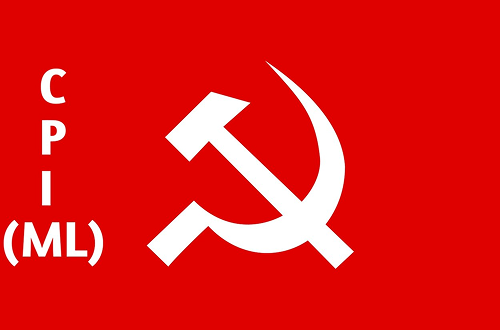
Party Flag
Communist Party Of India (marxist-leninist) (liberation)
Party Symbol
Flag With Three Stars
 Flag With Three Stars
Founder Subrata Dutta Vinod Mishra
Party Founded Date 01 Jan 1974
No. of MPs Loksabha : 2
Rajyasabha : 0
Party Headquarters Charu Bhawan, U-90, Shakarpur, Delhi-110092
General Secretary Dipankar Bhattacharya
Newspaper Liberation Deshabrati
Student Wing All India Students Association
Youth Wing Revolutionary Youth Association
Women's Wing All India Progressive Women's Association
Labour Wing  • All India Central Council of Trade Unions  • All India Agricultural and Rural Labour Association
Peasants Wing All India Kisan Mahasabha
Political Position Far-left
Website cpiml.net

Communist Party Of India (marxist-leninist) (liberation) (CPIMLL) Flag

Communist Party of India (MarxistLeninist) (Liberation) election symbol is Flag with Three Stars. It is reserved by the Election Commission of India for recognised contests. The design shows a flag carrying three stars. Media and ECI records place this symbol on ballots in Bihar and Jharkhand since 2019.

Alliances have not changed this allocation. During Mahagathbandhan seatsharing in Bihar and Jharkhand, CPI(ML) nominees campaigned beside partners while retaining the reserved mark. In Tamil Nadus 2021 Assembly election, candidates contested on the Flag with Three Stars symbol. This continuity supports voter recall and strengthens political identity.

CPI(ML): Symbol and Flag

This mark differs from Left allies emblems. CPI(M)s hammer, sickle and star is separate. The party flag is used at rallies. It is red and features the party logo. A white hammer and sickle appear with the CPI(ML) legend. The Election Commission of India regulates symbols, not party flags.

Recent Commission results confirm the partys ballot presence under its symbol. They include 2024 wins from Arrah and Karakat. For clarity in searches: Communist Party of India (MarxistLeninist) (Liberation) flag denotes the organisational banner. The EVM icon remains the Flag with Three Stars. Use the abbreviation CPI(ML) where searchers expect Party Abbreviation.

Read More

Communist Party Of India (marxist-leninist) (liberation) (CPIMLL) Ideology

The ideology of the Communist Party of India (Marxist–Leninist) Liberation emphasizes a revolutionary transformation of society to achieve a classless and egalitarian order. Rooted in Marxist-Leninist principles, the party seeks to dismantle capitalist structures and abolish feudal remnants, particularly in rural India. It advocates for worker empowerment, land redistribution, and socio-economic equality, aligning closely with its documented political philosophy.

At the core of the Communist Party of India (Marxist–Leninist) Liberation ideology lies a commitment to democratic socialism. This governance model prioritizes the collective welfare of marginalized communities, ensuring access to essential resources, education, and healthcare. The party also fiercely opposes neoliberal economic policies, which it argues exacerbate inequalities and undermine sovereignty. Its agenda further includes combating communalism and caste-based oppression, which remain significant social challenges in India.

CPI-ML Liberation's Stance on Governance and Social Justice

The Communist Party of India (Marxist–Leninist) Liberation's principles involve fostering grassroots participation and decentralization of power. It emphasizes empowering local governance bodies to ensure equitable resource distribution. This political philosophy is central to its approach to governance, opposing authoritarian tendencies in favor of people's democracy. The party agenda articulates a clear roadmap to expand social justice through inclusive policies and institutional reform.

Committed to its ideological roots, CPI-ML Liberation supports sustainable development that prioritizes public welfare over corporate interests. It underlines the importance of protecting workers’ rights, ensuring fair wages, and safeguarding the environment. The Communist Party of India (Marxist–Leninist) Liberation ideology continues to champion systemic change, addressing evolving economic, social, and political challenges while remaining grounded in its revolutionary vision.

Read More

Communist Party Of India (marxist-leninist) (liberation) (CPIMLL) Principles

The Communist Party of India (Marxist–Leninist) Liberation principles emphasize equality, justice, and socio-economic transformation. It advocates for dismantling feudal structures and securing rights for marginalized communities, including Dalits, Adivasis, and workers. The party’s governance model aligns with its focus on empowering the working class and promoting democratic decentralization.

The CPI(ML) Liberation ideology centers around Marxism-Leninism, highlighting anti-capitalist and anti-imperialist stances. It upholds secularism as a core political belief and actively opposes communalism and caste-based oppression. The party values grassroots movements to address systemic inequalities and build a people-centric governance framework.

Core Political Beliefs of CPI(ML) Liberation

One of the key values of the Communist Party of India (Marxist–Leninist) Liberation is securing labor rights. It prioritizes comprehensive land reforms to address rural poverty and redistribute resources equitably. The party’s ideology includes the opposition to neoliberal economic policies that widen socio-economic disparities.

The CPI(ML) Liberation supports progressive policies for gender equality and environmental sustainability. It also stresses strengthening public education and healthcare systems. The party principles identify collective action through mass mobilization as a critical strategy for achieving social change. These political beliefs shape the party's unique governance model in India.

Read More
Communist Party Of India (marxist-leninist) (liberation) (CPIMLL) Organisation Structure

The Communist Party of India (Marxist–Leninist) Liberation [CPI(ML)] has a well-defined organizational structure. At its core, the party functions under the principles of democratic centralism. This facilitates unity in direction while fostering discussions at various levels to strengthen collective decision-making. The CPI(ML) Liberation structure ensures effective governance over its diverse political initiatives and strategies.

The highest decision-making body in CPI(ML) is the Central Committee. It comprises senior leaders elected during the Party Congress held every few years. The Central Committee oversees all political and organizational policies, ensuring alignment with Marxist–Leninist principles. The general secretariat, led by the General Secretary, acts as the visible head of the leadership apparatus, executing Central Committee directives.

Governing Bodies of CPI(ML) Liberation

The CPI(ML) Liberation's primary governing body, the Politburo, operates as the executive council. Comprising select members of the Central Committee, the Politburo takes decisions on day-to-day political matters. In emergencies, the Politburo holds discretionary authority to make important decisions that are later reviewed by the Central Committee. Clear party organization rules guide Politburo functions.

The party includes additional committees coordinating efforts in regional units. State-level committees are established to oversee local implementation of central mandates. These units maintain harmony between national and provincial strategies. Grassroots fold into this political framework via district and local committees that represent the party's base-level workers and supporters.

CPI(ML) Leadership and Party Hierarchy

Leadership within the Communist Party of India (Marxist–Leninist) Liberation follows a hierarchical system in accordance with party statutes. The General Secretary, a vital leadership role, symbolizes the party’s collective will. Alongside this role, senior functionaries like Politburo members coordinate task divisions. This leadership model ensures an accountable and decentralized approach for policy execution.

Rank-and-file members contribute to the decision-making process through structured debates, allowing integration of grassroots concerns. Inputs are delivered hierarchically: from local organizers to district and state units. This cascading flow of ideas ensures the party's democratic processes remain robust without compromising central authority over strategy.

Decision-Making Process in CPI(ML) Liberation

The CPI(ML) Liberation employs a decision-making process rooted in consultative frameworks. Discussions begin at lower structures, such as local committees, where grassroots issues are highlighted. Decisions are deliberated upwards through district, state, and central organizational levels. The Central Committee and Politburo review final proposals for approval or revision.

Democratic discussion within the party enables two-way communication. Decisions are disseminated downward from the central leadership for implementation via the party hierarchy. This consultative mechanism balances grassroots engagement with organized direction, reinforcing unity in CPI(ML)'s national practices.

The Political Framework of CPI(ML) Liberation

The CPI(ML) Liberation political framework hinges on the integration of electoral and mass movement strategies. Electoral initiatives are directed centrally and executed locally. Similarly, agitational campaigns addressing workers, peasants, and marginalized sections are coordinated hierarchically across committees. This ensures practical on-ground delivery of ideological engagements.

CPI(ML) also incorporates allied organizations and affiliated unions to strengthen its reach. These groups, representing various societal segments, work in tandem under the guidance of state and central committees. This organizational network adds flexibility to implement complex political strategies while reflecting the party’s organizational efficiency.

LevelBodyResponsibilities
TopCentral CommitteePolicy direction, national strategies, internal supervision
SecondPolitburoExecution of policies, emergency decisions
LowerState and Local CommitteesImplementation of directives, grassroots coordination

Read More

Communist Party Of India (marxist-leninist) (liberation) (CPIMLL) Timeline

1998

Vinod Mishra, the General Secretary of CPI(ML) Liberation, passed away, and Dipankar Bhattacharya succeeded him.

1998

The party focused on expanding mass movements in rural and urban areas, advocating for issues like land rights, women’s empowerment, and workers\' rights.

1998

CPI(ML) Liberation continues to focus on mass struggles, democratic rights, and electoral politics, actively participating in Indian political discourse.

1988

CPI(ML) Liberation held its first Party Congress in January 1988 in Kolkata, signaling its efforts to strengthen its democratic mass movement strategy.

1988

CPI(ML) Liberation began participating in parliamentary politics in the 1990s, marking a key transition in the party\'s approach.

1982

Vinod Mishra took leadership of CPI(ML) Liberation and worked towards reorganizing the party and focusing on open mass work.

1974

CPI(ML) Liberation was formed as one of the factions after the split to focus on integrating mass movements with armed struggle.

1972

Charu Majumdar, the founding leader of CPI(ML), died in police custody, leading to a fragmentation within the party.

1972

The CPI(ML) witnessed splits during the late 1970s, with multiple factions emerging due to internal disagreements on strategy and ideology.

1969

The Communist Party of India (Marxist-Leninist) was formed in 1969, inspired by the Naxalbari uprising in West Bengal. The party was founded under the leadership of Charu Majumdar.

Disclaimer:The information provided on this page is sourced from various publicly available platforms including https://en.wikipedia.org/, https://sansad.in/ls, https://sansad.in/rs, https://pib.gov.in/, https://affidavit.eci.gov.in/ and the official websites of state assemblies respectively. While we make every effort to maintain the accuracy, comprehensiveness and timeliness of the information provided, we cannot guarantee the absolute accuracy or reliability of the content. The data presented here has been compiled without consideration of the objectives or opinions of individuals who may access it.

Notifications
Settings
Clear Notifications
Notifications
Use the toggle to switch on notifications
  • Block for 8 hours
  • Block for 12 hours
  • Block for 24 hours
  • Don't block
Gender
Select your Gender
  • Male
  • Female
  • Others
Age
Select your Age Range
  • Under 18
  • 18 to 25
  • 26 to 35
  • 36 to 45
  • 45 to 55
  • 55+