



Get Updates
Get notified of breaking news, exclusive insights, and must-see stories!
Home | Political Parties | Nationalist Congress Party

Nationalist Congress Party

The Nationalist Congress Party (NCP) is a prominent political party in India, established on June 10, 1999. Renowned for its center-left ideology, the NCP emphasizes social justice, federalism, and inclusive economic growth. As one of India's key political entities, it has played a significant role in shaping state and national policies. Its electoral presence spans states like Maharashtra, Gujarat, and Kerala, where it has established deep grassroots connections.

Founded by Sharad Pawar, P. A. Sangma, and Tariq Anwar, the Nationalist Congress Party was formed to promote secularism and democratic ideals. Over the years, it has allied with prominent national and regional parties to influence Indian politics. The NCP consistently advocates for the empowerment of marginalized communities while maintaining a commitment to India’s democratic framework. With its coalition-building strategies, the party remains a critical player in India's multi-party system.

Read More

By Administrator

Time Square

Saturday, March 21, 2026, 11:30:33 AM [IST]

`

Nationalist Congress Party (NCP) Information

Party Name Nationalist Congress Party
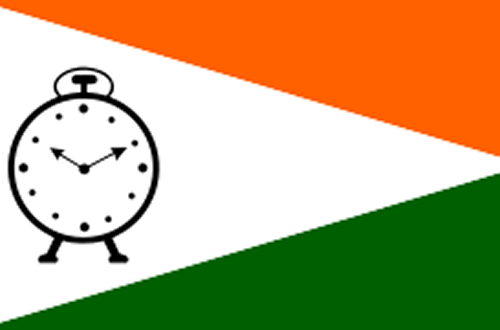
Party Flag
Nationalist Congress Party
Party Symbol
Alarm Clock
 Alarm Clock
Founder Sharadchandra Pawar
Party Founded Date 10 Jun 1999
Split From Indian National Congress
No. of MPs Loksabha : 1
Rajyasabha : 3
Party Headquarters 10, Bishmabhar Marg, New Delhi, India-110001
Party President Ajit Pawar(Deputy Chief minister of Maharashtra)
Loksabha Leader Sunil Tatkare
Rajya Sabha Leader Sunetra Pawar
Student Wing NCP Student's Wing
Youth Wing NCP Youth's Wing
Women's Wing NCP Women Wing
Political Position Centre to centre-right

Nationalist Congress Party (NCP) Flag

Nationalist Congress Party election symbol is the wall clock, reserved by the Election Commission of India. On February 7, 2024, the Commission recognised Ajit Pawars faction as the real NCP. It then granted the clock via ECI order. The Supreme Court later required disclaimer notices while the dispute remained sub judice.

Sharad Pawars group contested as Nationalist Congress PartySharadchandra Pawar. Under Supreme Court directions, the Election Commission reserved the man blowing turha symbol exclusively for it. Use continued for Lok Sabha and Assembly polls. The party abbreviation NCP-SP appeared on candidate lists and campaign material.

NCP: Symbol status and alliances

In 2024, the Ajit-led NCP campaigned within the NDAs MahaYuti. The NCP-SP joined the Maha Vikas Aghadi. It contested ten Maharashtra seats on the turha symbol, winning eight. In April 2023, the Election Commission revoked NCPs national status. It remains a state party in Maharashtra and Nagaland.

Nationalist Congress Party flag usage varies across campaign materials. The Election Commission of India does not allot party flags. It allots election symbols under the Symbols Order. Therefore, no official flag is recognised for ballots. The party logo and political identity are communicated through the clock or turha symbols.

Read More

Nationalist Congress Party (NCP) Ideology

The Nationalist Congress Party (NCP) ideology centers on fostering secularism, equality, and social justice in India. Rooted in a commitment to inclusive politics, the NCP principles emphasize democratic governance, equitable development, and the upliftment of marginalized groups. These ideals underpin the party's focus on maintaining India's unity through progressive and inclusive policies.

Central to the Nationalist Congress Party's political philosophy is the promotion of federalism and decentralization. The party advocates a governance model that strengthens local self-governance systems to address regional issues effectively. By upholding the parliamentary democratic system, NCP emphasizes the need for cooperative federalism in India's multi-tiered democracy.

NCP’s Principles on Social Welfare and Economic Growth

The NCP ideology stresses a balance between economic growth and social welfare. The party agenda prioritizes poverty alleviation, rural development, and empowerment through inclusive policies. It supports economic reforms aimed at sustainable growth and equitable distribution of resources, ensuring that vulnerable communities receive substantial social support mechanisms.

Focused on secularism, the Nationalist Congress Party principles also reject any form of communal polarization. Advocating for social harmony, its governance model works to preserve India's diverse culture while promoting unity. Additionally, the political party underlines youth empowerment, gender equality, and accessible education as key elements of its political philosophy, contributing to inclusive national development.

Read More

Nationalist Congress Party (NCP) Principles

The Nationalist Congress Party (NCP) emphasizes principles of social justice, equity, and inclusive development. Its governance model prioritizes democratic values and strives to balance economic growth with welfare policies. The party believes that political decisions should enhance the socio-economic opportunities of marginalized communities while fostering national integration.

The NCP ideology underscores secularism and opposes sectarian politics. It promotes harmony among diverse religious, linguistic, and cultural groups within India. The party values grassroots engagement and ensures public participation in decision-making. These principles guide its stance on governance, focusing on transparency and accountability.

NCP’s Commitment to Socio-Economic Equality and Good Governance

Nationalist Congress Party principles advocate for sustainable development, aiming to bridge urban-rural disparities. Its political beliefs center on empowering farmers, laborers, and youth through progressive policies. The governance model supports education reforms and affordable healthcare, ensuring accessibility for the underprivileged.

The party’s values stress the empowerment of women and marginalized groups, promoting gender equality and representation. It consistently upholds the constitutional framework to safeguard democratic processes. Through its core ideology, the NCP strives for balanced development, maintaining harmony between regional aspirations and national priorities.

NCP’s political beliefs also focus on environmental sustainability, urging policies to address climate challenges. These principles ensure the party’s governance model aligns with the larger interest of public welfare.

Read More
Nationalist Congress Party (NCP) Organisation Structure

The Nationalist Congress Party (NCP) is known for its hierarchical party organization and structured decision-making process. The party's organizational framework ensures a clear distribution of responsibilities and a streamlined approach to governance. Founded on strong ideological principles, the structure is designed to ensure accountability, transparency, and effective decision-making within the party. A robust leadership team underpins its operational framework, enhancing its political influence in India.

The NCP leadership is spearheaded by the National President, who serves as the central authority in the party hierarchy. The National Working Committee, which acts as the primary governing body, oversees all major policy decisions, election strategies, and organizational matters. This governing body ensures alignment with the party's vision and responsibilities across all levels. Supporting this structure is the National General Secretary, who coordinates activities across state and regional units.

Hierarchical Framework of the NCP’s Organizational Structure

The Nationalist Congress Party structure comprises national, state, district, and local units, which work in harmony. The National Executive Committee is responsible for implementing decisions taken by the National Working Committee and oversees operations at the national level. State Presidents manage state-level organizations under the guidance of the national leadership. This tiered approach ensures that the party structure remains cohesive yet operates autonomously at each level.

Regional offices of the NCP provide a direct link between the grassroots workers and upper leadership levels. District and Block Committees play a critical role in implementing policies and election strategies at the local level. The grassroots organization ensures effective coordination with party workers in rural and urban areas. Regular reporting keeps the hierarchy functionally intact and ensures transparency.

Role of Leadership and Decision-Making in the NCP

Decision-making in the Nationalist Congress Party leadership follows a top-down approach, built on consultation. While the National President acts as the paramount decision-maker, inputs from committees at various levels are considered. State-level leaders propose region-specific solutions, which are further scrutinized by the National Working Committee before implementation. This process enables efficient governance and reflects the party's political framework.

The NCP's leadership framework encourages the inclusion of marginalized groups and young leaders within its decision-making process. The Women’s Cell and Youth Wing report directly to the respective state-level or national-level committees. These ancillary units aim to promote gender diversity and youth representation, adding depth to the overarching party framework.

Core Governing Bodies of the NCP Organizational Framework

Governing BodyPrimary Role
National Working CommitteeFormulates policies, major decisions, and oversees party functioning.
National Executive CommitteeImplements policies, reviews reports, and coordinates state units.
State CommitteesManage state-level operations and interaction with district units.
District and Block CommitteesSupport local policy implementation and connect with grassroots workers.

The Nationalist Congress Party structure reflects a balance between centralized power and regional autonomy. Each governing body works seamlessly to ensure the effective execution of party policies. This political framework strengthens the party’s organizational core while addressing region-specific issues. Overall, the framework promotes a disciplined approach to political governance across diverse regions in India.

The organized and hierarchical structure of the Nationalist Congress Party enables well-coordinated electoral strategies and policy execution. Through its structured approach to leadership and decision-making, the NCP continues to consolidate its influence within India's political landscape. This efficient model reinforces its position as one of India's prominent political entities.

Read More

Nationalist Congress Party (NCP) Timeline

2019

NCP played a pivotal role in forming the Maha Vikas Aghadi (MVA) alliance with Shiv Sena and Congress, creating a coalition government in Maharashtra.

2019

The MVA coalition faced instability with internal conflicts among its major parties, affecting NCP\'s political equations.

2019

Ajit Pawar, along with a group of NCP leaders, joined the BJP-led government in Maharashtra, creating a split within the party.

2014

After a fallout with the Congress, NCP extended outside support to the BJP government in Maharashtra, sparking internal debates.

2012

Ajit Pawar, Deputy Chief Minister of Maharashtra and a key NCP leader, resigned amid allegations of corruption, creating political challenges for the party.

2009

NCP secured a strong voter base in Maharashtra and continued its coalition with the Congress in state governance.

2004

The NCP became part of the Congress-led UPA coalition at the national level and secured multiple ministerial posts.

2004

Sharad Pawar served as the Union Minister of Agriculture under the UPA government, playing a key role in India\'s agricultural policies.

1999

The Nationalist Congress Party (NCP) was founded by Sharad Pawar, P. A. Sangma, and Tariq Anwar after breaking away from the Indian National Congress due to ideological differences.

1999

The NCP contested its first election in Maharashtra and formed a coalition government with the Indian National Congress.

1999

Sharad Pawar, one of the founders of NCP, was appointed as the Chief Minister of Maharashtra as part of the coalition agreement.

Disclaimer:The information provided on this page is sourced from various publicly available platforms including https://en.wikipedia.org/, https://sansad.in/ls, https://sansad.in/rs, https://pib.gov.in/, https://affidavit.eci.gov.in/ and the official websites of state assemblies respectively. While we make every effort to maintain the accuracy, comprehensiveness and timeliness of the information provided, we cannot guarantee the absolute accuracy or reliability of the content. The data presented here has been compiled without consideration of the objectives or opinions of individuals who may access it.

Notifications
Settings
Clear Notifications
Notifications
Use the toggle to switch on notifications
  • Block for 8 hours
  • Block for 12 hours
  • Block for 24 hours
  • Don't block
Gender
Select your Gender
  • Male
  • Female
  • Others
Age
Select your Age Range
  • Under 18
  • 18 to 25
  • 26 to 35
  • 36 to 45
  • 45 to 55
  • 55+