


Get Updates
Get notified of breaking news, exclusive insights, and must-see stories!
Home | Political Parties | Aam Aadmi Party

Aam Aadmi Party

The Aam Aadmi Party (AAP) is a prominent political party in India established in 2012. Founded by Arvind Kejriwal, the party advocates for transparency, accountability, and anti-corruption policies in governance. Its focus remains on addressing pressing civic issues such as education, healthcare, and public infrastructure while promoting grassroots participation in policymaking.

Emerging as a dynamic force in Indian politics, AAP gained significant recognition with its Delhi Assembly election victories. The party emphasizes providing efficient, affordable public services and prioritizing sustainable development initiatives. Highlighting its commitment to democratic values, it has sought active citizen involvement in policy reforms and governance processes.

In recent years, AAP has expanded its influence across multiple states, aiming for broader national outreach. Known for its people-centric policies and clean politics, the Aam Aadmi Party continues to resonate with voters seeking systemic change in India’s political landscape.

Read More

By Administrator

Time Square

Monday, October 13, 2025, 02:05:04 PM [IST]

`

Aam Aadmi Party (AAAP) Information

Party Name Aam Aadmi Party
Party Flag
Aam Aadmi Party
Party Symbol
Broom
 Broom
Founder Arvind Kejriwal and others
Party Founded Date 26 Nov 2012
No. of MPs Loksabha : 3
Rajyasabha : 9
Party Headquarters 206, Deen Dayal Upadhyay Marg, New Delhi, Delhi India-110002
Loksabha Leader Gurmeet Singh Meet Hayer
Rajya Sabha Leader Sanjay Singh
Student Wing Chhatra Yuva Sangharsh Samiti
Youth Wing AAP
Women's Wing AAP Mahila Shakti
Labour Wing Shramik Vikas Sangathan
Political Position Centre-left
Website aamaadmiparty.org

Aam Aadmi Party (AAAP) Flag

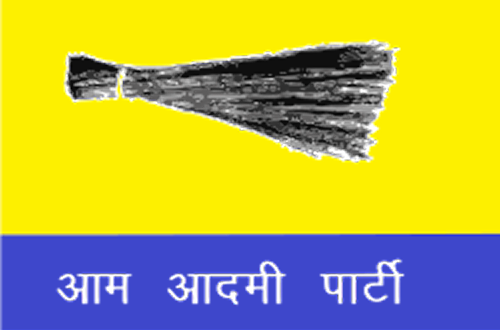
The Election Commission of India reserves the Broom as the Aam Aadmi Party election symbol. The reserved symbol appears beside AAP candidates on ballots and EVMs nationwide. The party logo consistently features the broom icon, reinforcing voter recall. This symbol is used across assembly and parliamentary contests, anchoring the partys political identity during campaigns.

Aam Aadmi Party flag is used for publicity and events by party units. The Election Commission of India does not register flags; recognition applies to symbols. The flag commonly displays the broom with the AAP abbreviation or name. Designs may vary across campaigns, while the election symbol remains constant for identification.

AAP: Election Symbol Usage and Flag Status

During alliances and seat-sharing arrangements, AAP candidates contest on the reserved Broom. The Election Commission of India does not allot a common election symbol to informal alliances. Aam Aadmi Party has not used an alternate symbol in such arrangements. Partner parties contest on their own symbols, ensuring voters identify each candidate clearly.

On ballots and EVMs, the broom graphic appears beside the AAP name. The Election Commission of India symbol order guides this display. The Aam Aadmi Party flag remains auxiliary publicity material, separate from the election symbol.

Read More

Aam Aadmi Party (AAAP) Ideology

The Aam Aadmi Party ideology revolves around transparency, accountability, and decentralized governance. Rooted in anti-corruption principles, the party emphasizes clean, people-centric governance. Launched in 2012, its core mission is to bridge the gap between government policies and grassroots public needs, aligning its political philosophy with democratic values and direct citizen participation in decision-making processes.

The Aam Aadmi Party principles advocate for simplifying bureaucratic systems and ensuring effective service delivery to citizens. The party's governance model is unique, focusing on accessible healthcare, free quality education, and affordable utilities. By prioritizing equitable development, AAP seeks to create a governance structure that minimizes elite dominance and maximizes inclusivity in policymaking.

Grassroots Participation in AAP’s Political Philosophy

AAP's political philosophy emphasizes mohalla sabhas (neighborhood assemblies), facilitating public discourse and decision-making at local levels. These assemblies empower citizens to voice concerns and propose solutions. Such a participatory framework showcases how the Aam Aadmi Party ideology integrates grassroots contributions into its overall agenda.

Key focal areas in the Aam Aadmi Party's agenda include battling corruption, improving infrastructural welfare, and fostering gender equality. Schemes offering free water, subsidized electricity, and robust healthcare underline AAP's governance model. This approach illustrates its commitment to creating equitable resource access while maintaining fiscal responsibility.

The party envisions evolving India’s political ecosystem into one rooted in transparency, efficiency, and transformative governance models.

Read More

Aam Aadmi Party (AAAP) Principles

The Aam Aadmi Party (AAP) principles emphasize transparency, accountability, and participatory governance to empower citizens. Committed to eradicating corruption, it promotes effective mechanisms like the Lokpal Bill to ensure ethical governance. AAP's ideology prioritizes public welfare by focusing on education, healthcare, and essential services for equitable access throughout all socioeconomic strata.

Driven by grassroots democracy, AAP values decentralized decision-making to reflect local issues and solutions. The political party advocates the use of technology to increase government efficiency, ensuring transparency in public systems and service delivery. Inclusive development lies at the core of AAP’s principles, aiming for justice across caste, religion, and gender divides.

AAP's Principles of Equitable Governance

AAP's governance model upholds clean politics by promoting honest leaders and opposing criminalization in political systems. The party's values stress the importance of citizen engagement in policymaking, fostering a sense of ownership among the public. It opposes dynastic politics, emphasizing the merit-based selection of candidates.

Key political beliefs of AAP include focusing on sustainable development by prioritizing clean energy and environmental conservation. The political party’s ideology supports building an inclusive economy by addressing unemployment, rural development, and MSME growth. These commitments underline AAP’s mission to establish accountable, honest, and people-centric administration frameworks.

Read More
Aam Aadmi Party (AAAP) Organisation Structure

The Aam Aadmi Party (AAP) has a well-defined organizational structure focused on grassroots democracy and transparency. The party operates with a decentralized framework, emphasizing public participation in decision-making processes. AAP’s organizational setup reflects its commitment to efficient governance and a strong leadership framework. Its hierarchy is designed to ensure smooth coordination between its governing body and volunteers across levels.

At the core of AAP’s structure is the National Executive, which acts as the party’s apex decision-making body. This governing body formulates policies, oversees key decisions, and provides overall guidance to the party. The executive members are elected or appointed, ensuring accountability and inclusiveness within the leadership framework. AAP’s leadership structure is further strengthened by the presence of regional and state-level committees to support its nationwide operations.

AAP Leadership and National Council Framework

The National Council of AAP acts as the supreme authority responsible for electing the party’s National Executive. It consists of founding members, state representatives, and key office-bearers. This tier of party organization focuses on both decision-making processes and internal democracy within the party. The council also monitors national strategies, leadership dynamics, and party policy implementations.

State and regional units play a crucial role in AAP’s political framework to ensure localized party outreach. Each state unit is led by a convenor, a position integral to the structure of AAP. The convenor liaises with the central leadership while also addressing state-specific priorities. This decentralized approach has empowered the party’s state leadership to handle region-specific challenges efficiently within the AAP organizational hierarchy.

The Role of Volunteers in AAP’s Political Framework

One of the unique traits of AAP’s organization is its reliance on a vast network of volunteers. Volunteers occupy a foundational role in the party’s political framework, working across grassroots campaigns, policy implementation, and electoral outreach. This participative model forms the backbone of AAP’s structure and strengthens its public-driven ideology. Volunteer committees are also formed during elections to ensure effective coordination between the party hierarchy and ground-level cadres.

Decision-making processes within AAP emphasize consultations with both leadership and volunteers. This approach promotes inclusivity and aligns with the party's commitment to collective governance. Local units are empowered to convene assemblies and consultations to refine strategies or policy decisions based on grassroots feedback. Such initiatives reflect AAP’s emphasis on participatory decision-making within its political framework.

Key Party Committees in AAP’s Structure

Multiple committees oversee various functional areas within AAP. For instance, the Disciplinary Committee handles internal disputes and ensures adherence to the party’s ethical code. The Political Affairs Committee (PAC) focuses on forming and implementing strategies, campaigns, and critical policies. The Media and Communications Team handles public relations and digital outreach, ensuring effective campaigns and smooth communication between the party hierarchy and public.

Additionally, AAP’s leadership deploys issue-centric task forces to address specific problems such as education, healthcare, and governance reforms. These committees align with the party’s broader objectives while addressing regional and sector-specific challenges. AAP’s governing body monitors these committees, ensuring alignment with the party’s core philosophy and electoral strategy goals.

Grassroots Organization and Hierarchy of AAP

The grassroots organization of AAP facilitates a seamless connection between the governing body and local communities. The party hierarchy mandates regional and district leaders to coordinate with volunteers, ensuring widespread participation. This layered structure allows flexibility in addressing regional challenges while maintaining cohesion within the broader political framework.

The organizational model of the Aam Aadmi Party demonstrates a balance between decentralized decision-making and strong central leadership. Through its structure, AAP strives to build a dynamic and accountable political party. Focus on committees, leadership at all levels, and grassroots volunteer engagement enables AAP to maintain its relevance in Indian politics while embracing participatory governance.

Read More

Aam Aadmi Party (AAAP) Timeline

2023

AAP was officially recognized as a national political party in India due to its presence and success in multiple states.

2020

AAP won the 2020 Delhi Legislative Assembly elections, securing 62 out of 70 seats, with Arvind Kejriwal continuing as the Chief Minister.

2020

AAP achieved a significant milestone by securing a clear majority in the Punjab Legislative Assembly, with Bhagwant Mann becoming the Chief Minister.

2015

AAP secured a historic victory by winning 67 out of 70 seats in the Delhi Legislative Assembly elections, with Arvind Kejriwal becoming the Chief Minister.

2015

AAP emerged as the second-largest party in Punjab, winning 20 seats, marking its significant expansion beyond Delhi.

2014

Arvind Kejriwal resigned as Chief Minister of Delhi after 49 days in office due to a stalemate over the Jan Lokpal Bill.

2012

The Aam Aadmi Party (AAP) was officially launched and founded by Arvind Kejriwal and others with the aim of establishing a corruption-free political system in India.

2012

AAP contested and won 28 out of 70 seats in the Delhi Legislative Assembly elections, forming the government with outside support from the Indian National Congress.

Disclaimer:The information provided on this page is sourced from various publicly available platforms including https://en.wikipedia.org/, https://sansad.in/ls, https://sansad.in/rs, https://pib.gov.in/, https://affidavit.eci.gov.in/ and the official websites of state assemblies respectively. While we make every effort to maintain the accuracy, comprehensiveness and timeliness of the information provided, we cannot guarantee the absolute accuracy or reliability of the content. The data presented here has been compiled without consideration of the objectives or opinions of individuals who may access it.

Notifications
Settings
Clear Notifications
Notifications
Use the toggle to switch on notifications
  • Block for 8 hours
  • Block for 12 hours
  • Block for 24 hours
  • Don't block
Gender
Select your Gender
  • Male
  • Female
  • Others
Age
Select your Age Range
  • Under 18
  • 18 to 25
  • 26 to 35
  • 36 to 45
  • 45 to 55
  • 55+