Get Updates
Get notified of breaking news, exclusive insights, and must-see stories!
Home | Political Parties | Bharath Dharma Jana Sena

Bharath Dharma Jana Sena

The Bharath Dharma Jana Sena (BDJS) is a prominent political party in India, known for its commitment to social justice and economic development. Established with a focus on promoting the rights and welfare of marginalized communities, the BDJS has become a significant force in Indian politics. The party's agenda emphasizes inclusive growth, education reform, and healthcare improvements, aiming to uplift underrepresented groups. As an ally of larger political coalitions, the BDJS plays a crucial role in shaping policy directions at both state and national levels. By advocating for sustainable development and equitable resource distribution, the BDJS strives to bridge socio-economic divides. With its roots deeply embedded in cultural heritage and traditional values, the party seeks to harmonize modern governance with ancient wisdom. The BDJS continues to expand its influence through grassroots mobilization and strategic alliances, reinforcing its position as a key player in India's dynamic political landscape.

Read More

By Administrator

Time Square

Thursday, March 19, 2026, 11:49:36 AM [IST]

`

Bharath Dharma Jana Sena (BDJS) Information

Party Name Bharath Dharma Jana Sena
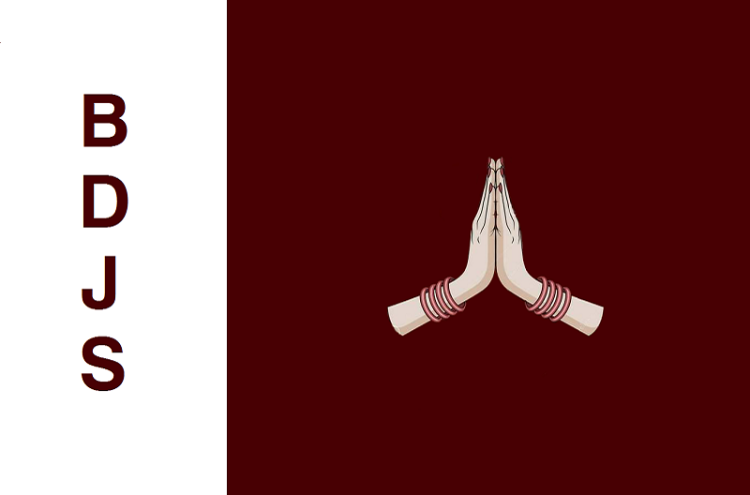
Party Flag
Bharath Dharma Jana Sena
Party Symbol
--
 --
Party Founded Date 01 Dec 2015
Party Headquarters

NA

Party President Thushar Vellappally
General Secretary T. V. Babu
Social Handles
facebook

Bharath Dharma Jana Sena (BDJS) Flag

Bharath Dharma Jana Sena election symbol is not permanently reserved by the Election Commission of India. In December 2015, the Commission rejected the proposed folded hands mark over similarity concerns. Therefore, BDJS competes using symbols allotted for each election by authorities. This influences candidate recognition and political identity across Kerala.

In local body polls, allocations come from the Kerala State Election Commission. On September 20, 2025, BDJS received the Earthen Pot for Kerala civic elections. Under NDA seatsharing, BDJS fields candidates using the allotted election symbol. Assignments can differ between Lok Sabha, Assembly, and panchayat contests. Party Abbreviation: BDJS.

BDJS: Symbol allocations and flag status

Reports in December 2015 described a maroonandwhite Bharath Dharma Jana Sena flag. Flag designs are internal party matters; the Election Commission of India regulates symbols. The Commission does not register party flags or logos for elections. Public materials may display a partydesigned emblem, separate from official symbols.

Voters should confirm the Bharath Dharma Jana Sena election symbol before each poll. Official lists are issued by the Election Commission of India and State Commissions. This safeguards political identity and minimises confusion during alliances. If contesting on a partners symbol, ballots show the partners emblem. For local bodies, consult official Kerala SEC notifications.

Read More

Bharath Dharma Jana Sena (BDJS) Ideology

Bharath Dharma Jana Sena (BDJS) follows an ideology rooted in Sree Narayana Guru’s social philosophy, emphasising social equality, dignity of labour, and community upliftment. The party projects itself as a socio-political platform aimed at addressing historical marginalisation, particularly of the Ezhava community, while also claiming to represent broader backward and economically weaker sections in Kerala.

 Social Reform Orientation

A central ideological pillar of BDJS is social reform through political participation. Drawing inspiration from the Sree Narayana movement, the party stresses education, social justice, and moral reform as prerequisites for political empowerment. Its outlook is reformist rather than revolutionary, seeking change within the democratic framework rather than through class-based mobilisation.

 Political Positioning and Alliances

Ideologically, BDJS adopts a pragmatic, non-Left stance, which shaped its alignment with the National Democratic Alliance (NDA) from 2016 onwards. While not ideologically aligned with Hindu nationalism in doctrinal terms, the party supports a governance model centred on development, cultural assertion, and national integration. This positioning places BDJS outside Kerala’s traditional UDF–LDF ideological binary, marking it as a community-oriented and alliance-driven political formation.

Read More

Bharath Dharma Jana Sena (BDJS) Principles

Bharath Dharma Jana Sena (BDJS) is guided by principles derived from the social teachings of Sree Narayana Guru, particularly equality, self-respect, and social justice. The party asserts that political participation is essential for translating social reform ideals into policy outcomes, especially for historically underrepresented communities.

 Community Representation and Empowerment

A core principle of BDJS is community empowerment through democratic means. The party prioritises political representation for Ezhava and other backward communities, advocating access to education, employment opportunities, and economic advancement. It views political organisation as a tool to secure proportional representation and policy attention within Kerala’s governance framework.

 Governance and Political Conduct

BDJS emphasises ethical governance, cultural dignity, and developmental politics. It supports decentralisation, welfare initiatives, and inclusive growth while maintaining a cooperative approach to alliances. Rather than rigid ideological positioning, the party follows a principle of strategic alignment to advance community interests, operating within constitutional and electoral norms.

Read More
Bharath Dharma Jana Sena (BDJS) Organisation Structure

Organisational Structure

The organisational structure of Bharath Dharma Jana Sena (BDJS) is designed around a central leadership model supported by state, district, and grassroots committees. Formed in 2015, the party developed its framework to translate socio-religious organisational strength into electoral coordination. The structure ensures that policy direction flows from the top leadership to local units in a coordinated manner.

Leadership within BDJS is central to its functioning. The party is headed by a President, supported by Vice Presidents, a General Secretary, and state office-bearers. The President plays the primary role in alliance negotiations, electoral strategy, and ideological positioning, particularly in coordination with the National Democratic Alliance (NDA). Key decisions are taken through executive committee meetings at the state level.


Party Hierarchy in BDJS

The hierarchy of BDJS follows a tiered model:

  • State President – Chief decision-maker and public face of the party.

  • State Committee & Executive Council – Formulates policies and oversees implementation.

  • District Committees – Coordinate political activities within respective districts.

  • Constituency Units – Manage booth-level mobilisation and election campaigns.

District Committees act as the bridge between the state leadership and local cadres. They supervise membership drives, campaign logistics, and community outreach programmes, reporting back to the state committee for strategic alignment.


BDJS Decision-Making Process

The decision-making process in BDJS involves consultations within the State Executive Committee and discussions with alliance partners when required. Electoral seat-sharing, candidate selection, and campaign planning are typically finalised after internal deliberations followed by coordination meetings with NDA leadership.

District and constituency-level committees provide feedback on local political conditions. This ensures that state-level decisions reflect ground realities. While leadership remains centralised, structured consultation mechanisms are part of the party’s organisational functioning.


BDJS Political Framework

BDJS operates within a framework that combines community representation and electoral pragmatism. Its structure reflects its origins in socio-religious mobilisation, especially linked to the Sree Narayana movement. Organisational emphasis is placed on disciplined coordination rather than a mass cadre-based ideology-driven model.

PositionResponsibilities
PresidentOversees overall strategy, alliances, and political direction
Vice PresidentsAssist in policy coordination and administration
General SecretaryManages daily organisational operations
State Executive MembersFormulate policy and supervise implementation
District PresidentsLead district-level political activities

Organisational Development

Since 2016, BDJS has focused on strengthening district committees and expanding membership across Kerala. Organisational reviews have followed major elections in 2016, 2019, and 2021, with structural adjustments aimed at improving coordination and electoral outreach.

As of 2026, BDJS maintains a structured but leadership-driven organisational model, operating primarily through state and district committees while continuing alliance-based political engagement within Kerala’s coalition framework.

Read More

Bharath Dharma Jana Sena (BDJS) Timeline

2026

As of 2026, Bharath Dharma Jana Sena continues as a registered regional political party in Kerala, functioning within the NDA framework with limited legislative representation.

2025

The party’s state leadership held meetings amid seat-sharing disputes with the BJP and discussed options for future electoral strategy, reflecting ongoing alliance negotiations.

2024

BDJS contested the 2024 Lok Sabha elections in Kerala constituencies such as Idukki and Mavelikkara but did not win seats; it remained part of the NDA coalition.

2023

The party sustained its role as an NDA ally in Kerala, engaging in internal alliance talks and political mobilisation without major electoral wins.

2022

Bharath Dharma Jana Sena remained a constituent of the National Democratic Alliance (NDA) in Kerala and continued organisational work after contesting elections; it did not secure legislative representation.

2021

Bharath Dharma Jana Sena contested in the Kerala Legislative Assembly elections again as part of the NDA alliance.

2016

Bharath Dharma Jana Sena (BDJS) was formed on February 21, 2016, under the leadership of Thushar Vellappally. It is a political party in the Indian state of Kerala.

2016

BDJS participated in the Kerala Legislative Assembly elections as part of the National Democratic Alliance (NDA) for the first time.

Disclaimer:The information provided on this page is sourced from various publicly available platforms including https://en.wikipedia.org/, https://sansad.in/ls, https://sansad.in/rs, https://pib.gov.in/, https://affidavit.eci.gov.in/ and the official websites of state assemblies respectively. While we make every effort to maintain the accuracy, comprehensiveness and timeliness of the information provided, we cannot guarantee the absolute accuracy or reliability of the content. The data presented here has been compiled without consideration of the objectives or opinions of individuals who may access it.

Notifications
Settings
Clear Notifications
Notifications
Use the toggle to switch on notifications
  • Block for 8 hours
  • Block for 12 hours
  • Block for 24 hours
  • Don't block
Gender
Select your Gender
  • Male
  • Female
  • Others
Age
Select your Age Range
  • Under 18
  • 18 to 25
  • 26 to 35
  • 36 to 45
  • 45 to 55
  • 55+