Yashwant Sinha
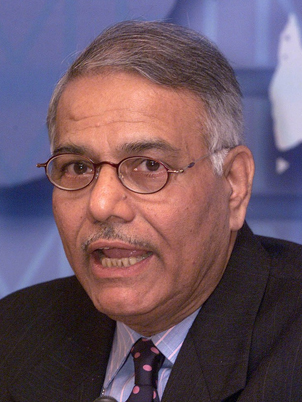
Yashwant Sinha Biography
Yashwant Sinha, a prominent Indian bureaucrat, politician, and government official, gained recognition as a leading figure within the Bharatiya Janata Party (BJP) of India. His journey in politics saw him serving as a cabinet minister in the Indian government twice, from 1990 to 1991 and again from 1998 to 2004.
Born on November 6, 1937, to Bipin Bihari Saran and Dhana Devi, Sinha hails from Patna, situated in what is now west-central Bihar state in eastern India. Despite his humble beginnings in a middle-class family, Sinha's dedication and prowess propelled him to significant roles within the political landscape of India.
Yashwant Sinha began his career in the Indian Administrative Service (IAS) in 1960. Over 24 years, he held various roles in Bihar and New Delhi, as well as overseas assignments in West Germany. These included serving as the first secretary (commercial) in the Indian embassy in Bonn (1971–73) and the Indian consul general in Frankfurt am Main (1973–74). He also served as joint secretary in the Ministry of Transport and Shipping from 1980 to 1984.
Yashwant Sinha's political journey commenced in 1984 with the Janta Party under the leadership of Chandrashekhar. Influenced by the political ideologies of Indian socialist leader Jaya Prakash Narayan during his bureaucratic tenure, Sinha made the pivotal decision to transition into politics. He became a member of the Janata Party (JP), where he swiftly rose to the position of general secretary within two years. Subsequently, he assumed the role of general secretary of the Janata Dal (JD) after its formation from the JP.
In 1990, Sinha joined the Janata Dal (Socialist) led by Chandra Shekhar after a split in the JD. However, his allegiance soon shifted towards the Bharatiya Janata Party (BJP), a move aligned with the party's burgeoning success. By June 1996, he had been appointed as a national spokesperson for the BJP, a role he fulfilled until June 2005. After spending several years with the BJP, he found himself increasingly at odds with the leadership of the BJP which eventually led to his departure from the party in 2018. Sinha eventually joined the Trinamool Congress Party in 2021, marking a significant transition in his political affiliations.
Yashwant Sinha's legislative journey commenced in 1988 when he was elected to the Rajya Sabha, the upper chamber of the Indian parliament. He served as the Minister of Finance in Prime Minister Shekhar's cabinet from November 1990 to June 1991.
In 1995, Sinha transitioned to the Bihar state legislative assembly as a BJP candidate, serving as the leader of the opposition until 1996. His electoral success continued in 1998 when he won a seat in the Lok Sabha, the lower chamber of the Indian parliament. He assumed the role of Finance Minister in the BJP-led National Democratic Alliance (NDA) government, a position he held until 2002. During his tenure, Sinha implemented various fiscal measures, including reducing bank interest rates and introducing tax deductions for mortgage interest.
Then he served as the Minister for External Affairs in the NDA government from 2002 to 2004. Despite losing his Lok Sabha seat in the 2004 elections, Sinha swiftly returned to parliament by winning reelection to the Rajya Sabha later that year. However, by 2009, his influence within the BJP had waned. After the party's disappointing performance in the Lok Sabha elections that year, he resigned as the BJP's vice president, a position he had held for two years. Despite his close ties to BJP leader Lal Krishna Advani, Sinha found himself marginalised by the party president Nitin Gadkari.
In 2012, Sinha openly supported Pranab Mukherjee, the Indian National Congress's candidate for the presidency, signalling his dissent within the BJP. By 2013, he was excluded from the BJP's core team, though he retained his membership in the party's 80-member National Executive Committee.
Opting out of the 2014 Lok Sabha polls, Sinha paved the way for his son Jayant Sinha, who secured victory from his old constituency in Jharkhand. Disillusioned with the BJP's leadership, particularly Prime Minister Narendra Modi, Sinha parted ways with the party in 2018, citing threats to democracy.
In the following years, he continued to critique Modi's government from the sidelines. In 2022, the Congress-led United Progressive Alliance nominated Sinha as their opposition candidate for the presidency, marking his significant role in Indian politics.
Apart from administrative and political positions, Sinha has held memberships in various clubs, including the Delhi Gymkhana Club in New Delhi and the Bankipur Club in Patna. Additionally, he has served as the President of the All India Tennis Association.
Beyond professional endeavours, Sinha enjoys leisure activities such as reading, travelling, listening to music, and watching films. On a personal front, Yashwant Sinha is married to Nilima Sinha, and together they are blessed with three children. His net worth stands at Rs. 3,65,76,217, reflecting his financial standing and success.
Yashwant Sinha Personal Life
| Full Name | Yashwant Sinha |
| Date of Birth | 06 Nov 1937 (Age 88) |
| Place of Birth | Patna, Bihar |
| Party Name | All India Trinamool Congress |
| Education | Post Graduate |
| Profession | IAS Officer-turned-politician |
| Father's Name | Late Bipin Bihari Saran |
| Mother's Name | Late Dhana Devi |
| Spouse's Name | Nilima Sinha |
| Children | 2 Son(s) 1 Daughter(s) |
| Religion | Hindu |
| Website | yashwantsinha.in |
Yashwant Sinha Net Worth
Interesting Facts about Yashwant Sinha
He is an IAS turned politician.
Before joining the Indian Administrative Services Mr Sinha also worked as a faculty of Political Science in Patna University, he is also an alumni of the same university.
Political Timeline of Yashwant Sinha
- 2022 : Yashwant Sinha contested for 15th presidential election against BJP candidate Draupadi Murmu but he lost.
- 2021 : Yashwant Sinha Joined the Trinamool Congress party led by Mamata Banerjee and given the responsibility of the national vice president of the party.
- 2018 : Once an admirer of Narendra Modi, Yashwant Sinha left the BJP following difference with the government and the party leadership.
- 2014 : Yashwant Sinha posted his desire stay away from electoral politics. His elder son Jayant Sinha got the party ticket instead and registered his first victory.
- 2009 : Yashwant Sinha was again elected as an MP from Hazaribagh on a BJP ticket.
- 2004 : Yashwant Sinha lost the Lok Sabha election for the first time from Hazaribagh constituency as a BJP candidate as the party went early into election under Shining India campaign but could not succeed to win.
- 2002 : The portfolio of Yashwant Sinha got changed in Bajpeyi government. He was appointed as the minister of external affairs on July 1, 2002
- 1999 : Yashwant Sinha registered the hat-trick of victory from Hazaribagh Lok Sabha constituency as a BJP candidate and continued to serve as the finance minister of India.
- 1998 : Mr. Sinha repeated his victory again from Hazaribagh Lok Sabha constituency on the BJP ticket. He was inducted into the Bajpeyi government as the minister of finance.
- 1996 : Yashwant Sinha got elected to the Lok Sabha from Hazaribagh constituency then in Bihar and now in Jharkhand as a BJP candidate.
- 1992 : Yashwant Sinha joined the Bharatiya Janta Party became the national spokesperson of the party 3 years later.
- 1990 : Yashwant Sinha was appointed as the cabinet minister of finance in the union government led by Chandrashekhar. He remained in office November 1990 to June 1991.
- 1989 : The Janta Party was resolved into a new political outfit called Janta Dal and Mr. Sinha was appointed its national general secretary as well.
- 1988 : Yashwant Sinha was elected to the Rajya Sabha as a Janta Party candidate
- 1986 : Yashwant Sinha was appointed the national general secretary of the Janta party in 1986
- 1984 : Yashwant Sinha quit Indian Administrative Services to join the Janta Paty.
Yashwant Sinha Early Life
- 1980: Served as a Joint secretary in the Ministry of Transport and Shipping from 1980-84.
- 1973: Served as an Indian consul general in Frankfurt am Main from 1973-74.
- 1971: Served as a secretary (commercial) in the Indian embassy in Bonn from 1971–73.
- 1960: Sinha joined the Indian Administrative Service in 1960 and spent over 24 years holding important posts during his service tenure. He served as Sub-Divisional Magistrate and District Magistrate for 4 years.
- 1958: Yashwant Sinha was graduated from the Patna University with a masters degree in Political Science.
Yashwant Sinha Achievements
Disclaimer:The information provided on this page is sourced from various publicly available platforms including https://en.wikipedia.org/, https://sansad.in/ls, https://sansad.in/rs, https://pib.gov.in/, https://affidavit.eci.gov.in/ and the official websites of state assemblies respectively. While we make every effort to maintain the accuracy, comprehensiveness and timeliness of the information provided, we cannot guarantee the absolute accuracy or reliability of the content. The data presented here has been compiled without consideration of the objectives or opinions of individuals who may access it.

List of Popular Leaders in India






Politicians by Age And Professions
Statewise Politicians List
- Andhra Pradesh Politicians
- Arunachal Pradesh Politicians
- Bihar Politicians
- Goa Politicians
- Gujarat Politicians
- Karnataka Politicians
- Kerala Politicians
- Madhya Pradesh Politicians
- Maharashtra Politicians
- Odisha Politicians
- Puducherry Politicians
- Tamil Nadu Politicians
- Telangana Politicians
- Uttar Pradesh Politicians
- Uttarakhand Politicians
-
 Sign in with Google
-
Block for 8 hours
-
Block for 12 hours
-
Block for 24 hours
-
Don't block


 Click it and Unblock the Notifications
Informed.
- Male
- Female
- Others
- Under 18
- 18 to 25
- 26 to 35
- 36 to 45
- 45 to 55
- 55+