

Get Updates
Get notified of breaking news, exclusive insights, and must-see stories!
Home | Political Parties | Telugu Desam

Telugu Desam

The Telugu Desam Party (TDP) is one of India's prominent regional political parties, primarily active in Andhra Pradesh and Telangana. Established in 1982 by Nandamuri Taraka Rama Rao (NTR), the party emerged as a strong regional force advocating for Telugu pride. Known for its developmental policies and pro-farmer initiatives, the TDP has played a vital role in state and national politics.

With a focus on welfare schemes, infrastructure development, and technology-driven governance, the Telugu Desam Party has continuously emphasized transparent administration. The party’s influence grew significantly under the leadership of Nara Chandrababu Naidu, who introduced economic reforms and visionary policies. Key priorities include rural development, education, and digital innovation to uplift communities across Andhra Pradesh.

The TDP remains a significant player in influencing regional dynamics while strengthening its political roots. Its ongoing goal is fostering socio-economic development and safeguarding regional interests within India's federal framework.

Read More

By Administrator

Time Square

Monday, March 23, 2026, 10:01:48 AM [IST]

`

Telugu Desam (TDP) Information

Party Name Telugu Desam
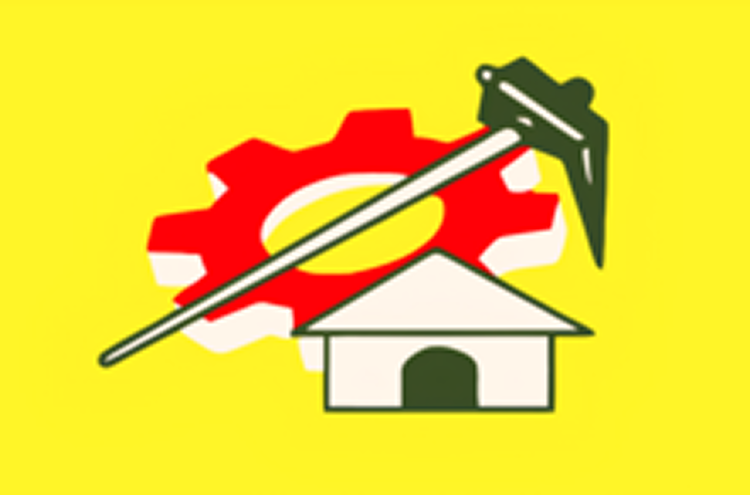
Party Flag
Telugu Desam
Party Symbol
Bicycle
 Bicycle
Founder N. T. Rama Rao
Party Founded Date 29 Mar 1982
No. of MPs Loksabha : 16
Rajyasabha : 2
Party Headquarters N. T. R. Bhavan, Mangalagiri, Andhra Pradesh, India
Party President N. Chandrababu Naidu
General Secretary Nara Lokesh
Parliamentary Chairperson Lavu Sri Krishna Devarayalu
Loksabha Leader Lavu Sri Krishna Devarayalu
Rajya Sabha Leader TBA
Student Wing Telugu Nadu Students Federation
Youth Wing Telugu Yuvatha
Women's Wing Telugu Mahila
Labour Wing Telugu Nadu Trade Union Council
Peasants Wing Telugu Rythu
Political Position Centre to centre-right
Website www.telugudesam.org

Telugu Desam (TDP) Flag

The Election Commission of India reserves the Cycle as the Telugu Desam election symbol. The device appears on Electronic Voting Machines and ballot papers for nominees. Telugu Desam Party (TDP) contests under this symbol in Andhra Pradesh. No official notification indicates any change or temporary allocation in recent elections.

The Telugu Desam flag is a yellow party flag used at campaign events and offices. The party logo is displayed on the flag and collateral. Flags are managed by the party; the Election Commission of India regulates only election symbols. The flag supports party visibility and political identity during outreach.

TDP: Symbol and Flag Usage

During alliances, TDP fields candidates on the Cycle symbol under seatsharing deals. In 2014, it aligned with BJP; each party kept its symbol. In 2024 Andhra Pradesh polls, TDP allied with BJP and Jana Sena. Partner symbols included Lotus and Glass, as allotted by the Election Commission.

TDP remains an active state party in Andhra Pradesh with the Cycle reserved. Candidates display the party logo and Telugu Desam flag at permitted venues, not on ballots. Voters identify the Cycle on EVMs and papers issued by the Election Commission of India. No delisting has been officially reported.

Read More

Telugu Desam (TDP) Ideology

The Telugu Desam Party (TDP) ideology revolves around democratic governance, regional development, and public welfare. Rooted in Telugu pride, the party emphasizes empowering the people of Andhra Pradesh through inclusive policies. The TDP principles are centered on economic growth, efficient public administration, and fostering technological progress. Their governance model envisions a transparent and accountable system aimed at improving citizen-centric services and maintaining fiscal responsibility.

A key aspect of the TDP's political philosophy is agricultural reform and rural development. The party prioritizes initiatives that support farmers, irrigation projects, and sustainable agricultural methods. This ideology aligns with ensuring self-sufficiency in food production and providing financial stability to rural communities. Additionally, the Telugu Desam Party's ideology focuses on industrialization, creating job opportunities, and fostering innovation in key sectors.

TDP Agenda: Welfare Programs and Education Reforms

The party agenda includes robust welfare programs targeted at marginalized populations and improving living standards. The Telugu Desam Party principles actively promote accessible education and skill development initiatives to empower the youth. Their comprehensive political philosophy supports building a knowledge-based economy for future generations. By emphasizing education reforms, TDP seeks to create an equitable society with ample upward mobility opportunities.

Furthermore, the TDP's governance model underscores urban infrastructure development. The party aims to transform Andhra Pradesh into a global investment hub by strengthening transportation, energy, and smart city projects. Telugu Desam Party's agenda also addresses improving healthcare facilities and ensuring equitable service delivery. Overall, their ideology supports sustainable development and inclusive governance practices.

Read More

Telugu Desam (TDP) Principles

The Telugu Desam Party (TDP) principles emphasize accountability, inclusive governance, and regional development as its core values. It focuses on economic growth, uplifting historically marginalized communities, and fostering sustainable development initiatives. The party’s ideology aligns with promoting welfare schemes alongside industrial growth, ensuring all societal strata benefit equally. TDP values emphasize transparency in governance, advocating for citizen-centric policies.

TDP’s governance model incorporates reforms in education, agriculture, and infrastructure to drive socioeconomic transformation. Inspired by its founder N.T. Rama Rao, the political beliefs of the TDP center on empowering rural and urban populations alike. Bridging the gap between technology and administration is a key component of its leadership approach, creating a robust foundation for good governance and innovation.

Key Ideology of TDP: Commitment to Accountability and Growth

The Telugu Desam Party ideology supports decentralization of power, ensuring effective policy implementation and regional representation. TDP principles prioritize addressing citizens’ grievances swiftly, reflecting its focus on participatory democracy. It constantly advocates for equitable resource distribution, fortifying its stance as a pro-people political force.

One of the enduring party values of TDP is a strong emphasis on education, skill development, and job creation. Its governance model promotes infrastructure-led growth, highlighting sustainable urbanization as a priority. By blending traditional values with technological advancements, the TDP reinforces its vision for a progressive and self-reliant Andhra Pradesh.

Read More
Telugu Desam (TDP) Organisation Structure

The Telugu Desam Party (TDP) has an efficient organizational structure designed to manage its political operations effectively. It operates on a hierarchical model where key decision-making authority lies with its central leadership.

The party's governing body is termed the "Central Committee," which oversees strategic decisions and policy formulation. The committee plays an instrumental role in planning electoral campaigns and setting the political agenda for the party.

Leadership Structure of Telugu Desam Party (TDP)

The TDP leadership is headed by the party president, who is its supreme authority. The president directs policies, coordinates with regional units, and ensures smooth organizational functioning at all levels. The role involves strategic oversight and decision-making in key party activities.

Beneath the president, there is a Politburo, which functions as a core advisory group. The Politburo consists of senior leaders tasked with providing inputs on governance, policy, and election campaign strategies. This body is vital for refining the TDP's political framework.

Telugu Desam Party’s Regional Structure

The political party operates through a strong regional network divided into state committees, district units, and constituency-level offices. State committees act as nodal centers responsible for coordinating between the central body and grassroots-level units. Each state committee has designated officials, including a general secretary and joint secretaries.

District-level structures play a pivotal role in implementing the TDP’s policies at the constituency level. They ensure seamless communication between higher authorities and the local cadre. District secretaries handle the execution of campaigns, events, and local issue management.

Governance and Decision-Making Process in TDP

The decision-making process within the Telugu Desam Party emphasizes consultation and consensus-building. Proposals are discussed at regional levels before elevation to the Politburo or Central Committee. Once approved at central levels, policies trickle down through state and district hierarchies to ensure consistent implementation.

The party fosters inclusivity through its membership programs and consultations with local leaders. These efforts strengthen its grassroots presence and align the organization with a broader political framework. Decisions on candidate selection involve rigorous screening across various hierarchical levels.

Key Positions in Telugu Desam Party Leadership

PositionRole
PresidentSupreme authority; directs political and organizational policies.
Politburo MembersAdvisors for governance and strategic planning.
State SecretaryCoordinates operations within individual states.
District SecretaryImplements party initiatives at the local level.

The TDP also prioritizes youth and women’s wings to diversify its member base. These specialized groups encourage participation among women and young members, strengthening the party's organizational base. Youth leaders often work closely with district secretaries to encourage activism in their respective zones.

The Telugu Desam Party's hierarchical structure balances centralized authority with regional autonomy, ensuring adaptability and responsiveness. Through its organized party structure, TDP efficiently addresses organizational goals, statewide strategies, and grassroots issues.

Read More

Telugu Desam (TDP) Timeline

2021

In its role as the primary opposition party in Andhra Pradesh, the TDP consistently raised issues concerning governance, welfare, and state policies.

2019

The Yuvajana Sramika Rythu Congress Party (YSRCP) led by Y. S. Jagan Mohan Reddy defeated the TDP in the Andhra Pradesh Assembly Elections.

2018

TDP severed ties with the BJP and NDA, citing the issue of Special Category Status for Andhra Pradesh as a major reason.

2014

After the bifurcation of Andhra Pradesh, the TDP formed the government in the residuary Andhra Pradesh with N. Chandrababu Naidu as Chief Minister.

2004

The TDP suffered a major defeat in the Andhra Pradesh Assembly Elections, losing to the Congress led by Y. S. Rajasekhara Reddy.

1999

TDP allied with the Bharatiya Janata Party (BJP) in the National Democratic Alliance (NDA) and supported Atal Bihari Vajpayee\'s government.

1994

TDP, under NTR\'s leadership, won the Assembly Elections with an impressive mandate, and NTR became Chief Minister again.

1994

NTR was ousted in an internal party coup led by his son-in-law, N. Chandrababu Naidu, who became the Chief Minister of Andhra Pradesh.

1994

Nandamuri Taraka Rama Rao passed away, marking a significant turning point in the history of the Telugu Desam Party.

1984

NTR faced a coup led by Nadendla Bhaskara Rao but successfully regained the Chief Minister position with public support.

1984

The TDP lost the Assembly Elections to the Indian National Congress led by Marri Chenna Reddy.

1982

The Telugu Desam Party (TDP) was founded by Nandamuri Taraka Rama Rao (NTR) to challenge the dominance of the Indian National Congress in Andhra Pradesh and promote Telugu pride.

1982

The TDP achieved a historic win in the Andhra Pradesh Assembly Elections, and NTR became the Chief Minister within nine months of the party\'s formation.

Disclaimer:The information provided on this page is sourced from various publicly available platforms including https://en.wikipedia.org/, https://sansad.in/ls, https://sansad.in/rs, https://pib.gov.in/, https://affidavit.eci.gov.in/ and the official websites of state assemblies respectively. While we make every effort to maintain the accuracy, comprehensiveness and timeliness of the information provided, we cannot guarantee the absolute accuracy or reliability of the content. The data presented here has been compiled without consideration of the objectives or opinions of individuals who may access it.

Notifications
Settings
Clear Notifications
Notifications
Use the toggle to switch on notifications
  • Block for 8 hours
  • Block for 12 hours
  • Block for 24 hours
  • Don't block
Gender
Select your Gender
  • Male
  • Female
  • Others
Age
Select your Age Range
  • Under 18
  • 18 to 25
  • 26 to 35
  • 36 to 45
  • 45 to 55
  • 55+