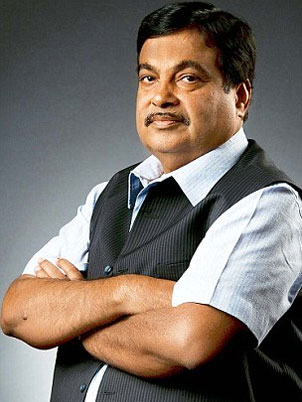
Nitin Jairam Gadkari
Quick Links
- Nitin Jairam Gadkari Biography
- Nitin Jairam Gadkari Personal Life
- Education Qualification of Nitin Jairam Gadkari
- Political Timeline of Nitin Jairam Gadkari
- Nitin Jairam Gadkari Achievements
- Interesting Facts about Nitin Jairam Gadkari
- Nitin Jairam Gadkari Early Life
- Nitin Jairam Gadkari Net Worth
- FAQ on Nitin Jairam Gadkari
Nitin Jairam Gadkari Biography
Nitin Gadkari was born on 27th May 1957 in a farming family in Nagpur, known as the orange city. His mother Bhanutai Jairam Gadkari mother had a significant influence on him.
The government's actions during the Emergency deeply disturbed Gadkari, prompting him to campaign against the Emergency as a student.
Gadkari became closely involved with the Rashtriya Swayamsevak Sangh (RSS) and the Akhil Bharatiya Vidyarthi Parishad (ABVP), dedicating himself to social work. He was especially inspired by RSS founder K. B. Hedgewar's ideals of humanity and nation-building.
The Emergency was a pivotal moment for Gadkari, marking the start of his active political involvement. During this period, he completed his Post-Graduate degree in Commerce, studied Law, and earned a Diploma in Business Management.
A key principle in Gadkari’s political life has been improving the lives of the underprivileged through Antyodaya, which aims to eradicate poverty, provide basic needs, and ensure opportunities for the poorest.
As a dedicated practitioner of Antyodaya, Gadkari initiated numerous projects for the benefit of landless labourers, small farmers, and tribal communities. These projects included education, healthcare, water conservation, and agriculture. He also established Ekal Vidyalayas (one-teacher schools) in tribal areas and organised over 1500 heart surgeries, artificial limb transplants, and programs for sickle cell eradication. He promoted tribal crafts, organic farming, and biofuel.
Gadkari's first significant opportunity to implement Antyodaya through governance came in 1995 when he became the Minister of the Public Works Department in Maharashtra.
He quickly realised that road connectivity was crucial for the development of backward villages. As PWD Minister, he overcame funding challenges and achieved all-weather road connectivity for 98 per cent of Maharashtra's population, including 13,736 remote villages, within four years. This helped reduce malnutrition among the tribal population in Vidarbha.
Gadkari's agricultural reforms in Maharashtra, such as water conservation and organic farming, significantly reduced farmers' suicides.
He introduced the PPP (Public-Private Partnership) model, known as BOT (Build Operate Transfer), for development projects. This approach led to the construction of the Mumbai-Pune Expressway and 55 flyovers in Mumbai in record time. The same model was later used for the "Golden Quadrilateral" and other projects by the National Highway Authority of India, freeing budget funds for rural road development.
Gadkari's reputation as an achiever earned him the nickname "Flyover Man." He proposed the "Pradhan Mantri Gram Sadak Yojana" to Prime Minister Atal Bihari Vajpayee, which the NDA government implemented to improve rural road connectivity nationwide. Vajpayee also tasked him with contributing to the National Highways Development Project (NHDP).
Gadkari is dedicated to promoting a transport fuel that is an import substitute, cost-effective, indigenous, and pollution-free. He has emphasised the adoption of green hydrogen as a clean and homegrown energy source for various industries and the mobility sector.
He has launched a hydrogen-powered car in Delhi as a pilot project. Road safety has always been a priority for Gadkari. His efforts include creating a new comprehensive Highway Capacity Manual and successfully enacting a world-class Road Safety Act, which was passed by both houses of Parliament.
Gadkari entered politics in 1980, starting with the BJP youth wing Janata Yuva Morcha, then becoming a BJP leader in Vidarbha. He served as the PWD Minister in the BJP-Shiv Sena government in Maharashtra from 1995-99 and was the leader of the opposition in the state Legislative Council for four consecutive terms, rising from a grassroots BJP worker to a national leader.
In 2005, he became BJP’s State President in Maharashtra and was elevated to the party's national president in 2009 at the age of 52.
Gadkari was elected to the 16th Lok Sabha from Nagpur by a significant margin. On 26th May 2014, he became the Minister for Road Transport in Narendra Modi's government. He was re-elected in the 2019 and 2024 Lok Sabha elections.
As the Union Minister for MSME, Gadkari has engaged with all stakeholders and introduced various welfare schemes to support artisans and daily wage workers in cottage and village industries, helping preserve India’s traditional arts and cultural heritage. For his massive contributions, he is inducted into the Modi 3.0 cabinet.
Nitin Jairam Gadkari Personal Life
| Full Name | Nitin Jairam Gadkari |
| Date of Birth | 27 May 1957 (Age 69) |
| Place of Birth | Nagpur (Maharashtra) |
| Party Name | Bharatiya Janata Party |
| Education | Graduate Professional |
| Profession | Agriculturist |
| Father's Name | Jairam Ramchandra Gadkari |
| Mother's Name | Bhanutai Jairam Gadkari |
| Spouse's Name | Kanchan Gadkari |
| Spouse's Profession | NA |
| Children | 2 Son(s) 1 Daughter(s) |
| Religion | Hindu |
| Caste | Brahmin |
| Website | https://nitingadkari.org.in/ |
Nitin Jairam Gadkari Net Worth
Galgotias University in Uttar Pradesh conferred him the honorary degree of Doctor of Philosophy in 2023 and SRM Institute of Science and Technology, Ghaziabad, Uttar Pradesh conferred the honourary degree of DOCTOR OF LITERATURE (D.Litt) in 2023.
Interesting Facts about Nitin Jairam Gadkari
He was the General Secretary of the BJP in Maharashtra when he was 35.
He is recognised for accelerating the rate of highway construction from 3 km/day in 2014 to 30 km/day under the ambitious Bharatmala project, aimed at creating a world-class road and highway network.
Political Timeline of Nitin Jairam Gadkari
- 2024 : He was elected to the 18th LOK Sabha from the Nagpur seat in Maharashtra. He is inducted to the Modi 3.0 cabinet.
- 2019 : He won the 2019 Lok Sabha elections from Nagpur, defeating Congress rival Nana Patole by two lakh votes. He was appointed Union Cabinet Minister for the Ministry of Micro, Small and Medium Enterprises. Later, he was inducted into Modi's cabinet as Minister of Micro, Small, and Medium Enterprises.
- 2017 : Union Cabinet Minister, Water Resources, River Development and Ganga Rejuvenation.
- 2014 : Gadkari was elected to the 16th Lok Sabha. He was appointed Minister of Road Transport and Highways and Shipping in Modi's cabinet. He also served as Union Cabinet Minister for Rural Development, Panchayati Raj, and Drinking Water and Sanitation (Additional Charge).
- 2009 : He served as the President of the Bharatiya Janata Party from 2009 to 2013.
- 2004 : He became the President of BJP Maharashtra state in 2004.
- 1999 : Leader of Opposition, Maharashtra Legislative Council.
- 1995 : He served on the High Power Committee for Privatization in Maharashtra until 1999. He founded and chaired MSRDC Ltd. and was the Guardian Minister of Nagpur district. He chaired the mining policy implementation committee in Maharashtra and the National Rural Road Development Committee for the Government of India. He was also the Chairperson of the Metropolis Beautification Committee in Maharashtra. He served as the PWD Minister in the Government of Maharashtra.
- 1985 : He was the secretary in 1985 of the BJP Nagpur city. He became MLC for four consecutive years.
- 1980 : He joined the BJP youth wing Janata Yuva Morcha.
- 1979 : He became the Secretary of the Vidharbha region in 1979. He later held all positions in the Nagpur University student council.
- 1976 : Nitin Gadkari started his political career with ABVP.
- :
Nitin Jairam Gadkari Early Life
- 1976: He joined the student political outfit Akhil Bharatiya Vidya Parishad (ABVP) in 1976.
Nitin Jairam Gadkari Achievements
Frequently Asked Questions (FAQs on Nitin Jairam Gadkari)
-
Who is the current Minister for Road Transport & Highways of India?Nitin Gadkari is the current Minister for Road Transport and Highways of India.
-
How old is Nitin Gadkari?Nitin Gadkari is 66 years old (As of 2023).
-
What is Nitin Jairam's height?Nitin Gadkari's height is 5'6".
-
Does Nitin Jairam have criminal cases?Yes, Nitin Jairam has 4 criminal cases.
-
Who is Nitin Jairam's wife?Smt. Kanchan Gadkari is the wife of Nitin Gadkari.
-
What is Nitin Jairam's caste?Nitin Jairam belongs to a Hindu, Brahmin family.
-
What is the qualification of Nitin Jairam?Nitin Jairam pursued an M. Com. and L.L.B. degree from Nagpur University.
-
From which party does Nitin Jairam belong to?Nitin Jairam belongs to the Bharatiya Janata Party.
-
Who is the longest serving Minister for Road Transport & Highways of India?Nitin Jairam is the longest-serving Minister for Road Transport & Highways of India.
-
Who is Nitin Jairam?Nitin Jairam serves as the current Minister for Road Transport & Highways of India.
Disclaimer:The information provided on this page is sourced from various publicly available platforms including https://en.wikipedia.org/, https://sansad.in/ls, https://sansad.in/rs, https://pib.gov.in/, https://affidavit.eci.gov.in/ and the official websites of state assemblies respectively. While we make every effort to maintain the accuracy, comprehensiveness and timeliness of the information provided, we cannot guarantee the absolute accuracy or reliability of the content. The data presented here has been compiled without consideration of the objectives or opinions of individuals who may access it.

List of Popular Leaders in India






Politicians by Age And Professions
Statewise Politicians List
- Andhra Pradesh Politicians
- Arunachal Pradesh Politicians
- Bihar Politicians
- Goa Politicians
- Gujarat Politicians
- Karnataka Politicians
- Kerala Politicians
- Madhya Pradesh Politicians
- Maharashtra Politicians
- Odisha Politicians
- Puducherry Politicians
- Tamil Nadu Politicians
- Telangana Politicians
- Uttar Pradesh Politicians
- Uttarakhand Politicians
-
 Sign in with Google
-
Block for 8 hours
-
Block for 12 hours
-
Block for 24 hours
-
Don't block


 Click it and Unblock the Notifications
Informed.
- Male
- Female
- Others
- Under 18
- 18 to 25
- 26 to 35
- 36 to 45
- 45 to 55
- 55+