Hit and Run New Law
The Hit and Run New Law in India introduces stricter criminal provisions for drivers involved in fatal road accidents who leave the scene without reporting or assisting victims. Enacted under the Bharatiya Nyaya Sanhita (BNS), 2023, the law aims to close loopholes that earlier allowed offenders to evade serious consequences under the Indian Penal Code (IPC). Hit-and-run cases have long been a concern due to delayed medical aid, weak investigations, and poor accountability. The new framework clearly distinguishes between drivers who act responsibly after an accident and those who deliberately flee. Applicable to all vehicle categories, the law strengthens road safety enforcement and prioritises human life across India.
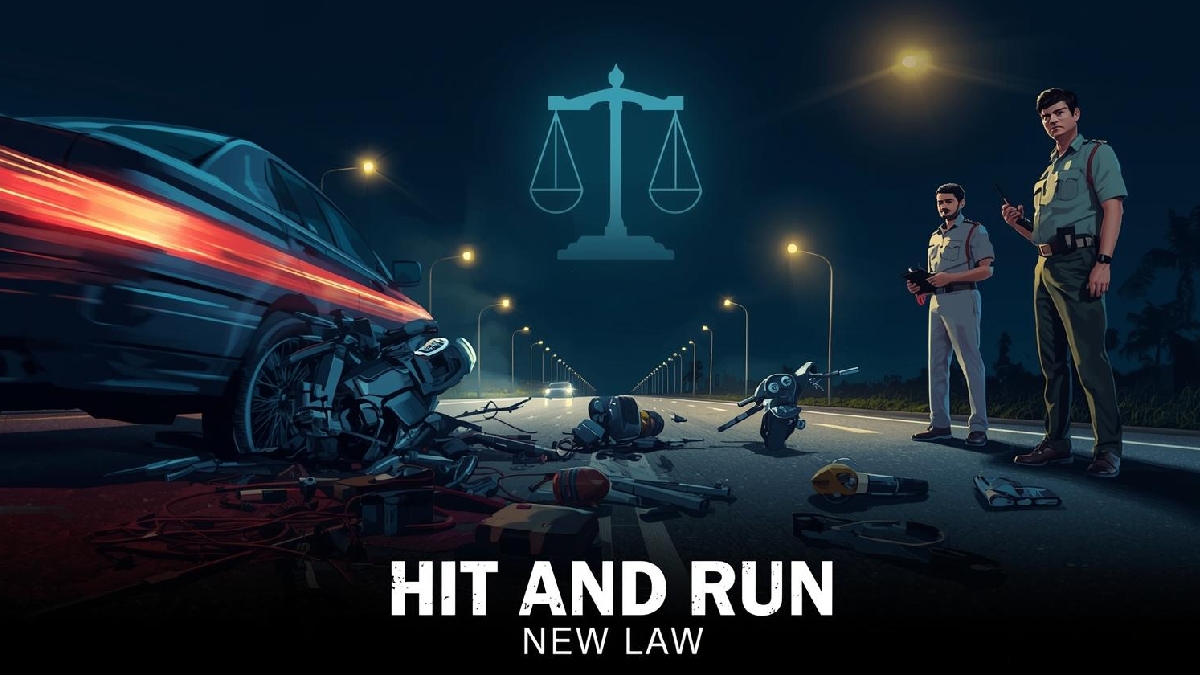
What Is the Hit and Run New Law? Explained Simply
The Hit and Run New Law defines stricter punishment for drivers who cause accidents resulting in death or serious injury and then escape without informing authorities or helping victims.
Key explanation points:
- Governed under Bharatiya Nyaya Sanhita, 2023
- Focuses on post-accident behaviour, not just the accident itself
- Treats fleeing the scene as a serious criminal offence
- Creates two separate offences based on driver responsibility
Drivers who stop, report, and assist victims face lesser punishment, while those who run away face enhanced criminal liability.
Why Was the Hit and Run Law Introduced in India?
The law was introduced to address rising road fatalities and ineffective punishment under older legal provisions.
Main reasons for introduction:
- Many offenders escaped punishment by fleeing the accident scene
- Victims often died due to delayed medical assistance
- Investigations became difficult without driver presence
- IPC penalties were considered too lenient
The new law reinforces accountability, encourages immediate help to victims, and strengthens trust in the legal system.
Hit and Run New Law, Provisions, Significance, Concerns
The law lays down clear legal duties and penalties for drivers involved in serious road accidents.
Core provisions include:
- Mandatory stopping of vehicle after an accident
- Providing medical help to injured persons
- Immediate reporting to police or emergency services
- Severe punishment for fleeing the scene
Significance:
- Improves emergency response time
- Strengthens road safety enforcement
- Ensures justice for victims’ families
Concerns:
- Need for public awareness
- Risk of misuse without proper investigation
- Requirement of fair and uniform enforcement
Key Changes in the Hit and Run Law Compared to the Old Law
The new law marks a clear departure from earlier IPC-based handling of hit-and-run cases.
Earlier IPC Sections Used:
- IPC 279 – Rash and negligent driving
- IPC 304A – Causing death by negligence
- IPC 337 & 338 – Causing hurt or grievous hurt
Key changes under BNS:
- Fleeing the scene is now a separate offence
- Higher imprisonment and fines
- Clear legal duty placed on drivers post-accident
- Uniform application across private and commercial vehicles
This shift strengthens deterrence and improves accident response outcomes.
Hit and Run New Law Punishment, Rules, Jail Term and Fine Details
The new law introduces significantly harsher punishment for offenders.
Punishment under Bharatiya Nyaya Sanhita:
- BNS Section 106(2):
- Applies when driver causes death and flees
- Imprisonment up to 10 years
- Monetary fine
- BNS Section 106(1):
- Applies when driver reports accident and helps victims
- Lesser punishment compared to Section 106(2)
Supporting Motor Vehicles Act Sections:
- Section 134 – Duty of driver after accident
- Section 187 – Punishment for failure to comply
Fleeing the scene is treated as a grave criminal act, not a minor violation.
Who Will Be Affected by the Hit and Run New Law?
The law applies to all motor vehicle users in India.
Affected groups include:
- Private car owners
- Two-wheeler riders
- Commercial drivers (buses, trucks, taxis)
- Transport and logistics companies
- Law enforcement agencies
The general public benefits through faster medical aid, improved investigations, and stronger justice mechanisms.
What Should Drivers Do After an Accident Under the New Law?
Drivers must follow specific legal steps after an accident.
Mandatory actions:
- Stop the vehicle immediately
- Ensure safety at the accident site
- Provide medical assistance to victims
- Inform police or emergency services
- Cooperate with authorities during investigation
Running away, hiding the vehicle, or avoiding authorities attracts severe punishment.
Hit and Run Law: Impact on Drivers, Transporters, and Public
The law creates long-term behavioural and systemic changes.
Impact areas:
- Higher accountability for drivers
- Improved compliance training for transporters
- Stronger deterrence against reckless driving
- Faster emergency medical response
- Better traffic discipline nationwide
Effective enforcement combined with awareness campaigns is essential for success.
Is the Hit and Run New Law Applicable to Old Cases?
The Hit and Run New Law is not retrospective.
Key clarification points:
- Applies only to accidents occurring after the law came into force
- Older cases will be governed by IPC provisions applicable at that time
- Ongoing trials will continue under previous legal frameworks
Understanding this distinction helps avoid confusion among drivers, transporters, and the public.
FAQs
1. Does the Hit and Run new law apply to minor accidents?
The Hit and Run new law only applies to accidents which cause death or severe bodily harm. The legal system handles minor accidents which lack serious injuries through existing motor vehicle laws and criminal statutes.
2. Is reporting the accident mandatory even if the injuries seem minor?
The police must be notified by drivers whenever an accident occurs. The driver needs to report the incident because it provides legal protection and creates essential records for the case, despite the initial assessment showing only minor injuries.
3. Does the Hit and Run new law apply to private vehicle owners?
The law requires all drivers to comply with its regulations, which include private car owners, two-wheeler riders and commercial vehicle drivers.
4. Can punishment be avoided if the driver reports immediately?
The driver who reports the accident while helping victims will receive a legal penalty reduction because the law treats the case as a hit-and-run incident.
5. Are commercial drivers treated differently under the Hit and Run new law ?
The law applies the same way to commercial drivers and private drivers, while professional drivers must adhere to additional safety and reporting requirements.
6. Does the Hit and Run new law cover accidents caused by negligence only?
The legal system evaluates driver behaviour following the accident. The punishment for fleeing the scene of an accident doubles when a driver shows negligence.
7. Is compensation affected by Hit and Run new law classification?
The classification of hit-and-run incidents directly affects the compensation process for victims and their families during legal proceedings.
Latest News
-
 Karnataka Dam Water Level Today (18 June 2026): Check Dam Water Level In Karnataka State
-
 TVK's First Tamil Nadu Assembly Session Begins Sans Controversy; State Anthem Sung Before National Anthem
-
 From ‘Aman Ki Asha’ to AI Billionaires: How an Indian and a Pakistani Built a Silicon Valley Giant Together
-
 Sewage Leak Suspected Behind Mangaluru's Contaminated Water, 30+ Wells Found Unsafe
-
 IIT Delhi Bags Country’s Best QS Rank, Jumps to 118 Globally
-
 Oil Prices Drop As US-Iran Peace Deal Reopens A Vital Global Trade Route
-
 Donald Trump Signs Historic Peace Deal With Iran: Oil Sanctions Lifted & Strait Of Hormuz Reopens
-
 Agbalumo Smoothie: Nigerian African Star Apple Beverage Recipe Guide
-
 Tarot Card Reading June 18, 2026: Get Your Tarot Cards Read Based on Your Zodiac
-
 Arvind Swamy Gemini Horoscope: Predictions for Love, Career and Health
List Of Popular Leaders In India
-
Karnataka Dam Water Level Today (18 June 2026): Check Dam Water Level In Karnataka State
-
TVK's First Tamil Nadu Assembly Session Begins Sans Controversy; State Anthem Sung Before National Anthem
-
From ‘Aman Ki Asha’ to AI Billionaires: How an Indian and a Pakistani Built a Silicon Valley Giant Together
-
Sewage Leak Suspected Behind Mangaluru's Contaminated Water, 30+ Wells Found Unsafe
-
IIT Delhi Bags Country’s Best QS Rank, Jumps to 118 Globally
-
Oil Prices Drop As US-Iran Peace Deal Reopens A Vital Global Trade Route
-
Donald Trump Signs Historic Peace Deal With Iran: Oil Sanctions Lifted & Strait Of Hormuz Reopens
-
Agbalumo Smoothie: Nigerian African Star Apple Beverage Recipe Guide
-
Tarot Card Reading June 18, 2026: Get Your Tarot Cards Read Based on Your Zodiac
-
Arvind Swamy Gemini Horoscope: Predictions for Love, Career and Health
List Of Popular Leaders In India
-
 Sign in with Google
-
Block for 8 hours
-
Block for 12 hours
-
Block for 24 hours
-
Don't block


 Click it and Unblock the Notifications
Informed.
- Male
- Female
- Others
- Under 18
- 18 to 25
- 26 to 35
- 36 to 45
- 45 to 55
- 55+