Hardeep Singh Puri
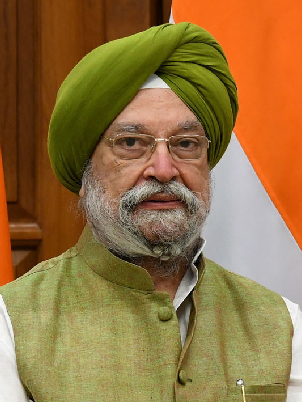
In 2021, he was handling Ministries of Housing and Urban Affairs in addition to Ministry of Petroleum and Natural Gas.
In May 2019, he also took on the roles of Minister of State (Independent Charge) for Civil Aviation and Minister of State for Commerce and Industry.
He became the Minister of State (Independent Charge) for Housing and Urban Affairs in September 2017.
He joined the Indian Foreign Service in 1974 and has served as India's Permanent Representative to the United Nations in Geneva and New York, as well as having postings in Tokyo and Colombo.
Hardeep Singh Puri Biography
Born in Daryaganj, Delhi, on 15 February 1952, Hardeep Singh Puri came into a family of refugees. His parents, Sardar Bhagat Singh Puri and Sardarni Kundan Puri, began their lives in a refugee camp, facing numerous hardships. Despite these challenges, they placed great importance on education, ensuring their children received a good schooling.
Puri's father was a diplomat, serving in various countries. Due to the lack of English-language education in these countries, Puri stayed with his grandparents and attended boarding schools in India, including The Frank Anthony Public School in Delhi. He spent parts of his early childhood in Bonn, Germany, and a few teenage years in Birmingham, UK.
During his college days at Hindu College in Delhi, Puri developed a keen interest in student politics. He was elected Prime Minister of the Hindu College Parliament. Recognising the close relationship between law and politics, he studied law, aiming to effectively contribute to governance through politics. He was actively involved with the Akhil Bharatiya Vidyarthi Parishad (ABVP) during his time at Hindu College.
Before joining the civil services, Puri worked as a lecturer in History at St. Stephen’s College, University of Delhi, maintaining his engagement in student politics throughout his tenure.
Puri, a distinguished Indian Foreign Service officer of the 1974 batch, served in pivotal roles within the Ministry of External Affairs and the Ministry of Defence, marking a career that spanned nearly 39 years.
During his tenure as First Secretary (Political) at the Indian High Commission in Colombo, Puri played a crucial role in 1987 by visiting Sri Lanka’s Jaffna peninsula and engaging with LTTE chief V. Prabhakaran, successfully persuading him to enter talks with New Delhi following the signing of the India-Sri Lanka Accord.
Between 1992 and 1994, as Joint Secretary (Americas) at the Ministry of External Affairs in New Delhi, Puri transformed bilateral relations in areas such as security and strategic cooperation, human rights, science and technology cooperation, and economic partnerships. He also led the Indian delegation in the 2nd and 3rd rounds of Indo-US dialogue on disarmament and non-proliferation.
Puri made history as the first IFS officer to become Joint Secretary at the Ministry of Defence in New Delhi, serving from 1994 to 1997. He headed the Defence Planning and Coordination Division, overseeing Army-Air Force-Navy cooperation and coordinating India’s international defence cooperation efforts.
Puri served as the Deputy Ambassador of India to the UK from 1999 to 2002. During his tenure, he played a pivotal role in establishing 'Friends of India' groups within all major political parties in the UK. He also launched initiatives to broaden bilateral economic ties by engaging with various regions across the country.
In 2002, Puri was appointed as the Permanent Representative of India to the United Nations and other international organizations in Geneva, a position he held until 2005. During this period, he facilitated the adoption of the first-ever public health treaty, the Framework Convention on Tobacco Control. He was instrumental in the adoption of the Sao Paulo Consensus at UNCTAD XI, which aimed to assist developing countries in participating equitably in the global economy.
Puri also contributed to the World Summit on Information Societies in 2003 and 2005, focusing on reducing the global digital divide by improving internet access in developing nations. Additionally, he played a significant role in the establishment of the Human Rights Council, the development agenda of the World Intellectual Property Organization, and the UNGA64 agenda, which led to the creation of UN Women.
Puri has a longstanding association with trade-related matters and has specialized in this field. Early in his career, he joined the UN in Geneva for a UNDP project supporting developing countries during the Uruguay Round of Trade Negotiations. He served as a coordinator for the Multilateral Trade Negotiations Project of the UN Development Program and the UN Conference on Trade and Development, advising developing countries during the Uruguay Round. In 2003, Puri was appointed as the head of several Dispute Settlement Panels of GATT and the WTO.
Puri served as an Ambassador to Brazil from 2006 to 2008, where he enhanced bilateral relations, including trade, investment, technology, defence, and energy cooperation. His tenure saw the inception of the India-Brazil-South Africa (IBSA) initiative and participation in BRICs dialogue.
From 2009 to 2013, Puri served as India's Permanent Representative to the UN in New York. In August 2011, he was elected President of the United Nations Security Council and later chaired its Counter-Terrorism Committee from 2011 to 2012.
Upon retiring from the Indian Foreign Service on 28 February 2013, Puri joined the International Peace Institute in New York as Vice President. He later became the Secretary-General of the Independent Commission on Multilateralism.
Driven by a passion for public service, Puri entered politics in 2013, joining the Bharatiya Janata Party (BJP). In 2017, he was appointed Minister of State (Independent Charge) for Housing and Urban Affairs. His portfolio expanded in May 2019 to include Civil Aviation and Commerce and Industry.
Elected unopposed to the Rajya Sabha from Uttar Pradesh in 2020, Puri was appointed Union Minister of Petroleum and Natural Gas & Housing and Urban Affairs in July 2021. Following the 2024 general elections, he joined the Modi 3.0 cabinet as the Union Minister of Petroleum and Natural Gas.
Puri is a distinguished author and seasoned diplomat, having penned three notable books: Separating the Wheat from the Chaff: Decoding Dominant Narratives (Konark Publications, July 2019), Delusional Politics: Back To The Future (Penguin Random House, January 2019), and Perilous Interventions: The Security Council and the Politics of Chaos (Harper Collins, September 2016).
On a personal note, Puri met his wife, Lakshmi Puri, while serving as an Indian Foreign Service (IFS) officer. She is also an accomplished IFS officer, and has served as an Ambassador, Assistant Secretary-General at the UN, and Deputy Executive Director of UN Women in New York. Together, they have raised two daughters who have grown into independent and empowered women.
Hardeep Singh Puri Personal Life
| Full Name | Hardeep Singh Puri |
| Date of Birth | 15 Feb 1952 (Age 74) |
| Place of Birth | New Delhi |
| Party Name | Bharatiya Janata Party |
| Education | Post Graduated |
| Profession | Former lecturer in History at St. Stephen’s College, University of Delhi and Retired Diplomat |
| Father's Name | Late Bhagat Singh Puri |
| Mother's Name | Late Kundan Puri |
| Spouse's Name | Lakshmi Puri |
| Spouse's Profession | Retired IFS and now an Assistant Secretary-General at United Nations. |
| Children | 2 Daughter(s) |
| Religion | Sikh |
| Website | https://t.co/F8YKgaiYhA |
Hardeep Singh Puri Net Worth
Interesting Facts about Hardeep Singh Puri
He served thrice as India's member of GATT and as India's Permanent Representative to the UN in Geneva (2002-2005) and New York (2009-2013).
Puri made history as the first IFS officer to become Joint Secretary at the Ministry of Defence in New Delhi, serving from 1994 to 1997.
Political Timeline of Hardeep Singh Puri
- 2025-2026: Functions as a senior Union Minister handling key national portfolios, as of 2026.
- 2024: Union Minister of Petroleum and Natural Gas.
- 2021: Appointed as Union Minister of Petroleum and Natural Gas & Housing and Urban Affairs.
- 2020: Member of Rajya Sabha from Uttar Pradesh.
- 2019: He was inducted in Narendra Modi's cabinet as Civil Aviation minister & Minister of State for Commerce and Industry. He contested and lost the Lok Sabha polls from Amritsar seat.
- 2018: Member of Parliament, Rajya Sabha Uttar Pradesh Constituency.
- 2017: Minister of Housing and Urban Affairs. President, Governing Body and Chairman, Governing Council of the Research and Information System for Developing Countries, New Delhi.
- 2014: He joined the BJP officially.
Hardeep Singh Puri Early Life
- 2013: Vice President - International Peace Institute (IPI) post-retirement from IFS. Senior Adviser, International Peace Institute (IPI), New York (U.S.A.).
- 2011: President of the United Nations Security Council (August 2011). Chairperson of the United Nations Security Council Counter-Terrorism Committee (2011-2012).
- 2009: Ambassador and Permanent Representative of India to the UN in New York (2009-2013).
- 2008: Secretary (Economic Relations), Ministry of External Affairs, New Delhi, 2008-09.
- 2006: Ambassador of India to Brazil (2006-2008).
- 2003: Head of several Dispute Settlement Panels of GATT and WTO.
- 2002: Permanent Representative of India to the UN and other international organizations in Geneva (2002-2005).
- 1999: Deputy High Commissioner of India to the UK (1999-2002).
- 1997: Joint Secretary (Europe West), Ministry of External Affairs, New Delhi, 1997-99.
- 1994: Joint Secretary - Ministry of Defence, New Delhi (1994-1997).
- 1992: Joint Secretary (Americas) - Ministry of External Affairs, New Delhi (1992-1994).
- 1991: Director, Foreign Secretary’s Office, Ministry of External Affairs, New Delhi, 1991-92.
- 1988: Coordinator, UNDP/UNCTAD Multilateral Trade Negotiation Project to help Developing Countries in the Uruguay Round of MTNS, 1988-91.
- 1984: Counsellor, High Commission of India, Colombo (Sri Lanka), 1984-88.
- 1981: First Secretary, Permanent Mission of India to GATT, Geneva (Switzerland), 1981-84.
- 1979: Under Secretary (Foreign Service Personnel), Ministry of External Affairs, New Delhi, 1979-81.
- 1978: Officer on Special Duty (Press Relations), Ministry of External Affairs, New Delhi, 1978-79.
- 1976: Second Secretary, Embassy of India, Tokyo (Japan), 1976-78.
- 1974: He joined Indian Foreign Services and served as a diplomat till 2013. Served at India's missions in Tokyo and Colombo.
- 1973: He was elected as Prime Minister of the Hindu College Parliament.
Hardeep Singh Puri Achievements
Disclaimer:The information provided on this page is sourced from various publicly available platforms including https://en.wikipedia.org/, https://sansad.in/ls, https://sansad.in/rs, https://pib.gov.in/, https://affidavit.eci.gov.in/ and the official websites of state assemblies respectively. While we make every effort to maintain the accuracy, comprehensiveness and timeliness of the information provided, we cannot guarantee the absolute accuracy or reliability of the content. The data presented here has been compiled without consideration of the objectives or opinions of individuals who may access it.


List of Popular Leaders in India


Politicians by Age And Professions
Statewise Politicians List
- Andhra Pradesh Politicians
- Arunachal Pradesh Politicians
- Bihar Politicians
- Goa Politicians
- Gujarat Politicians
- Karnataka Politicians
- Kerala Politicians
- Madhya Pradesh Politicians
- Maharashtra Politicians
- Odisha Politicians
- Puducherry Politicians
- Tamil Nadu Politicians
- Telangana Politicians
- Uttar Pradesh Politicians
- Uttarakhand Politicians
-
 Sign in with Google
-
Block for 8 hours
-
Block for 12 hours
-
Block for 24 hours
-
Don't block


 Click it and Unblock the Notifications
Informed.
- Male
- Female
- Others
- Under 18
- 18 to 25
- 26 to 35
- 36 to 45
- 45 to 55
- 55+