H. D. Devegowda
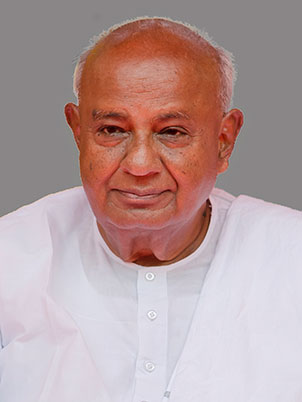
With a political career spanning many years, he is still a powerful personality in local and national politics. He is still a Member of Parliament in the Rajya Sabha as of 2025.
H. D. Devegowda Biography
H.D. Devegowda was born on May 18, 1933, in Haradanahalli village of Holenarasipura taluk, Hassan District, Karnataka. He served as the 11th Prime Minister of India and the 14th Chief Minister of Karnataka.
Gowda participated in the freedom struggle as a student leader. Before entering politics, he worked as a contractor, handling small projects. Known for his simple lifestyle and modest demeanour, he began his political journey at the age of 20, joining the Congress Party in 1953 after completing his education. He remained a member until 1962. Growing up in a middle-class farming family, he experienced firsthand the challenges faced by farmers and vowed to advocate for the rights of the underprivileged and oppressed sections of society.
Starting from humble beginnings in the democratic system, Gowda gradually climbed the political ladder. He made a mark on people's minds while serving as the President of the Anjaneya Co-operative Society and later as a member of the Taluk Development Board in Holenarasipura.
At the age of 28, Gowda ran as an Independent candidate and quickly gained popularity upon winning a seat in the Karnataka Legislative Assembly in 1962. Representing the Holenarasipur constituency, he secured seats in the Assembly for three consecutive terms: the Fourth (1967-71), the Fifth (1972-77), and the Sixth (1978-83) Assemblies. Renowned for his effective speaking skills in the Assembly, he earned admiration from both peers and seniors alike.
After his re-election in 1967, Gowda gained confidence in his political abilities. In 1969, amidst the split of the Congress party, he aligned with the Congress (O) led by Nijalingappa, which held power in Karnataka at the time. However, Gowda's major opportunity arose after the Congress (O) suffered a defeat in the 1971 Lok Sabha elections. He emerged as the leader of a reduced opposition, challenged by the strong influence of Indira Gandhi. His tenure as the Leader of the Opposition in the Assembly, from March 1972 to March 1976 and again from November 1976 to December 1977, earned him praise and recognition. In 1975-76, during the period of emergency, Gowda incurred the displeasure of the central government and was imprisoned under the Maintenance of Internal Security Act (MISA) during the Emergency in 1976.
Gowda tendered his resignation from the Sixth Assembly on November 22, 1982. In the subsequent Seventh and Eighth Assemblies, he assumed the role of Minister of Public Works and Irrigation. During his tenure as Irrigation Minister, several irrigation projects were initiated. However, in 1987, he stepped down from his cabinet position in protest against what he perceived as inadequate funding for irrigation projects. In 1991, he was elected to Parliament from the Hassan Lok Sabha constituency. In this role, he played a key part in highlighting the issues faced by the state, particularly those concerning farmers.
Gowda held significant positions within the Janta Party, serving as its President at the state level twice. In 1994, he assumed the presidency of the State Janata Dal. He played a pivotal role in propelling the Janata Dal to power in the state during the same year. Following his election as the leader of the Janata Dal Legislative Party, Gowda officially became the 14th Chief Minister of Karnataka on December 11, 1994. Concurrently, he contested and won from the Ramanagar Assembly constituency with a substantial majority. On May 30, 1996, Deve Gowda resigned from his position as the Chief Minister of Karnataka to assume office as the 11th Prime Minister of India on behalf of the United Front coalition.
However, his time as Prime Minister was brief. In April 1997, the Congress (I) Party withdrew its support from the coalition government. They cited a lack of consultation from Gowda on important matters despite the government's dependency on Congress support. Consequently, on April 11, 1997, Gowda faced a vote of no confidence in the Lok Sabha and lost by a significant margin. Inder Kumar Gujral, the then Minister for External Affairs, was chosen as the new coalition leader.
Following this, Gowda was elected to the Rajya Sabha (Council of States) from 1996 to 1998. He then secured re-election to the Lok Sabha in 1998, 2002, 2004, 2009, and 2014. However, he lost his seat in the 2019 general elections. He was then re-elected to the Rajya Sabha in 2020.
Demonstrating his political savvy, Gowda addressed the contentious Idgah Maidan issue in Hubli. This ground, belonging to the minority community, had become embroiled in political controversy. Through adept negotiation, Gowda successfully facilitated a peaceful resolution to the matter.
In January 1995, Deve Gowda embarked on a tour of Switzerland, where he participated in the Forum of International Economists and during his visit to Singapore, he successfully attracted significant foreign investment to the state, showcasing his aptitude for business.
He was born into a Vokkaligas family to Dodde Gowda and Devamma. He takes pride in his humble agricultural upbringing. He is married to Chennamma, and the couple is blessed with four sons and two daughters. One of their sons, H. D. Kumaraswamy is a candidate for the 2024 general elections while their other son H.D. Revanna serves as a Member of the Legislative Assembly (MLA) in Karnataka.
H. D. Devegowda Personal Life
| Full Name | H. D. Devegowda |
| Date of Birth | 18 May 1933 (Age 93) |
| Place of Birth | Holenarsipura, Distt. Hassan (Karnataka) |
| Party Name | Janata Dal (Secular) |
| Education | Others |
| Profession | AgriculturistEngineer, Farmer, Social Worker |
| Father's Name | Late Dodde Gowda |
| Mother's Name | Devamma |
| Spouse's Name | Chennamma |
| Spouse's Profession | House wife'Social Activist |
| Children | 4 Son(s) 2 Daughter(s) |
| Religion | Hindu |
| Caste | Vokkaligas |
| Website | http://www.hddevegowda.in/home.htm |
H. D. Devegowda Net Worth
Interesting Facts about H. D. Devegowda
During his working days, he was also engaged in reading books in the library of the Legislative Assembly.
Apart from this, he is popular for performing and maintaining the reputation and dignity of the Parliament.
H.D. Devegowda's son and grandson, H.D. Revanna and Prajwal Revanna, a sitting MP are facing the charges of kidnapping and sexual harassment of their domestic help, respectively.
Political Timeline of H. D. Devegowda
- 2022: He became a member of the Consultative Committee for the Ministry of Agriculture and Farmers Welfare.
- 2020: He was elected to the Rajya Sabha for the second term. He served as a member of the Committee on Railways from 2020 to 2022. Then he was made a member of the Committee on Water Resources.
- 2019: He lost the general elections.
- 2014 : With his power and trust among the people, he was again re-elected to the 16th Lok Sabha (6th term). On 6 Sep 2014, he became a member of the Standing Committee on Defence.
- 2009 : Once again, he was re-elected to the 15th Lok Sabha for 5th Time. On 31st August, he became a member of the committee on Defence.
- 2006 : He appointed as the Member of Committee on Railways from 2006-2008
- 2004 : He was Re-elected to 14th Lok Sabha (4th term).
- 1999 : In 1999, many leaders, including Madhu Dandawate, joined the Janata Dal (Secular) faction headed by Deve Gowda, who became the National president of this faction. Also, in the same year, he was defeated in the 1999 general elections but staged a comeback by winning the Kanakapura by-elections in 2002.
- 1996 : In the 1996 general elections, the Congress party headed by P. V. Narasimha Rao lost decisively but no other party won enough seats to form a government. Also, in the same year, he took over as Prime Minister of India on 1 June 1996 and continued until 11 April 1997. He also took charge of Ministries/Departments of Petroleum and Chemicals, Personnel, Public Grievances and Pensions, Atomic Energy, Home Affairs, Agriculture, Food Processing Industries, Urban Affairs, and Employment and Non-Conventional Energy Sources.
- 1995 : In January 1995, Gowda toured Switzerland and attended the Forum of International Economists. His tour to Singapore brought in foreign investment to the State.
- 1994 : He became President of the state unit of Janata Dal in 1994 and was the driving force behind the victory of the party in the 1994 State Assembly elections. He was elected from the Ramanagara and sworn in as the 14th Chief Minister of Karnataka in December.
- 1983 : He served as a minister in the Janata Party Government in Karnataka, headed by Ramakrishna Hegde, from 1983 to 1988.
- 1975 : During the Emergency (1975–77), he was imprisoned in the Bangalore Central Jail.
- 1972 : He joined the Congress (O) during the Congress split and served as the Leader of Opposition in the Assembly from March 1972 to March 1976 and again from November 1976 to December 1977.
- 1962 : Gowda was elected to the Karnataka Legislative Assembly from Holenarasipura constituency as an independent candidate in 1962. Later, he was elected from the same constituency to the Assembly for six consecutive terms from 1962 to 1989.
- 1953 : Gowda joined the Indian National Congress party in 1953 and remained a member until 1962
H. D. Devegowda Early Life
- 1950's: H D Devegowda was working as a contractor after achieving his Diploma degree in Civil Engineering.
H. D. Devegowda Achievements
He was a member of the Taluk Development Board and Co-operative Societies
His interests are Agriculture and Horticulture
He was the Chairman of the Steering Committee of the United Front
Also, he was the President of the Anjaneya Cooperative Society of Holenarasipura
Shri H.D. Deve Gowda was a prominent political personality who played an efficient role in uplifting the lower classes of society, mainly agrarians
He introduced a reservation system that favored the minority, backward classes, scheduled castes and tribes, and women too.
Disclaimer:The information provided on this page is sourced from various publicly available platforms including https://en.wikipedia.org/, https://sansad.in/ls, https://sansad.in/rs, https://pib.gov.in/, https://affidavit.eci.gov.in/ and the official websites of state assemblies respectively. While we make every effort to maintain the accuracy, comprehensiveness and timeliness of the information provided, we cannot guarantee the absolute accuracy or reliability of the content. The data presented here has been compiled without consideration of the objectives or opinions of individuals who may access it.

List of Popular Leaders in India

Politicians by Age And Professions
Statewise Politicians List
- Andhra Pradesh Politicians
- Arunachal Pradesh Politicians
- Bihar Politicians
- Goa Politicians
- Gujarat Politicians
- Karnataka Politicians
- Kerala Politicians
- Madhya Pradesh Politicians
- Maharashtra Politicians
- Odisha Politicians
- Puducherry Politicians
- Tamil Nadu Politicians
- Telangana Politicians
- Uttar Pradesh Politicians
- Uttarakhand Politicians
-
 Sign in with Google
-
Block for 8 hours
-
Block for 12 hours
-
Block for 24 hours
-
Don't block


 Click it and Unblock the Notifications
Informed.
- Male
- Female
- Others
- Under 18
- 18 to 25
- 26 to 35
- 36 to 45
- 45 to 55
- 55+