Narendra Modi
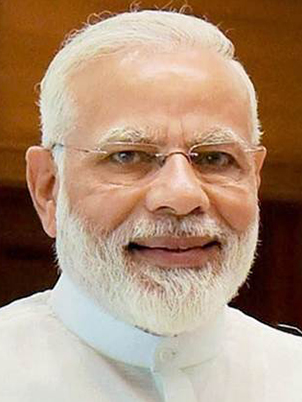
In 2019, Modi's BJP, along with the BJP-led NDA alliance, secured another majority in the general elections. Although the BJP didn't achieve a majority on its own in the 2024 Lok Sabha elections, the NDA alliance won 293 seats out of 543, ensuring Modi's third consecutive term as prime minister.
Additionally, Modi is also in charge of the Ministry of Personnel, Public Grievances and Pensions; Department of Atomic Energy; Department of Space; all important policy issues; and all other portfolios not allocated to any Minister.
Quick Links
- Narendra Modi Biography
- Narendra Modi Personal Life
- Education Qualification of Narendra Modi
- Political Timeline of Narendra Modi
- Narendra Modi Achievements
- Interesting Facts about Narendra Modi
- Narendra Modi Early Life
- Narendra Modi Net Worth
- Election History of Narendra Modi
- FAQ on Narendra Modi
- Narendra Modi Latest News & Updates
Narendra Modi Biography
On 26th May 2014, Narendra Damodardas Modi was sworn in as Prime Minister of India at Rashtrapati Bhawan in New Delhi. His journey to becoming Prime Minister began in Vadnagar, a small town in North Gujarat’s Mehsana district. He was born on 17th September 1950, three years after India's independence, making him the first Prime Minister born in independent India. He was the third child of Damodardas and Hiraba Modi, who lived modestly in a small single-storey house measuring about 40 feet by 12 feet.
In his early years, Modi balanced his studies with helping at his family's tea stall as they struggled financially. Influenced by Swami Vivekananda, he developed a strong urge to serve society.
Modi's thoughts and dreams as a child were different from those of his peers. Vadnagar, once a centre of Buddhist learning and spirituality, might have influenced him. From a young age, he felt a strong desire to make a difference in society. Inspired by Swami Vivekananda, he pursued spiritualism and was driven to realize Vivekananda's dream of making India a Jagat Guru, or world teacher.
At 17, Modi left home to travel across India, immersing himself in its diverse cultures for two years. Upon returning, he was a changed person, with a clear vision for his future. He then moved to Ahmedabad and joined Rashtriya Swayamsevak Sangh (RSS), a socio-cultural organization focused on India's social and cultural revival.
From 1972, Modi's life in Ahmedabad was rigorous, starting his day at 5 AM and continuing late into the night as he became a Pracharak for RSS. In the late 1970s, he actively participated in the movement to restore democracy in India during the Emergency period.
During the 1980s, while fulfilling various roles within the Sangh, Modi distinguished himself as an exceptional organizer. In 1987, he took on the role of General Secretary of the BJP in Gujarat. His organizational prowess became evident as he led the BJP to its first victory in the Ahmedabad Municipal Corporation elections. Additionally, under his leadership, the BJP secured a strong second position in the 1990 Gujarat Assembly elections. In 1995, his organizational skills further propelled the BJP to win 121 seats in the Assembly elections.
From 1995, Modi served as the National Secretary of the BJP, overseeing the party's activities in Haryana and Himachal Pradesh. As the General Secretary Organization, he played a pivotal role in securing victory for the BJP in the 1998 Lok Sabha elections.
In 1995, Modi took on the role of secretary for the BJP's national organization in New Delhi, then rose to become its general secretary three years later. He held this position for another three years until October 2001, when he replaced Keshubhai Patel as Gujarat's chief minister following Patel's criticized handling of the Bhuj earthquake aftermath, which claimed over 20,000 lives.
In September 2001, a phone call from then-Prime Minister Vajpayee marked a significant turning point in Modi's life, transitioning him from the realm of organizational politics to the sphere of governance.
Modi's entry into electoral politics came in February 2002 with a by-election that secured him a seat in the Gujarat state assembly. His subsequent political career was marked by both controversy and self-promoted achievements. He faced scrutiny for his role as chief minister during the communal riots in Gujarat in 2002, where over 1,000 people, mostly Muslims, lost their lives following the Godhra train incident.
The United States and the United Kingdom criticized Modi's involvement in the 2002 riots, leading to the denial of a diplomatic visa by the U.S. In the years following, although Modi himself avoided indictment or censure, some of his associates were found guilty of complicity in the events.
Modi's administration faced allegations of extrajudicial killings, including a controversial case in 2004 involving individuals accused of plotting against him. Despite these challenges, Modi's political success in Gujarat solidified his position within the BJP, leading to victories in the 2002, 2007, and 2012 state assembly elections. Each time, he secured his seat and returned as chief minister, emphasizing growth and development in Gujarat.
As the leader of the Gujarat government, Modi gained a strong reputation as an effective administrator, credited with driving the state's economy forward swiftly. His success in elections further bolstered his standing within the BJP, positioning him as a leading figure within the party and a potential contender for India's prime minister role. In June 2013, Modi was selected as the BJP's campaign leader for the 2014 Lok Sabha elections.
Following an intense campaign where Modi positioned himself as a practical leader capable of revitalizing India's sluggish economy, he and his party secured victory in the elections, with the BJP winning a clear majority of seats in the chamber. Modi took office as prime minister on May 26, 2014, and wasted no time in initiating various reforms. These included efforts to enhance India's transportation infrastructure and liberalize rules on foreign investment.
Early in his term, Modi achieved two significant diplomatic feats. In mid-September, he welcomed Chinese President Xi Jinping on a visit to India, marking the first such visit by a Chinese leader in eight years. Later that month, Modi, having been granted a U.S. visa, made a successful trip to New York City, including a meeting with U.S. President Barack Obama.
As prime minister, Modi promoted Hindu culture and implemented wide-ranging economic reforms. These reforms, while ambitious, caused some temporary disruptions nationwide. Notably, the sudden demonetization of 500- and 1,000-rupee banknotes aimed to combat the use of "black money." Additionally, the introduction of the Goods and Services Tax (GST) centralized the consumption tax system, simplifying the tax structure but slowing GDP growth.
The disappointment over economic outcomes was evident during the late 2018 state elections, where the BJP faced losses in all five states, including its strongholds. However, a security crisis in Jammu and Kashmir in February 2019, which escalated tensions with Pakistan, boosted Modi's image just before the national elections. Despite initial concerns, Modi's charisma and the BJP's strong campaign secured their return to power, making Modi the first non-Congress Party prime minister to be re-elected after a full term.
During his second term, Modi's government made significant changes, including revoking Jammu and Kashmir's special status in October 2019, bringing it under direct union government control. This move faced criticism and legal challenges due to concerns about legality and restrictions on communication and movement in the region.
In March 2020, Modi took swift action to combat COVID-19, implementing strict nationwide measures. Indian biotech firms played a crucial role in vaccine development. To counter the pandemic's economic impact, Modi liberalized the agricultural sector in June 2020, leading to protests over fears of farmer exploitation.
In 2021, protests intensified, and COVID-19 cases surged, overwhelming the healthcare system. Modi's handling of the crisis, including holding political rallies, faced criticism. Despite this, the BJP lost elections in key states. In November, amidst ongoing protests, Modi announced the repeal of the agricultural reforms.
In October 2023, Modi fulfilled a BJP promise by announcing the construction of the Ram Mandir at Ram's birthplace, with the consecration ceremony held in January 2024. In the 2024 Lok Sabha elections, despite Modi's ambitious target of 400 seats for the BJP-led NDA alliance, they only won 240 seats. Although the NDA secured enough seats to form a government, Modi's BJP will rely on allies for support, marking his third term as prime minister.
Narendra Modi Personal Life
| Full Name | Narendra Modi |
| Date of Birth | 17 Sep 1950 (Age 75) |
| Place of Birth | Vadnagar, Mehsana (Gujarat) |
| Party Name | Bharatiya Janata Party |
| Party Position | Lok Sabha Leader |
| Education | Post Graduate |
| Profession | Social Worker, Political Activity |
| Father's Name | Damodardas Mulchanddas Modi |
| Mother's Name | Smt. Hiraben Damodardas Modi |
| Spouse's Name | Jashodaben Modi |
| Spouse's Profession | Homemaker |
| Religion | Hindu |
| Caste | Other Backward Class |
| Website | http://www.narendramodi.in |
| Current Constituency | Varanasi |
Narendra Modi Net Worth
Interesting Facts about Narendra Modi
During his school days, PM Modi acted in several plays. He was barely 13 or 14 when he enacted a play to raise funds to repair a broken wall of his school in his hometown.
Inspired by the growing gypsy culture, PM Modi, during his adolescence, spent around two years travelling around India. He returned to Gujarat after visiting various religious centers across the country.
At the 'Pran Pratishtha' ceremony in Ayodhya, Modi was the chief ‘yajman’ or the host of the Ram temple consecration and on his behalf, the prayers were offered.
PM Modi is the first ever PM to be born after India attained Independence.
Political Timeline of Narendra Modi
- 2024 : PM Modi was elected from the Varanasi Lok Sabha seat, for a third term in the 18th Lok Sabha elections. He defeated Congress' Ajay Rai by winning 54.24 per cent vote share. He was sworn in as the Prime Minister of India for the third consecutive term. Additionally, he was made in charge of the Ministry of Personnel, Public Grievances and Pensions; the Department of Atomic Energy; the Department of Space; All important policy issues; and all other portfolios not allocated to any Minister.
- 2019 : Indian PM Narendra Modi has secured another five-year term after winning a landslide general election victory.
- 2014 : Narendra Modi was elected as the 14th and current Prime Minister of India. Modi was sworn in as the Prime Minister of India on 26 May 2014. He became the first Prime Minister born after India's independence from the British Empire.
- 2012 : Modi was again elected from Maninagar. This time he defeated Bhatt Shweta Sanjiv by 34097 votes. He again took oath as chief minister (fourth term). Later he resigned from the assembly in 2014.
- 2007 : On 23 December 2007, Modi's third term as CM started and was completed on 20 December 2012. This time again, he won from Maninagar. He defeated Dinsha Patel of Congress.
- 2002 : He contested from Maninagar and won the assembly election. He defeated Oza Yatinbhai Narendrakumar of Congress by 38256 votes. He was retained as Chief Minister of Gujarat. (Second Term).
- 2001 : Keshubhai Patel's health was failing, and the BJP lost a few state assembly seats in by-elections. The BJP national leadership replaced Patel with Modi as Chief Minister of Gujarat. On 7 October 2001, Modi took the oath as CM of Gujarat. On 24 February 2002, he won a by-election to the Rajkot – II constituency. He defeated Ashwin Mehta of the INC by 14,728 votes. This was his first and very short term.
- 1995 : He was elected BJP national secretary and transferred to New Delhi. He headed the election campaigns of Haryana and Himachal Pradesh. Modi was promoted to BJP general secretary (organization) in 1996.
- 1990 : Modi helped to organize L. K. Advani's 1990 Ram Rath Yatra and Murli Manohar Joshi's Ekta Yatra in 1991–92.
- 1987 : Modi was elected as the organizing secretary of the BJP's Gujarat unit.
- 1986 : After L. K. Advani, Modi became president of the BJP. At that time RSS decided to place its members in important positions within the BJP.
- 1985 : RSS assigned Modi to the BJP. Later in 1987, Modi helped to organize the BJP's campaign in the Ahmedabad municipal election. BJP won that election.
- 1979 : He went to work for the RSS in Delhi. where he was put to work researching and writing the RSS's version of the history of the Emergency.
- 1978 : He became an 'RSS sambhag pracharak'. Associated with RSS activities in the areas of Surat and Vadodara.
- 1975 : Narendra Modi was appointed as general secretary of the "Gujarat Lok Sangharsh Samiti" by RSS. During the Emergency, Modi was forced to go underground to avoid arrest. He was involved in printing pamphlets opposing the government.
Narendra Modi Early Life
- 1972: Joined the Rashtriya Swayamsevak Sangh (RSS).
- 1967: He completed his higher secondary education in Vadnagar. Due to family tension, he left home. Modi spent around two years travelling across Northern and North-eastern India. As a Bharat Bhraman, he travelled across India including the Himalayas, Rishikesh, and Ramakrishna Missions.
- 1960s: As a child, Modi helped his father to sell tea at the Vadnagar railway station. Later, he ran a tea stall with his brother near a bus stand.
Narendra Modi Achievements
He was the 9th-Most-Powerful Person in the World in 2015, 2016, and 2018. During his premiership, India rose to the 100th rank in the 2018 Ease of Doing Business ranking by the World Bank.
In 2020, Modi Ji was one of the eight world leaders who received the parodic Ig Nobel Prize in Medical Education "for using the COVID-19 viral pandemic to teach the world that politicians can have a more immediate effect on life and death than scientists and doctors can".
President Donald Trump awarded Modi with the Legion of Merit for elevating the India–United States relations on 21 December 2020.
The largest cricket stadium in the world - Ahmedabad, was renamed Narendra Modi Stadium by the Gujarat Cricket Association on 24 February 2021.
Another side, PM Modi is featured in TIME Magazine's 100 most influential people of 2021 list. Moreover, He was called as third "pivotal leader" of independent India after Jawaharlal Nehru and Indira Gandhi who "dominated the country's politics like no one since then."
In August 2023, Modi laid the foundation stone of the Ram Temple. This marked the official start of the construction of the Ram Temple after the Supreme Court's judgement.
Election Results of Narendra Modi
| Year | Election | Type | Constituency | Result |
|---|---|---|---|---|
| 2019 | Parliament election | MP | Varanasi | Won |
| 2014 | Parliament election | MP | Vadodara | Won |
| 2014 | Parliament election | MP | Varanasi | Won |
| 2012 | Gujarat Assembly election | MLA | Maninagar | Won |
| 2007 | Gujarat Assembly election | MLA | Maninagar | Won |
| 2002 | Gujarat Assembly election | MLA | Maninagar | Won |
Frequently Asked Questions (FAQs on Narendra Modi)
-
When PM Modi is going to take the oath as a Prime Minister of India for the third time?PM Modi will sworn in as the Prime Minister of India for the third consecutive term on 9 June 2024.
-
Does PM Modi have a child?No, Prime Minister Narendra Modi has no biological child.
-
What are Narendra Modi’s hobbies?Prime Minister Narendra Modi’s hobbies are - collecting branded watches, clicking photos, writing poems, and staying up-to-date about the latest tech stuff. Modi is also very particular about his appearance, as he has made several headlines because of his fashion sense.
-
Was Narendra Modi a tea seller?Narendra Modi initially helped his father to sell tea at the Vadnagar railway station. He later ran a tea stall with his brother near a bus stand.
-
What is Narendra Modi’s caste?Narendra Modi comes from the “Modh Ghanchi” caste of Gujarat, which goes under the Other Backward Category.
-
Are Narendra Modi and Lalit Modi brothers?No, Narendra Modi and Lalit Modi are not from the same family background.
-
What is the name of Narendra Modi’s wife?Narendra Modi’s wife’s name is Jashodaben Modi, but she was estranged merely after 3 years of their wedding.
-
Is Narendra Modi married?Narendra Modi was married to Jashodaben Modi in 1968, who is a former School teacher. Subsequently, the couple decided to get separated.
-
Who are Narendra Modi’s favourite leaders?Narendra Modi’s favorite leaders are Mohandas Karamchand Gandhi and Swami Vivekananda.
-
What is Narendra Modi’s blood group?Narendra Modi’s blood group is A positive.
-
What is Narendra Modi’s height?Narendra Modi’s height is approx. 5'6".
-
What is Narendra Modi’s real name?Narendra Modi’s real name is Narendra Damodardas Modi.
Narendra Modi Latest News & Updates
-
PM Modi Urges High Voter Turnout in Final Phase of West Bengal ElectionsOn 29 April 2026, Prime Minister Narendra Modi encouraged citizens to vote in record numbers during the final phase of the West Bengal Assembly elections. He specially called upon women and young voters to participate in the democratic process.This appeal follows a major victory for the Bharatiya Janata Party in Gujarat's local body elections on 28 April 2026. The BJP won fifteen municipal corporations, showing strong support for its governance and development plans across the state.
-
Prime Minister Narendra Modi Launches Major Development Projects in VaranasiOn 28 April 2026, Prime Minister Narendra Modi visited his constituency, Varanasi, to launch projects worth 6,350 crore rupees. These initiatives focus on improving local infrastructure and transportation. He also participated in a special meeting for women's empowerment.During his visit, the Prime Minister laid foundation stones for various railway and road developments. These projects aim to reduce traffic congestion and boost the local economy. He highlighted that these improvements will help the entire region grow and create more jobs.
-
PM Narendra Modi Campaigns in West Bengal as State Prepares for Second Phase of Local PollsPrime Minister Narendra Modi campaigned in West Bengal on 26 April 2026. He held several rallies to support BJP candidates before the second phase of assembly elections. The Prime Minister focused on women's safety and promised new development projects if the party wins.Meanwhile, local body elections began in Gujarat today. Over four crore people are expected to vote for more than ten thousand seats. PM Modi, who usually votes in person, used a postal ballot this time due to his busy campaign schedule across the country.
-
PM Modi Predicts BJP Victory in West Bengal Following Massive First-Phase Voter TurnoutPrime Minister Narendra Modi expressed strong confidence in a BJP victory on 25 April 2026. He said a "wave of change" has arrived in West Bengal. This follows a record voter turnout of nearly 92 per cent during the first phase of state elections.Speaking at a rally in Dum Dum, the Prime Minister promised to bring justice for past crimes. He stated that after results on 4 May, his government would reopen files on every atrocity. He also focused on women’s safety as a key election priority for the party.
-
PM Modi Predicts Landslide Victory for BJP in West Bengal as Elections Reach Crucial PhasePrime Minister Narendra Modi expressed strong confidence in a landslide victory for the Bharatiya Janata Party during his recent election rallies. On 24 April 2026, he addressed large gatherings in West Bengal, claiming a record voter turnout indicates a mandate for change.The Prime Minister highlighted that the ongoing assembly elections have seen the lowest level of violence in fifty years. He promised that a new BJP government would focus on women's safety and economic growth, while accelerating the citizenship process under the CAA.
-
PM Modi campaigns as BJP ramps up efforts for second phase of West Bengal pollsPrime Minister Narendra Modi is leading a major campaign drive in West Bengal today, April 23, 2026. The Bharatiya Janata Party is focusing on 142 assembly seats as the state moves into its second phase of voting.This push comes after the Prime Minister called voting a sacred duty for every citizen. He especially encouraged young people and women to participate. The BJP aims to secure a strong lead against the ruling Trinamool Congress.
-
PM Narendra Modi Criticises Opponents Over Women’s Bill Following West Bengal RalliesPrime Minister Narendra Modi addressed major election rallies in West Bengal on 19 April 2026. He accused the opposition of blocking a key bill for women’s reservation. Modi stated that the BJP remains fully committed to empowering women and ensuring their safety across the country.The Prime Minister also promised new welfare schemes for tribal communities and youth during his visit. He claimed that a new BJP government would bring faster development to the region. These updates come as political campaigning intensifies ahead of the upcoming local assembly elections.
-
PM Modi Hails Women’s Quota as Parliament Convenes Special Session TodayPrime Minister Narendra Modi on 16 April 2026 called the rollout of women’s reservation a historic step for India. He spoke as a special three-day session of Parliament began to discuss constitutional changes for gender equality.This new plan aims to give women one-third of the seats in the Lok Sabha. The government wants to implement this before the 2029 elections. They also propose increasing the total number of parliamentary seats to 850.
-
PM Narendra Modi Inaugurates Key Economic Corridor and Secures Support for Women’s BillOn 14 April 2026, Prime Minister Narendra Modi inaugurated the Delhi-Dehradun Economic Corridor in Uttarakhand. This major project reduces travel time between the two cities to just 2.5 hours. It also includes an elevated wildlife section to protect animals.Meanwhile, the Prime Minister is seeking political cooperation for the Women’s Reservation Act amendments. A special three-day Parliament session starts on 16 April 2026. The government aims to implement the landmark law before the 2029 national elections.
-
PM Modi Pushes for Women's Reservation and Targets TMC as 2026 Bengal Polls NearPrime Minister Narendra Modi has urged political parties to support the early rollout of the Women's Reservation Act for the 2029 elections. In a letter on 12 April 2026, he called for unity during an upcoming special Parliament sitting to ensure women gain more leadership roles.Meanwhile, the BJP has intensified its campaign for the 2026 West Bengal Assembly elections. On 13 April 2026, PM Modi criticized the ruling TMC for corruption and neglecting security. He promised that a BJP government would focus on development, healthcare, and infrastructure across the state.
Disclaimer:The information provided on this page is sourced from various publicly available platforms including https://en.wikipedia.org/, https://sansad.in/ls, https://sansad.in/rs, https://pib.gov.in/, https://affidavit.eci.gov.in/ and the official websites of state assemblies respectively. While we make every effort to maintain the accuracy, comprehensiveness and timeliness of the information provided, we cannot guarantee the absolute accuracy or reliability of the content. The data presented here has been compiled without consideration of the objectives or opinions of individuals who may access it.

List of Popular Leaders in India

Politicians by Age And Professions
Statewise Politicians List
- Andhra Pradesh Politicians
- Arunachal Pradesh Politicians
- Bihar Politicians
- Goa Politicians
- Gujarat Politicians
- Karnataka Politicians
- Kerala Politicians
- Madhya Pradesh Politicians
- Maharashtra Politicians
- Odisha Politicians
- Puducherry Politicians
- Tamil Nadu Politicians
- Telangana Politicians
- Uttar Pradesh Politicians
- Uttarakhand Politicians
-
 Sign in with Google
-
Block for 8 hours
-
Block for 12 hours
-
Block for 24 hours
-
Don't block


 Click it and Unblock the Notifications
Informed.
- Male
- Female
- Others
- Under 18
- 18 to 25
- 26 to 35
- 36 to 45
- 45 to 55
- 55+