


'Unfair To Deny Them': Trump Signals Major Shift On Iran's Ballistic Missile Programme


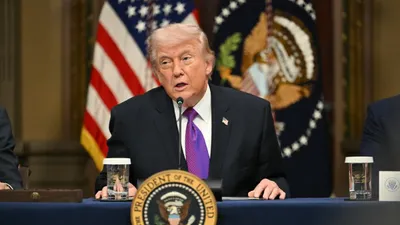
US President Donald Trump has indicated a significant shift in Washington's position on Iran's ballistic missile programme, suggesting that Tehran should not be denied missile capabilities if other countries in the region possess similar weapons.

AI-generated summary, reviewed by editors
His remarks came shortly after the United States and Iran signed a historic peace agreement aimed at ending months of military confrontation in the Middle East. Speaking to reporters in Paris, Trump argued that regional security discussions should be viewed through the lens of balance rather than absolute restrictions.
Trump Calls Missile Restrictions 'Unfair'
While addressing the media, Trump questioned the logic of preventing Iran from maintaining ballistic missiles when neighbouring nations continue to possess them.
"I'm saying that if other countries have them, it's a little bit unfair for them not to have some," Trump told reporters in Paris.
Expanding on the point, he referred to Gulf nations that maintain missile capabilities and suggested Iran's arsenal should be considered in proportion to the broader regional landscape.
"If Saudi Arabia and Qatar, and they all have some, I would say in relative proportion, I think it's okay," said Trump.
The comments have sparked debate as they appear to depart from the tougher position traditionally taken by Washington and its allies regarding Iran's missile programme.
Distinguishing Missiles From Nuclear Weapons
Trump emphasised that ballistic missiles and nuclear weapons should not be treated as the same category of threat.
According to the US President, conventional missile systems do not pose the kind of global risk associated with nuclear arms.
"Missiles aren't the problem... They hurt a little location, but they don't blow up the planet (like nuclear weapons do)," he was quoted as saying by Times of Israel.
Although he appeared open to Iran retaining some missile capabilities, Trump clarified that missile-related concerns would remain part of future negotiations between the two countries.
Israel's Longstanding Concerns Remain
Trump's remarks are likely to draw attention in Israel, where leaders have consistently argued that Iran's missile programme cannot be separated from concerns surrounding its nuclear ambitions and regional influence.
Israeli Prime Minister Benjamin Netanyahu has repeatedly maintained that any lasting agreement with Tehran must address both nuclear development and ballistic missile capabilities.
However, Trump reiterated that the two issues should be viewed differently.
"A ballistic missile is not the same thing as what we're talking about when we talk nuclear," the US President said.
US Military To Stay In Gulf Region
Despite the peace agreement, Trump confirmed that American military forces would continue operating in the Gulf for the foreseeable future.
Trump stated that the US military would remain in the region "for a while" following the signing of the accord.
The peace deal was formally signed by Trump and Iranian President Masoud Pezeshkian in an effort to end nearly four months of conflict that had raised fears of a wider regional war.
The memorandum of understanding was signed during a dinner hosted at the Palace of Versailles by French President Emmanuel Macron, following Trump's participation in the G7 summit.
The agreement is being viewed as a major diplomatic breakthrough, though discussions over Iran's missile programme and broader regional security issues are expected to continue in the months ahead.









 Click it and Unblock the Notifications
 Sign in with Google