


Two quick hangings & more: What makes UPA suddenly decisive?


Has the Congress-led UPA II government decided to go for the slogging as the end of its tenure is nearing? After yet another high-profile hanging, the scenario looks very much so. The Manmohan Singh government, which won its second term in 2009 after putting up a decent show during its first tenure, had been struggling on all fronts.
Plagued by a series of scandals, economic under-performance and indecisiveness in key issues, the government seemed to have run out of steam and speculations were rife that it would not survive its full term.
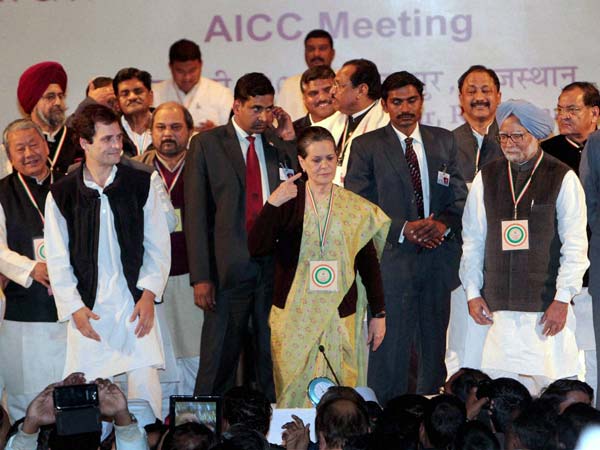
The withdrawal of the second-largest ally from the ruling alliance, the Trinamool Congress (TMC) in September last year, which had reduced the government into a working minority and periodic clashes of views with other allies strengthened the apprehension. Then there was pressure from social activist Anna Hazare and expose by Arvind Kejriwal, whose open attack against the son-in-law of the Gandhi family, the power-centre of the Congress, also indicated at hopelessness. The nadir was perhaps the 'Fleedom at Midnight' in December end, 2011.
But just like the Phoenix, the party came back from nowhere and displayed a renewed vigour to carry out its work in various sectors, irrespective of the potential obstruction and consequences. Whether its economic (FDI and other economic reforms), social (cash-transfer scheme, law against crime against women), political (executing terror convicts, reservation and Lokpal bill) or foreign policy (the recent flare-up with Pakistan) matters, the party has shown a remarkable decisiveness and urgency. Or did India ever see two 'high-profile' terror convicts hanged within three months? Certainly not.
Yes, massive public pressure fuelled by the media for ant-corruption and anti-rape laws or the approaching elections are a reason. But do they adequately explain how a snail-paced administration picked up the momentum? Prime Minister Manmohan Singh was heard saying a few months ago that "We will go down fighting" on the issue of pushing economic reforms. The statement was mocked at in different quarters for very few were convinced by the words of the 'feeble PM'. But perhaps it was something the PM truly meant, second time after his determined show to go forward with the Indo-US nuclear treaty amid all opposition in 2008.
Absence of trouble-making allies
There are some good reasons that could have encouraged the UPA II government to rediscover itself. The very first reason could be the departure of an unwilling ally like the TMC. The exit of the unpredictable Mamata Banerjee undoubtedly gave the UPA government much breathing space, be it in issues like giving entry to foreign direct investment, raising the fuel price or revise railway fares. The Manmohan-Sonia duo had been clearly uncomfortable to find a way amid the chaos of coalition politics and it was causing much harm to the government and the party at the expense of pampering the lesser parties' ego.
Though the UPA leaders gained confidence to do it alone once Banerjee was out of the government, it had also found the confidence to defy Banerjee during the drama that unfolded in New Delhi last year at the time of choosing the alliance's presidential candidate.
Banerjee had done a great favour to the Congress then by adamantly opposing Pranab Mukherjee's candidature and in effect, nullified her political advantage. Mulayam's u-turn had also done the Congress a world of good for not only it succeeded in putting Mukherjee in the Raisina Hills (that made the two quick executions much easier) and also corner Banerjee in national politics.
Counter-strategy to the saffron politics
The second reason is the party's counter-strategy to political opposition, the saffron brigade. The Congress is more concerned in tackling Narendra Modi than the BJP. As far as the latter is concerned, its threat was nullified by two factors: One, the excessive protesting in the Parliament by the BJP over issues like Coalgate, Assam violence or FDI had actually dented its image as a responsible opposition more than the government and secondly, Kejriwal's allegations of corruption against Nitin Gadkari proved to be big setback and put BJP's house in big disorder. The Congress's bigger concern has been Modi, the strong leader who is about to make a national appearance.
Modi's entry into the national politics has also been accompanied by a tendency to revive Hindutva and Union Home Minister Sushilkumar Shinde's recent controversial comment on 'Hindu terror' gave a big platform to the rightist forces to prepare for an assault on the Congress. The party found it an apt time to carry out the execution of Afzal Guru, irrespective of the fact that it would lead to serious consequences.
It can be mentioned here that another terrorist Ajmal Kasab was hanged in November last year, ahead of the Gujarat assembly election polls. Both the moves were undoubtedly aimed at nullifying whatever advantage Hindutva could offer to Modi and the Sangh Parivar. Also, both the executions were carried out just days ahead of the Winter and Budget sessions of the Parliament, respectively. The aim is clear: The UPA wants to take the wind out of the sails of its adversaries.
The Congress still remembers Modi's jibe at it before the 2007 Gujarat polls when he asked Sonia Gandhi to hand over Afzal Guru to Gujarat to hang him if the UPA government could not do it. Modi had taken the radical stand after the Congress tried to attack him over the 2002 riots. The party will also remember how its decision to disband the National Security Group and releasing several militants in Jammu and Kashmir in 2002 marred its prospects against Modi. The party has learnt to meet fire with fire now. Secularism, after all, is the 'turn-coat ideology' for communalism in this country.
It also stressed 'zero toleration' towards terrorism, something that would hijack the rightist forces' voice.
Change towards the Rahul days?
A third reason, and which might look to be the most desirable for the Congress supporters, is the transition of leadership in the Congress. Is the party's timing its decisive steps with Rahul Gandhi's elevation as the vice-president just a coincidence?
One gets a feeling that the party is earnestly trying to come of age through determinism, something a young leadership is generally identified with. If Rahul has to successfully lead the party and future governments led by it, he should establish before the nation that Congress doesn't only reflect a gerontocratic culture marked by lack of direction and agility. The delivery system needs to be brought into action soon. The process has already begin inside the party circles. With the next general elections a year away, the timing could not have been better.



 Click it and Unblock the Notifications
 Sign in with Google