


Trump Governance in 2025: Trade Wars, Alliance Strain and the Price of America First


If 2024 marked Donald Trump's return to the centre of American politics, 2025 became the year he sought to define his legacy.

AI-generated summary, reviewed by editors
The past twelve months unfolded not as routine governance but as a series of high-impact decisions that reshaped US policy at home and recalibrated America's posture abroad.
From sharp executive actions and renewed trade wars to confrontational diplomacy and theatrical political messaging, Trump's second act on the global stage kept allies uneasy, rivals alert and markets volatile. As the year draws to a close, 2025 stands out as a period when power, performance and pressure collided under a presidency that rarely allowed the world to look away.
America First Returns, Loud and Clear
Trump began 2025 by doubling down on the America First agenda that defined his earlier presidency. Within weeks, executive actions prioritised domestic manufacturing, tighter border enforcement and economic nationalism. The administration signalled that global cooperation would no longer drive US decision-making, placing American advantage firmly at the centre of policy.
Allies were urged to adapt to Washington's new tone, while adversaries were warned against testing it. The message was unmistakable and set the rhythm for a year where disruption often preceded diplomacy.
Border Enforcement and a Renewed Migration Hardline
One of the administration's earliest and most controversial moves came on immigration. Emergency powers were invoked, asylum norms were tightened and federal funding was redirected towards enforcement.
Trump framed the shift as a restoration of national sovereignty. Critics described it as a humanitarian rollback. The policy divide once again turned immigration into a defining ideological battleground, not only within the United States but across Western democracies watching Washington's lead.
NATO Faces Pressure Over Defence Spending
Relations with Europe were jolted when Trump publicly questioned America's commitment to NATO unless member states significantly increased defence spending. The rhetoric was direct and deliberately confrontational, triggering concern across European capitals.
Behind the public statements lay a deeper recalibration of US expectations. Europe was pushed to accelerate military investment and reduce its dependence on Washington. While the alliance endured, the sense of strategic comfort that once defined NATO was noticeably diminished.
Ukraine Support, With Conditions Attached
Trump did not withdraw American support for Ukraine, but he reshaped its framework. Military assistance continued, accompanied by demands for negotiations, clearer end goals and greater burden-sharing among allies.
For Kyiv, the policy brought reassurance alongside uncertainty. For Moscow, it suggested a shift in Washington's tone. Internationally, it marked a move away from moral absolutism towards a more transactional approach to geopolitics.
China and the Return of Strategic Trade Conflict
Tensions with China intensified as 2025 saw the revival of tariff threats, technology restrictions and supply chain decoupling. Trump portrayed Beijing not merely as a trade rival but as a long-term civilisational competitor.
Semiconductors, artificial intelligence and rare earth materials emerged as central battlegrounds. Markets reacted nervously, multinational corporations recalibrated strategies and the Asia-Pacific region braced for sustained economic and strategic friction.
Middle East Signals, Hard Power and Diplomacy
In the Middle East, Trump reaffirmed unwavering support for Israel while issuing sharper warnings to Iran. Sanctions were tightened, rhetoric escalated and military signalling became more pronounced.
At the same time, backchannel diplomacy with Gulf states was revived, focusing on energy security, defence cooperation and investment flows. While the region did not stabilise, the administration's priorities and red lines became more clearly defined.
Climate Policy Takes a Step Back
One of the most criticised decisions of the year came with the rollback of key climate commitments. Environmental regulations were eased, fossil fuel projects fast-tracked and international climate pledges questioned.
Trump described the approach as economic realism. Environmental groups warned of long-term damage. Globally, the shift reinforced the perception of a divided world, with the United States stepping away from a leadership role in climate action.
Global Institutions Under Renewed Scrutiny
Trump also reignited his criticism of multilateral institutions. The United Nations, World Health Organization and World Trade Organization faced funding threats and public rebukes over alleged inefficiency and bias.
For the administration, national sovereignty outweighed multilateral consensus. For the international community, the stance contributed to weaker coordination at a time of overlapping global crises.
Economic Nationalism at Home
Domestically, Trump pushed aggressive tax incentives to boost American manufacturing while warning companies against shifting jobs overseas. Wall Street responded cautiously, while blue-collar voters largely welcomed the approach.
The strategy strengthened Trump's political base, even as economists raised concerns over inflationary pressures and potential retaliation from trade partners.
Governing Through Spectacle
Perhaps the most defining feature of Trump's 2025 presidency was not a single policy but the method itself. Press briefings became events, social media functioned as statecraft and negotiations were often conducted in full public view.
Threats were issued openly, rivals were named directly and diplomacy unfolded as much through perception as power. The result was a presidency that kept both allies and adversaries constantly reacting.
The Trump Doctrine at Year's End
As 2025 concludes, one reality is clear. Donald Trump did not merely govern America this year, he reshaped the global conversation. Supporters see decisiveness, strength and national pride. Critics point to volatility, confrontation and uncertainty.
Yet whether admired or opposed, Trump remained impossible to ignore. As the world moves into 2026, global politics under his leadership shows no sign of becoming quieter or more predictable. It is assertive, transactional and unmistakably shaped by Donald Trump.
-
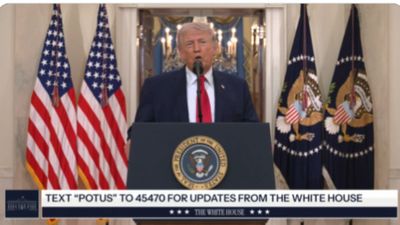 Trump Addresses Nation Amid Iran War, Targets Obama Nuclear Deal, Justifies ‘Operation Epic Fury' , Watch
 -
 Trump's Address To Nation: Key Pointers From US President's Speech
 -
 ‘Go Get Your Own Oil’: Trump Slams Nations Hit By Hormuz Fuel Crisis For Refusing To Back Iran Strikes
 -
 Trump Warns Iran Of Possible Attacks On Energy Sites Amid Israel-Hezbollah Conflict
 -
 Trump Says Iran Is ‘Incapable’ Of Building Nuclear Weapon, US Will Be Out ‘Pretty Quickly’
 -
 Trump Signals US Exit from Iran Within Weeks, Shifts Focus from Diplomacy to Military Goals
 -
 ‘Iran Wants Ceasefire’: Donald Trump Threatens To Send Tehran ‘Back To The Stone Age’
 -
 Iran-US War: Donald Trump’s Missteps And The NATO Paradox
 -
 Gold Rate Today 31 March 2026: Latest IBJA Benchmark And Tanishq, Kalyan, Malabar, Joyalukkas Rates
 -
 Hyderabad Gold Silver Rate Today, 31 March 2026: Gold And Silver See Fresh Movement, Check Latest City Rates
 -
 Gold Silver Rate Today, 31 March 2026: City-Wise Prices, MCX Trend As Gold Rises And Silver Slips
 -
 Thunderstorm Warning In Delhi NCR: IMD Issues Orange Alert Amid Sudden Weather Shift



 Click it and Unblock the Notifications
 Sign in with Google