


PM Modi Is My Good Friend, Trade Deal With India Soon: Donald Trump


United States President Donald Trump voiced optimism about a future trade agreement with India, even as Washington announced new duties over alleged forced labour in supply chains. Trump praised Prime Minister Narendra Modi, while separate USTR measures set higher tariffs on many economies, including India, under Section 301 of the US Trade Act of 1974.
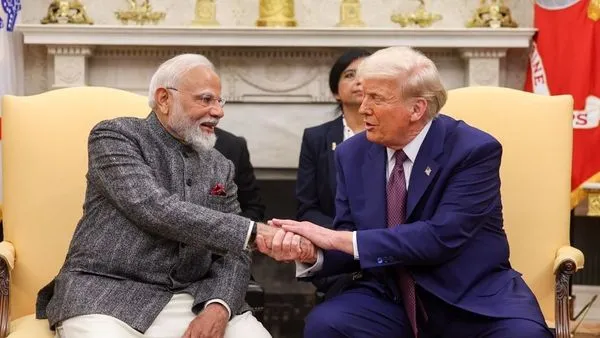
Speaking to reporters at the White House, Trump said on Thursday, "For years, India took advantage of the United States... They charged us tremendous tariffs and paid nothing... Now it is the exact reverse and we are making a lot of money with India. But we will get to a deal because I like your Prime Minister (Narendra Modi) a lot; he is a good friend of mine, and we get along well. We have a good relationship."
AI-generated summary, reviewed by editors
Forced labour tariffs and global trade measures
On Tuesday, the United States announced extra tariffs linked to concerns over forced labour in production chains. Washington said investigations showed goods from 60 countries were made using forced labour. The Office of the United States Trade Representative (USTR) responded with new forced labour tariffs targeting a wide group of economies.
The USTR stated that 54 economies, including India, had not, in its view, imposed and enforced effective bans on importing products made with forced labour. The list covered Australia, China, Israel, Japan, Qatar and Russia. It also mentioned Saudi Arabia, Singapore, South Korea, Sri Lanka, Switzerland, Taiwan, Thailand, Turkiye, the UAE and the United Kingdom.

Forced labour tariffs, rates and affected economies
According to the USTR, economies that already maintain some form of import restriction on forced labour goods, or have promised such rules in trade agreements, could face an extra tariff of 10 per cent. Other economies without such frameworks may instead face an additional duty of 12.5 per cent on their exports to the United States.
The main tariff structure for the forced labour tariffs was described as follows.
| Category | Criteria | Additional US tariff |
|---|---|---|
| Group A | Economies with some forced labour import prohibition or related trade commitments | 10 per cent |
| Group B | Economies without such measures in place | 12.5 per cent |
Forced labour tariffs under Section 301 framework
The proposed action also included a textile mechanism. This would allow a set quantity of apparel and textile imports from some economies to enter the United States at a reduced Section 301 tariff rate. The measure aimed to adjust costs while still applying pressure over alleged forced labour practices.

The USTR said the move fell under Section 301 of the Trade Act of 1974. This law permits action against the acts, policies and practices of over 60 economies when these are judged harmful to US commerce. The office described the failure to impose and prohibit goods produced with forced labour as "unreasonable" and a burden on United States trade interests.
In a further step, the USTR identified six economies for what it called a failure to effectively enforce bans on importing products made with forced labour. Those flagged included the European Union, Pakistan and Canada. These designations came alongside the wider list of 54 economies, where India appeared even as Trump stressed a positive relationship with Narendra Modi and confidence about a future trade deal.
With inputs from ANI



 Click it and Unblock the Notifications
 Sign in with Google