New Delhi, July 22: ISRO launched Chandrayaan-2 mission to the moon at sharp 2.43 pm on Monday. The GSLV-Mk-3 blasted off from Satish Dhawan Space Station in Sriharikota with 3,290 kilograms payload. ISRO chief K Sivan announced that spacecraft which consists of orbitor, Vikram and Pragyan has been sucessfully placed in designated orbit.
This is the most technically complex mission undertaken ever by ISRO. Of course Gaganyaan, which would be far more complex will follow in 2022, but for now Chandrayaan-2 is the most complex ISRO mission till date.
Image - DD/Twitter
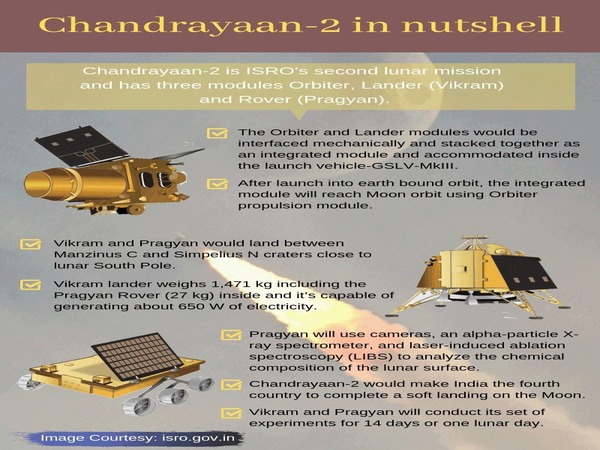
illed as the most complex mission undertaken by the ISRO, Chandrayaan-2 will make India the fourth country to soft land a rover on the lunar surface after Russia, the United States and China.
Stay tuned with us for all the LIVE updates relating to the launch:
Jul 22, 2019, 5:13 PM IST
About 16.20 minutes after the lift-off, the GSLV rocket placed Chandrayaan-2 into 170 km x 39059 kms Earth orbit. From here onwards, the mission will undergo a series of manoeuvres by scientists to carry out different phases of the mission over the next 48 days. Subsequent to the rescheduling of the launch, the space agency has tweaked the orbital phases, increasing Earth-bound phase to 23 days as against 17 days planned originally. At the end of the Earth-bound phase, the orbit of the spacecraft will be finally raised to over 1.05 lakh km before nudging it into the Lunar Transfer Trajectory taking it to the proximity of Moon in the next two days. Then gradually over the next few days it will be brought to 100 X 100 km circular orbit when the lander will separate and after another few days of orbiting it will make a soft landing at a chosen place on the Lunar surface. The soft landing of the lander - Vikram carrying rover 'Pragyan', one of the toughest phases of the mission and described by the ISRO chief as "15 minutes of terror (filled moments), would be attempted between September 6-8.
Jul 22, 2019, 4:57 PM IST
Scientists led by ISRO chief K Sivan watched the launch sequence in rapt attention and broke into applause after every key stage of the rocket's flight which progressed precisely as programmed. A visibly relieved Sivan, who announced the success of the mission, said "it is the beginning of a historical journey of India towards the moon." "We bounced back in flying colours after the earlier technical snag," he said about the glitch that made the space agency reschedule the Chandrayaan-2 launch from July 15 to Monday. There will be 15 "very crucial manouvres" in the next one and half months before the satellite is brought around the moon, he said in his post-launch address from mission control centre. "After that the D-Day will come and on that day we are going to experience 15 minutes of terror, to ensure the landing is safely near the South Pole," he added.
Jul 22, 2019, 4:55 PM IST
Andhra Pradesh Chief Minister YS Jagan Mohan Reddy has congratulated the ISRO team for the successful launch of Chandarayaan- 2 which, he says, is a giant leap in space technology. The successful launch places our country in the orbit of Moon Mission odyssey and ISRO has scripted history with this fluent take-off.
Jul 22, 2019, 4:27 PM IST
PM Modi watching Chandrayaan-2 launch.
Jul 22, 2019, 4:08 PM IST
PM Modi:
#Chandrayaan2 is unique because it will explore and perform studies on the south pole region of lunar terrain which is not explored and sampled by any past mission.
This mission will offer new knowledge about the Moon.
"Efforts such as #Chandrayaan2 will further encourage our bright youngsters towards science, top quality research and innovation.
Thanks to Chandrayaan, India’s Lunar Programme will get a substantial boost. Our existing knowledge of the Moon will be significantly enhanced," tweets PM Modi.
110 replies 574 retweets 2,433 likes
Jul 22, 2019, 3:52 PM IST
I am extremely happy to announce that the GSLVMkIII-M1 successfully injected Chandrayaan2 spacecraft into Earth Orbit. It is the beginning of a historic journey of India towards moon and to land at a place near South Pole to carry out scientific experiments," Dr Sivan said.
Jul 22, 2019, 3:11 PM IST
Task is not over. Next challenge is to land the lander Vikram on moon surface, he says.
Jul 22, 2019, 3:10 PM IST
K Sivan congratulates all teams that worked on the mission.
Jul 22, 2019, 3:07 PM IST
Sivan lauds scientists who fixed the glitch due to which July 15 glitch was fixed. He says, the glitch was fixed in 24 hours.
Jul 22, 2019, 3:06 PM IST
ISRO control room erupted with claps when signal from satellite was received.
Jul 22, 2019, 3:05 PM IST
GSLV-Mk-3 has placed the satellite in Geosynchronous Transfer Orbit successfully, says ISRO chief K Sivan.
Jul 22, 2019, 3:03 PM IST
ISRO receives signal from satellite. This confirms sucessfully into the orbit.
Jul 22, 2019, 3:01 PM IST
Chandrayaan-2 Launch LIVE: GSLV-Mk-3 blasts-off from Sriharikota, spacecraft separates from launch vehicle
Jul 22, 2019, 2:59 PM IST
Less than a minute left for satellite injection.
Jul 22, 2019, 2:58 PM IST
Launch normal and GSLV-Mk-3 over 3000 kms away from earth.
Jul 22, 2019, 2:57 PM IST
Weighing about 3,850 kg, Chandrayaan 2 is a three-in-one integrated spacecraft. Several state-of-art indigenous systems were conceived and realised in the areas of navigation, guidance, control, onboard autonomy, precision sensors, and intricate communication links involving orbiter, lander, rover, and ground systems for this mission.
The 43.43m tall three-stage rocket dubbed 'Baahubali' for its ability to carry heavy payloads would blast-off carrying Chandrayaan-2 and inject the spacecraft into Earth orbit about 16 minutes later.
READ MORE
Jul 22, 2019, 6:15 am IST
ISRO Chairman K Sivan said all preparations were on and the glitch had been rectified.
Jul 22, 2019, 6:27 am IST
"Chandrayaan 2 is ready to take a billion dreams to the Moon now stronger than ever before! Join us for the launch on Monday 22 July, 2019 at 2:43 PM IST," ISRO had tweeted on July 18 while announcing the rescheduled launch. On the eve of launch,
Jul 22, 2019, 6:36 am IST
A 20-hour countdown for the launch began at 6.43 pm Sunday, ISRO announced. Chandrayaan-2 comes 11 years after ISRO's successful first lunar mission Chandrayaan-1 which scripted history by making more than 3,400 orbits around the Moon and was operational for 312 days till August 29, 2009.
Jul 22, 2019, 6:47 am IST
The Indian Space Research Organisation (ISRO) scientists, who aborted the previous launch with 56 minutes left for the countdown to end on July 15, have taken quick remedial action based on an analysis carried out by a team set up to look into the snag and announced the rescheduled launch three days ago.
Jul 22, 2019, 6:57 am IST
The Rs 978 crore mission, which has been rescheduled for Monday after scientists corrected the glitch in the rocket, will be launched at 2.43 p.m from the second launchpad at Satish Dhawan Space Centre here, over 100 km from Chennai.
Jul 22, 2019, 7:06 am IST
The mission launch, described as the most complex and prestigious undertaken since ISRO's inception, was called off due to a technical snag less than an hour before blast-off early Monday due to technical problems.
Jul 22, 2019, 7:17 am IST
The Chandrayaan-2 mission aims to deliver a rover to an elevated plane close to the uncharted lunar South Pole on September 6 or 7 and investigate the surface for signs of water and potentially new sources of abundant energy. It's one step in an envisioned progression that includes putting a space station in orbit and - eventually - landing a crew on the moon.
Jul 22, 2019, 7:27 am IST
Chandrayaan-2 will take 54 days to accomplish the task of landing on the Moon through meticulously planned orbital phases.
Jul 22, 2019, 7:39 am IST
Announcing fresh date, ISRO tweeted: "Chandrayaan-2 launch, which was called off due to a technical snag on July 15, 2019, is now rescheduled at 2:43 pm IST on Monday, July 22, 2019."
Jul 22, 2019, 7:48 am IST
Chandrayaan-2, which will be launched on-board the most powerful Geostationary Launch Vehicle GSLV-Mk-III dubbed 'Baahubali, is ready "to take a billion dreams to the Moon", the Indian Space Research Organisation said on Twitter.
Jul 22, 2019, 8:37 am IST
Space missions are very complex. A lot of systems and processes have to work precisely in a coordinated manner for a mission to be successful. There is absolutely no room for any error no matter how insignificant it may seem. Extensive checks and inspections are done as one small failure can result in a disaster, in fact it was due to such a mechanism that glitch could be detected before Chandrayaan-2's July 15th launch.
Jul 22, 2019, 8:40 am IST
Chandrayaan 2 is an advanced version of the previous Chandrayaan 1 mission successfully launched about 10 years ago.
Jul 22, 2019, 8:43 am IST
Chanddrayaan-2 and Gaganyaan would give ISRO a much required impetus in the highly competitive satellite launch market which is expanding into a multi-billion industry.
Jul 22, 2019, 8:45 am IST
Filling of N204 for the liquid core stage (L110) of #GSLVMkIII-M1 completed today (22.07.2019) at 0240 hrs IST, tweets ISRO.
Jul 22, 2019, 9:10 am IST
Chandrayaan-2 mission, if executed perfectly, will establish India's capability to safely land on the moon and operate a rover on the lunar surface for the first time. The next step is Gaganyaan.
Jul 22, 2019, 9:17 am IST
On July 15 between 1.50 am to 2 am, speculations that the launch could be called-off began making rounds much before the official announcement from the ISRO came as the reverse countdown clock was stopped exactly when 56 mins and 24 seconds remained for the take-off. The countdown clock read 56:24 when it was stopped.
Jul 22, 2019, 9:24 am IST
Among many of the objectives of Chandrayaan-2, what has time and again cropped up is about Helium-3 (He-3) exploration. Helium-3, many opine, could be the fuel of the future. HE-3 is hardly available on Earth but abundant on the moon. He-3 is considered a clean source of energy, unlike fossile fuels. This isotope of Helium can theoretically meet global energy demands for three to five centuries. There are approximately 1 million metric tons of Helium-3 embedded in the moon, according to a report. India's official stand on Helium-3 is that exploring it or mining the isotope is "outside the scope of the current Moon mission".
Jul 22, 2019, 9:30 am IST
Yesterday, ISRO Chairman K Sivan said all preparations were on and the glitch had been rectified. "Whatever technical snag we observed on July 15 has been rectified. The vehicle is in good health... The (pre-launch) rehearsal has been successfully completed," he told reporters at the Chennai airport on brief a stopover enroute here.
Jul 22, 2019, 9:31 am IST
ISRO encountered the snag on July 15 when the liquid propellant was being loaded into the rocket's indigenous cryogenic upper stage engine. Veteran scientists heaped praise on ISRO for calling off the launch rather hurrying into a major disaster.
Jul 22, 2019, 9:34 am IST
Chandrayaan-2 has three modules namely Orbiter, Lander (Vikram) and Rover (Pragyan). Orbiter and Lander modules will be stacked together as an one entity inside the launch vehicle GSLV MK-III.
Jul 22, 2019, 10:07 am IST
ISRO tweet:
Less than five hours for the launch !!! Filling of Liquid Oxygen for the Cryogenic Stage(C25) of #GSLVMkIII-M1 commenced#Chandrayaan2#ISRO
Previous mission, Chandarayaan-1 did not involve landing on moon, the main objective of that mission was to produce a complete map of moon's chemical characteristics and three-dimensional topography.
Jul 22, 2019, 10:46 am IST
ISRO aims to study the extent of water molecule distribution on the lunar surface. There is a possibility of the presence of water in permanently shadowed areas around the south pole. The region has craters that are cold traps and contain a fossil record of the early solar system. Chandrayaan 2 aims to extensively map the lunar surface to study variations in lunar surface composition to trace back the origin and evolution of the Moon. In addition, the South Pole region has craters that are cold traps and contain a fossil record of the early solar system.
Jul 22, 2019, 11:57 am IST
Filling of Liquid Hydrogen for the Cryogenic Stage(C25) of #GSLVMkIII-M1 commenced, tweets ISRO.
Jul 22, 2019, 12:37 pm IST
The original launch date was 2.51 am on July 15, but it had to be called off 56.24 minutes before the scheduled launch time due to a glitch. It is commendable that the glitch was noticed before the launch and what could have resulted in a major embarassment was averted. One small failure can result in a disaster. Mission failure means crores of rupees down the drain, hard work of scientists wasted and a permanent damage to the reputation of ISRO.
Jul 22, 2019, 12:38 pm IST
Scientists had detected a fault in a fuel connecting joint in the GSLV-MK III rocket on July 15, because of which the launch was called-off. ISRO rectified the issue and announced that Chandrayaan-2 would be launched on July 22, and also successfully completed the launch rehearsal. It was also announced that there won't be any change in the planned landing date of the mission on the Moon.
Jul 22, 2019, 1:15 pm IST
ISRO's latest tweet:
#ISRO#Chandrayaan2 As our journey begins, do you know what is the distance of Moon from Earth? The average distance is 3, 84, 000 km, Vikram lander will land on Moon on the 48th day of the mission, which begins today. Here's different view of #GSLVMkIII-M1 pic.twitter.com/4LFEmT2xxZ
"Two hours to go !!! Filling of Liquid Oxygen in Cryogenic Stage(C25) of #GSLVMkIII-M1 completed and Filling of Liquid Hydrogen is in progress," ISRO tweets.
Jul 22, 2019, 1:18 pm IST
Chandrayaan-1 vs Chandrayaan-2: The net weight of the spacecraft which was carried by PSLV (Polar Satellite Launch Vehicle) for Chandrayaan-1 on October 22, 2008, was 1380 kgs. The Chandrayaan-2 spacecraft weighs approximately 3290 kilograms and it would launched by the Geosynchronous Satellite Launch Vehicle Mk-III (or GSLV Mk) rocket.
Jul 22, 2019, 1:39 pm IST
Chandrayaan-1 vs Chandrayaan-2: Chandarayan-1, involved surveying the lunar surface to produce a complete map of its chemical characteristics and three-dimensional topography. Chandrayaan-1 was in operation for 312 days. Chandrayaan-2, equipped with a lander and rover, will observe the lunar surface and send back data which will be useful for analysis of the lunar soil. The lander will carry instruments like a seismometer and a thermal probe, and the rover will carry spectrometers to analyse the lunar soil. The lander and rover have nominal lifetimes of one lunar daytime (14 Earth days).
READ MORE
What went wrong with the Chandrayaan-2 launch:
A leak of helium gas from a bottle in the cryogenic upper stage of the rocket was the villain of the piece on July 15.
The leak forced the Indian Space Research Organisation (ISRO) to cancel the launch of its Geo-synchronous Satellite Launch Vehicle-Mark III (GSLV-Mk III). It was a prestigious mission for ISRO because it involved putting the spacecraft Chandrayaan-2, with the lander, called Vikram, and a rover, named Pragyan, into an orbit around the moon.
Cost of the mission:
The cost of Chandrayaan-2 mission is Rs 978 crore, including Rs 603 crore for the orbiter, lander, rover, navigation and ground support network and Rs 375 crore for the heavy rocket -- Geo-stationary Satellite Launch Vehicle with an indigenous cryogenic engine
Where did Chandrayaan-1 leave us?
Chandrayaan-1 was India's first mission to the Moon and lasted for 312 days before the Indian Space Research Organisation (ISRO) lost contact with it. The National Aeronautical and Space Administration (NASA) found it in 2017 still orbiting the Moon.
Chandrayaan-1 detected water molecules on the surface of the Moon in its maiden mission.
Chandrayaan-2 is aimed at sampling the water as well as other minerals, Nayak added.
According to mission scientists, global interest in India's low-cost Moon mission is peaking.
In 2014, ISRO successfully put a satellite into orbit around Mars, becoming only the fourth nation to do so. In 2017, India created history by successfully launching 104 satellites on a single mission, overtaking the previous record of 37 satellites launched by Russia.
If Chandrayaan 2 is successfully placed in the lunar orbit and its components fulfill the objectives then it would not only help us understand the Moon better but also create background knowledge to transform it into a staging area. From here, future human missions to explore far-off planetary bodies can be launched.





 Click it and Unblock the Notifications
 Sign in with Google