


Azadi Ka Amrit Mahotsav: Remembering Acharya Prafulla Chandra Ray


New Delhi, Aug 04: History has largely neglected the contributions of scientists towards the freedom struggle. As India celebrates Azadi Ka Amrit Mahotsav to make 75 years of Independence, it is time to acknowledge and honour those scientists who contributed to the Indian freedom movement, yet are anonymous to the masses today.
Prafulla Chandra Ray, known as the father of Indian Chemistry, was a popular figure in science but only a handful have heard about his contribution towards India's Independence.
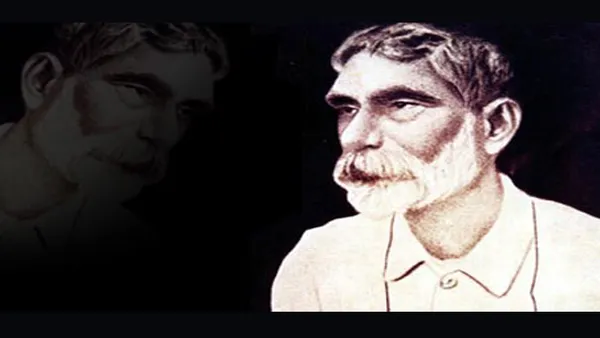
He instilled patriotism in his students with the clarion call "science can wait, swaraj cannot".
A staunch nationalist, Ray had helped Indian revolutionaries by providing them food and shelter at his factories and also in making explosives.
He was described by the British as a "Revolutionary in the garb of a Scientist" and following his death, many revolutionaries mentioned his support and help in manufacturing explosives.
Though he could not directly take part in the freedom movement, he gave all his support to the Indian National Congress during the Non-Cooperation Movement.
Congress leaders including Mahatma Gandhi were regularly in touch with him. He had a particularly close association with Gandhiji and Gokhale, and invited the former to Kolkata.
Born on 2 August 1861, he was a Bengali industrialist, historians, philanthropist and chemist.
Prafulla Chandra Ray was born in Raruli-Katipara village (present-day in Bangladesh). His father Harish Chandra Raychowdhury was a zamindar while his mother Bhubanmohini was the daughter of a local taluqdar.
Prafulla Chandra was the third among the seven siblings. His great-grandfather was a Diwan under the British East India Company.
During his initial days, Prafulla Chandra Ray received his elementary education from the Krishnagar Government College. He gained deep knowledge in Persian, English, and Sanskrit.
While Prafulla Chandra Ray was in his fourth standard, he suffered from dysentery which compelled him to stop going to school and go back to his ancestral home. However, Ray always considered this as a golden opportunity and went on to study biographies, articles, English, greek, Sanskrit, and many other languages.
Later Ray went on to pursue First Arts student at Vidyasagar College (then Metropolitan institution), during those days Chemistry was one of the important subjects in FA. But with no teaching facility of science subject in the Metropolitan College, Ray went on to study physics and chemistry as an external student in the Presidency College.
Eventually, he started taking interest in Chemistry. He later decided to make his career by pursuing Chemistry as the mainstream subject. While Ray was still studying for his BA examination, he applied for the Gilchrist Prize Scholarship.
In the year 1882, he went to the United Kingdom to study at the University of Edinburg. There he studies chemistry under Alexandar Crum Brown and his former student John Gibson. While his mentor Alexendar Crum Brown was interested in organic chemistry, Ray was inclined towards inorganic chemistry. Ray was awarded the degree of D. Sc in 1887.
In 1888, Ray returned to Kolkata and taught Chemistry as an Assistant Professor at the Presidency College. He also established a research laboratory where he worked with some of his dedicated students. It was in the year 1892 when he established the Bengal Chemical Work with the net capital of 700 INR.
Till 1896, he researched about the discovery of stable compound mercurous nitrite while working on nitrite and hyponitrite compounds. In 1901, his Bengal Chemical Work company became Bengal Chemical and Pharmaceutical Works Ltd (BCPW) which is India's first pharmaceutical company.
Presently, this company is one of the leading manufacturers and producers of medicines.
Prafulla Chandra Ray also researched the organic compounds containing double salt, sulphur, homomorphism and fluorination.
The book 'History of Hindu Chemistry' comprises of some of the noteworthy works of Prafulla Chandra Ray. 12. In 1920, he was elected as the President of the Indian Science Congress. 13. He died on 16 June 1944. He was 82 years old.



 Click it and Unblock the Notifications
 Sign in with Google