


'USA, S Korea can't afford to ignore N Korea's threat'


The US, a strategic ally of South Korea since the Korean War days, is concerned at the developments after the latest nuclear test. It had been carrying out joint army and naval exercises near the DMZ with its South Korean ally. North Korea possesses some crude nuclear bombs and has successfully tested Musudan-1 medium range missile with a range of 4000 km.
Moreover, a series of North Korean actions like announcing the entry of North Korea into a state of war with South Korea, plan to restart Yongbayong nuclear reactor, moving of medium range missiles to the eastern coast, continuous broadcasting of military rhetoric, suspending the operations of joint Korean Kaesong industrial zone and instruction to the military to be ready for war are all indications of preparations for war.
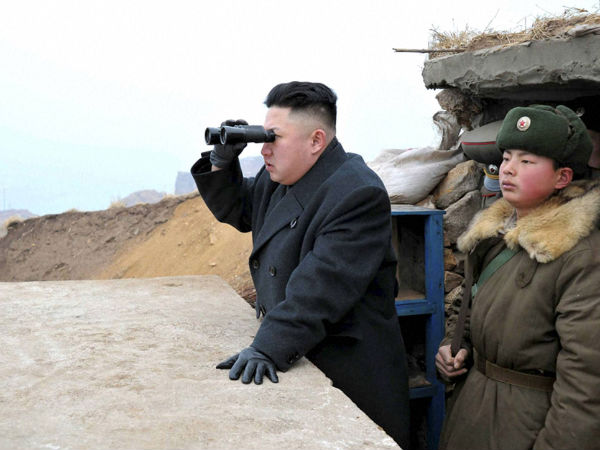
So the US and South Korea cannot afford to ignore Kim Jong-un's threat as bluster because he could act impetuously in true Kim family tradition. In order to discourage any such adventurism the US flew two B2 stealth bomber sorties over South Korea in a show of force. It has also moved F22 fighters and missile defence systems, naval ships and troops into the region. U.S. missile and missile defence systems in Japan as well as in Guam were also placed on alert.
Due to the strategic alignment of China and North Korea on one side and South Korea, Japan and the US on the other, any conflict initiated by North Korea has every possibility of enlarging into a much bigger conflict particularly if North Korea uses nuclear weapons.
It would definitely affect China's core interest of maintaining harmony in its strategic neighbourhood. It can also complicate the China-US relations already under strain ever since China started asserting its territorial claims in South China Sea. So probably there is an unstated strategic convergence between China and the US in not wanting to allow North Korea to trigger a war at a time of not their choosing.
To sum up, North Korean threats and actions have an element of imminence to become a reality. However, Pyongyang's shrill rhetoric on state TV also has a surreal quality as media reports indicate normal life continuing even as threats are reeled out. Seoul continues to maintain equanimity perhaps because like the US it does not want to exacerbate the charged situation, while keeping its powder dry.
Potential impact of conflict on Indian interests
South Korea can be considered as one of the success stories of India's look east policy. India's economic relations with South Korea have been growing rapidly since 2006. It has become multi-faceted now, buoyed by the signing of the Comprehensive Economic Partnership Agreement (CEPA) in January 2010. India-Korea trade now around $ 20 billion is expected to reach $ 40 billion by 2015.
South Korea has also emerged as an important investor in India. It has a healthy share of around 20 percent in Indian automobile industry while most of the Indian IT majors and some of the major industrial houses like Tatas are operating in South Korea.
Growing strategic convergence between India and the US has inevitably brought South Korea also closer to India. Beijing's strong strategic relations with Pakistan and North Korea's transfer of nuclear technology to it have given India a natural convergence of security interest with Seoul. These interests were formalised when India and South Korea signed a Memorandum of Understanding (MoU) on Defence Logistics and Supplies in the year 2005. In May 2007, Indian and South Korean defence ministers met for the first time to discuss "matters of mutual interest" and agreed to strengthen cooperation on training of armed forces personnel.
Both countries decided to raise the level of their strategic partnership during the visit of South Korean President Lee Myung-bak to New Delhi in January 2010. His joint declaration with Indian Prime Minister Dr. Manmohan Singh focused on strategic interests and security cooperation between the two countries.
Indian defence minister AK Antony visited South Korea a few months later to sign two MoUs with his Korean counterpart on experience and information sharing on defence matters and on futuristic joint defence technology development. The visit of Prime Minister Dr Manmohan Singh to Seoul in 2012 and the proposed visit of South Korea's newly elected President Park Geun-hye to India are likely to bring the two nations closer.
Considering the growing economic and strategic dimensions of India-South Korea relations, any war involving South Korea would be a matter of serious concern for India. While India may not be directly involved in the conflict, it is likely to use its influence to help out South Korea and contribute to any international initiative to bring back peace in the Korean peninsula.
(Col R Hariharan, a retired Military Intelligence specialist on South Asia and its neighbourhood is associated with the Chennai Centre for China Studies and the South Asia Analysis Group. E-Mail: [email protected] Blog: www.colhariharan.org)



 Click it and Unblock the Notifications
 Sign in with Google