


Pardon to Sanjay Dutt: When Swamy & Katju took on each other


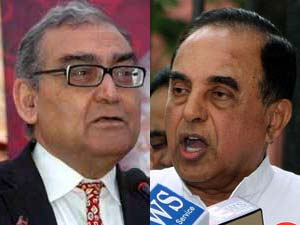
The Supreme Court upheld Dutt's conviction under the Arms Act for possessing and destroying an AK-56 rifle before the 1993 Mumbai blasts.
Swamy said the apex court had clearly said that the only ground on which a pardon plea could be considered is that of public good. He cited the court's landmark judgment of 2006 (in Sudhakar versus the state of Andhra Pradesh case) to substantiate his view.
Swamy said "public welfare" is a vital consideration to grant pardon and there were parameters that needed to be followed but they didn't apply to Dutt's case. He said Dutt had received the "lightest sentence" while that of Zaibunisa Kazi was tougher.
Both Dutt and Kazi received five years of rigorous imprisonment but while the former was convicted under the Arms Act, the latter was convicted under the anti-terror law. Swamy said the issue of pardon was not unfettered and was subject to judicial review.
Katju, who was also on air, said in case of Dutt's case, the Supreme Court had said that he was not involved in blasts and though he had a prohibited weapon, it was meant for his personal safety. He said the actor hence could be granted a pardon on "humanitarian grounds". Katju, the chief of the Press Council of India, said the humanitarian element comes into play while granting pardon and there are no strict norms or rules for this.
Katju said he would also appeal for the pardon of Kazi.
Swamy retaliated at this, saying there was hardly any possibility of enhancing public welfare in Dutt's case, which would make the apex court grant him pardon. He added that the judiciary has been extraordinarily lenient towards Dutt so far. Swamy had said many a times in the past that Dutt was associated with criminals who had been linked to the 1993 blasts.
Katju begged to differ. He said humanitarian consideration was fully justified in Dutt's case. He said the actor wasn't getting away scott-free and had already served 18 months in jail and struggled to restore his film career. He said Dutt was ostracised once by the film industry and even for going abroad, he required a special permission.
Meanwhile, sources in Dutt's family said the actor would try and complete all his shootings before e surrendering to the court. Dutt had four weeks to surrender, starting March 21.
OneIndia News



 Click it and Unblock the Notifications
 Sign in with Google