


Was Alexei Navalny Killed By A KGB-Style Punch To The Heart? Here's What We Know


It has been five days since the news of the death of Russia's most popular dissident, Alexei Navalny, emerged. However, the cause of his death still remains a mystery. At the time of his passing, it was announced by the Federal Penitentiary Service of the Yamalo-Nenets Autonomous District that Navalny, a convict, felt unwell after a walk in penal colony number 3 on February 16.
He almost immediately lost consciousness, and despite all necessary resuscitation measures being carried out, they did not yield positive results. The doctors of the ambulance pronounced the death of the convict, with the causes of death currently being established.

Following the death of the 47-year-old, rumours and conjectures began swirling regarding what led to Navalny's demise. Now, it is claimed by a human rights activist that Navalny, Vladimir Putin's most vocal critic, was most likely killed with a punch to the heart, a technique often used by KBG operatives, after being exposed to sub-zero temperatures for several hours.
Here's what we know about this new claim.
Theory 1 - A single punch to the heart
- The opinion that Navalny, the Russian opposition leader, was killed by a single punch to the heart, a technique used by the KGB, is held by Vladimir Osechkin, founder of the human rights group Gulagu.net.
- It was stated by Osechkin to The Times that the bruising found on Navalny's body was consistent with the "one-punch" technique that KGB operatives are known to specialize in. He mentioned that it was an old method of the KGB's special forces divisions, where their operatives were trained to kill a man with one punch in the heart, in the centre of the body. According to him, it was a hallmark of the KGB
- It was also mentioned by Osechkin to the British publisher that he had been made aware by a source working at the penal colony of Navalny being forced to spend more than two-and-a-half hours outdoors in open-air solitary confinement space where temperatures could dip to minus 27 degrees Celsius. Osechkin stated, "I think that they first destroyed his body by keeping him out in the cold for a long time and slowing the blood circulation down to a minimum." He further mentioned, "And then it becomes very easy to kill someone, within seconds, if the operative has some experience in this."
- It was further opined by Osechkin that former prisoners, who had served sentences in the penal colonies in the Arctic region, had previously reported inmates being killed by their jailers in this way, as per the First Post report.
No official confirmation of Navalny's death
No official confirmation on Navalny's death has been provided. Osechkin's theory of Navalny's demise is just one of the many that is currently circulating. In fact, when Navalny's mother, Lyudmila, was given a notice of the death, it was stated that 'sudden death syndrome' was the cause of death.
Recommended Video
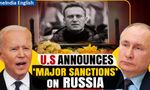
Ivan Zhdanov, who directs Navalny's Anti-Corruption Foundation, stated on Saturday, "When Alexei's lawyer and mother arrived at the colony this morning, they were told that the cause of Navalny's death was sudden death syndrome." For the unaware, 'Sudden death syndrome' is a vague term for different cardiac syndromes that cause sudden cardiac arrest and death.
Theory 2 - Navalny's death is that he died of a blood clot.
Here's the passage rephrased in passive voice:
Accusations of the Kremlin hiding his body to cover up his killing in an Arctic penal colony have also been made by Yulia Navalnaya, widow of Russian opposition leader Alexei Navalny. In a nine-minute video message, it was stated by her that authorities were waiting for traces of "yet another Putin's Novichok" to leave his body - referring to the military nerve agent used to poison him years ago.
As of now, there is no official confirmation regarding the whereabouts of Navalny's body or the cause of his death. On Tuesday, Navalny's family was informed that his body would not be released for two weeks. His mother had been informed that the critic's body was being held for "chemical analysis."
In a video message, Yulia Navalnaya, widow of Russian opposition leader Alexei Navalny, vowed to continue his fight against the Kremlin, while authorities denied his mother access to a morgue where his body is believed to be held after his death last week in an Arctic penal colony.
The Kremlin speaks
On Tuesday, the accusations were referred to as "unfounded and vulgar" by Russian president Vladimir Putin's spokesperson Dmitry Peskov, who also mentioned that due to Navalnaya being widowed just days ago, further comments wouldn't be made.
It was further added by Peskov that the investigation into Navalny's death is ongoing and "vulgar statements" over the Kremlin's responsibility for Navalny's death were slammed.
"It is unacceptable to make such blatantly vulgar remarks in these conditions when there is no information," Peskov was quoted as saying.
World condemns Russia over Navalny's death
Peskov's last statement on "vulgar remarks" was prompted by world leaders who blamed Vladimir Putin and his government for the death of Navalny. It was stated by US president Joe Biden that Washington does not know exactly what happened, "but there is no doubt that the death of Navalny was a consequence of something Putin and his thugs did."
Similar sentiments were voiced by European Union Commission president Ursula von der Leyen, who said Navalny's death showed that "Putin fears nothing more than dissent from his own people." She further called it "a grim reminder of what Putin and his regime are all about," and added it should provide impetus to "unite in our fight to safeguard the freedom and safety of those who dare to stand up against autocracy."
Apart from world leaders expressing their shock and concern, tributes to the fearless critic were paid by people across the globe and his death was commemorated by holding memorials. In Russia itself, spontaneous memorials took place in several urban areas, resulting in the detention of over 400 people.
In the Serbian capital of Belgrade, candles were lit and flowers were laid outside the Russian embassy by hundreds of Russians and others, while in the Georgian capital of Tbilisi, banners were held saying "Putin is the killer" and "We will not forgive" by hundreds gathered.
In Israel too, hundreds rallied outside the Russian Embassy in Tel Aviv, chanting "Russia without Putin!" and "Russia will be free!" Protesters also rallied in Berlin and Paris, as well as the capitals of Latvia, Bulgaria, and Estonia, plus other European cities in crowds.



 Click it and Unblock the Notifications
 Sign in with Google