


Most distant orbiting planet discovered


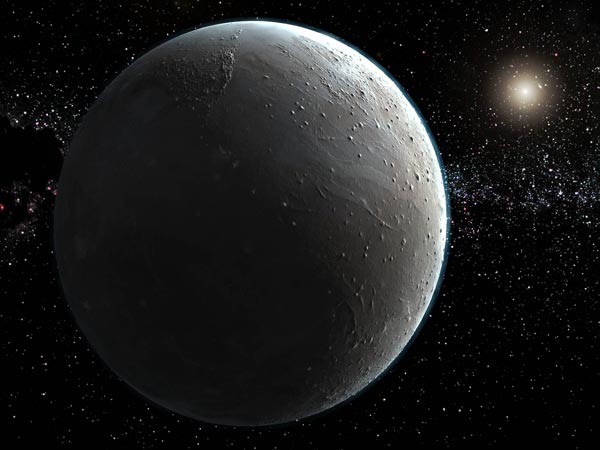
The discovery of the giant planet has puzzled the astronomers, effectively throwing a wrench in planet formation theories.
An international team of astronomers, led by a University of Arizona graduate student, discovered the planet HD 106906 b around a Sun-like star.
"This system is especially fascinating because no model of either planet or star formation fully explains what we see," said Vanessa Bailey, who led the research.
An International team discovered the planet HD 106906 b around a Sun-like star
It is thought that planets close to their stars, like Earth, coalesce from small asteroid-like bodies born in the primordial disk of dust and gas that surrounds a forming star.
However, this process acts too slowly to grow giant planets far from their star, researchers said.
Another proposed mechanism is that giant planets can form from a fast, direct collapse of disk material. However, primordial disks rarely contain enough mass in their outer reaches to allow a planet like HD 106906 b to form.
"A binary star system can be formed when two adjacent clumps of gas collapse more or less independently to form stars, and these stars are close enough to each other to exert a mutual gravitation attraction and bind them together in an orbit," Bailey said.
According to Bailey, the mass ratio of the two stars in a binary system is typically no more than 10-to-1.
"In our case, the mass ratio is more than 100-to-1," she said.
"This extreme mass ratio is not predicted from binary star formation theories - just like planet formation theory predicts that we cannot form planets so far from the host star," Bailey said.
This system is also of particular interest because researchers can still detect the remnant "debris disk" of material left over from planet and star formation.
At only 13 million years old, this young planet still glows from the residual heat of its formation. Because at about 1,500 degrees Celsius the planet is much cooler than its host star, it emits most of its energy as infrared rather than visible light.
Earth, by comparison, formed 4.5 billion years ago and is thus about 350 times older than HD 106906 b.
The study was published in The Astrophysical Journal Letters.
PTI



 Click it and Unblock the Notifications
 Sign in with Google