


Deadly Ebola virus vaccine in five years: Israeli scientist


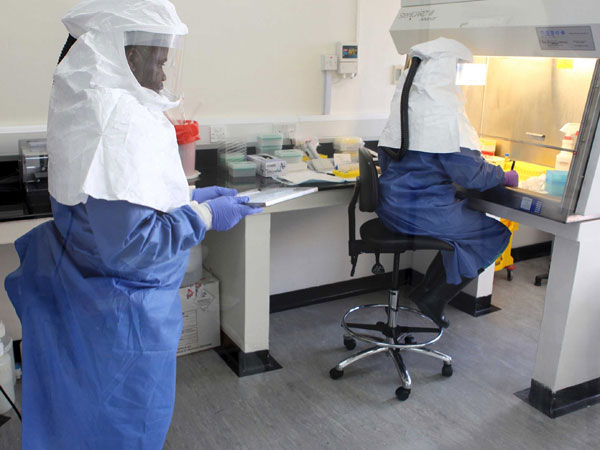
For the past 12 years, Lobel has studied several strains of the deadly virus in his laboratory at the Israeli university, in coordination with the Virus Research Institute in Uganda, where he travels several times a year.
His research focuses on analysing survivors and studying how their bodies become immune to the disease thanks to human monoclonal antibodies that have neutralised the virus and could serve to develop a long-awaited vaccine.
"In the last four years we have gathered a host of human antibodies that can neutralise the Ebola and Marburg haemorrhaegic fever viruses," he told EFE news agency.
His team, which has isolated antibodies from survivors, expects an effective "global vaccine" to be available within approximately five years for different strains of the virus.
Although the World Health Organisation (WHO) hopes that a vaccine to contain the spread of the current epidemic could be ready in early 2015 for use in Africa, the scientist believes the announcement is quite rash.
"We cannot produce cures in that accelerated manner. It is simply not realistic, no matter how much money is invested," he argues.
The US Army currently has an active vaccine available, but Lobel's goal is to create anti-bodies from components produced by the human immune system, which would make fighting the virus faster and more effective.
Originally from New York and educated at Columbia University, the Ebola expert, who emigrated to Israel in 2003, is the only academic researcher on the subject outside the US.
He receives financing from institutions such as the US Army, the Pentagon and the European Union and regrets that Israel has not contributed to his research.
In Israel, most of the research is done in pharmaceutical or military laboratories and HIV, responsible for AIDS, has absorbed much of the interest and funds from other viruses, he argues.
"We must be prepared for the future. The world has been blind for 40 years. Our main challenge is to make society understand that infectious diseases are a problem," he adds.
WHO has announced that new vaccines are now being tested at a Swiss laboratory and in Canada and could be given to medical staff in Ebola-stricken countries in January.
The scientist said he became interested in Ebola because it has a mortality rate of 70 percent and "if I develop a vaccine I would be saving lives".
Africa and other equatorial regions are a reservoir for infectious diseases for the next millennium and present a grim scenario for the future, he warns.
Ebola was discovered in 1976 in the Democratic Republic of Congo (then Zaire) and the current outbreak in western Africa has already affected more than 13,000 people and killed more than 5,000 since last March, according to the WHO.
IANS



 Click it and Unblock the Notifications
 Sign in with Google