


Bangladesh Unrest: Student-Led Deadly Protest Kills Over 100 As India, UN Issue Caution | Key Updates


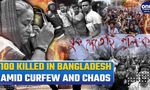
Over 100 people, including 14 policemen, were killed, and hundreds of others were injured during renewed anti-government protests that have swept across Bangladesh over the last three days.
The protests, which began as a student-led movement, have escalated into widespread unrest, with demonstrators demanding the resignation of Prime Minister Sheikh Hasina.

On Sunday, thousands of protesters gathered in various parts of the country, chanting slogans like "down with the autocrat" as they clashed with government supporters. Security forces responded with tear gas and stun grenades to disperse the crowds, leading to one of the deadliest days since the protests began.
The protests first erupted last month after the Bangladesh High Court reinstated a controversial quota system for government jobs, which reserves 30% of positions for families of veterans from the 1971 war of independence from Pakistan.
Recommended Video
The Supreme Court later suspended this order pending a hearing set for August 7, but the students' demands have intensified, leading to widespread unrest.
The situation took a turn for the worse after the students set fire to the country's state broadcaster, a day after Sheikh Hasina appeared on the network, urging calm amid escalating clashes.
As the violence escalated on Sunday, some protesters stormed a police station in the northeastern town of Enayetpur, where sustained gunfire was reported. The demonstrators, reportedly joined by unidentified individuals and right-wing activists from the Islami Shashontantra Andolon, attacked police stations, ruling party offices, and leaders' residences, and burned several vehicles.
The government responded by imposing a nationwide curfew, shutting down mobile internet services, and announcing a three-day general holiday to ensure public safety.
Prime Minister Hasina condemned the protesters, stating that those engaging in "sabotage" were "not students but terrorists" and urged the public to suppress them with a firm hand. She also called for a meeting of the National Committee on Security Affairs, which was attended by the chiefs of the Army, Navy, Air Force, police, RAB, BGB, and other top security officers.
In response to the violence, India advised its nationals to avoid traveling to Bangladesh and urged those already in the country to "exercise extreme caution".
"In view of ongoing developments, Indian nationals are strongly advised against travelling to Bangladesh till further notice...All Indian nationals presently in Bangladesh are advised to exercise extreme caution, restrict their movements and remain in contact with the High Commission of India in Dhaka through their emergency phone numbers 8801958383679, 8801958383680, 8801937400591," the Ministry of External Affairs (MEA) said in a statement.
The United Nations human rights chief Volker Turk also condemned the violence, calling it "shocking" and urging all parties to protect the right to life and the freedom of peaceful assembly and expression.
"With a mass march on Dhaka planned for tomorrow, and the youth wing of the ruling party called up against the protesters, I am deeply worried that there will be further loss of life and wider destruction. I appeal urgently to the political leadership and to the security forces to abide by their obligations to protect the right to life, and the freedom of peaceful assembly and expression," Turk said.
The students' primary demand is the abolition of the quota system that reserves more than half of government jobs for specific groups, including the children of veterans from the 1971 liberation war.
The demonstrations have continued to grow in intensity, reflecting deep-seated frustrations with the current government's policies and leadership.



 Click it and Unblock the Notifications
 Sign in with Google