


Fishermen Save Elephant Calf From Raging Teesta River; Watch Video Here


A newborn elephant calf swept away by the Teesta's strong current was rescued by five fishermen in Jalpaiguri on Monday, after it was separated from its herd during a river crossing near the Apalchand forest area. The rescue ended with the calf being reunited with its mother after forest officials, local residents and the fishermen worked for nearly two hours.
The calf had drifted about 4 km downstream from the point where the herd was crossing the river near the Kathambari range. It was spotted struggling in the swollen water near the 12th spur of the Teesta, close to the Punjab embankment. Its trunk was raised above the surface as it tried to breathe while being pushed further away by the current.
AI-generated summary, reviewed by editors
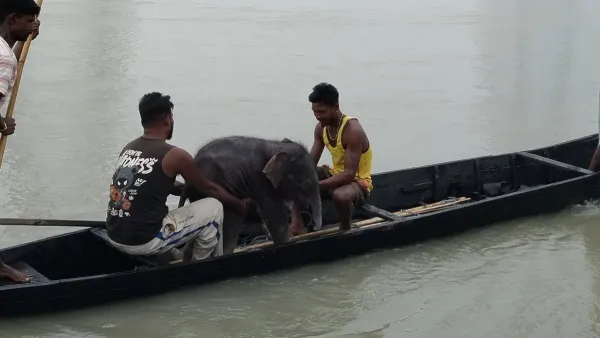
How Jalpaiguri fishermen pulled the elephant calf from the Teesta
The five fishermen, identified as Bablu Das, Mithun Das, Kader Das, Biswanath and Gopal, were on a small row boat when they noticed the calf in distress. They steered towards the animal despite the river being in spate, a move that required quick judgement and considerable risk in fast-moving water.
Such an amazing work. These are heroes.
— Parveen Kaswan, IFS (@ParveenKaswan) September 22, 2026
Yesterday a small calf of 3–4-days was swept away by the Teesta River near Gajoldoba and found several kilometres downstream. While mother was looking after it. See how it was saved by fisherman and united with the help of forest staff. pic.twitter.com/LDxJVERvpn
Three of them jumped into the river as the boat reached the calf. Together, they managed to lift the newborn onto the boat. As the boat turned back towards the bank, the three men swam alongside it, helping push the vessel against the current while the others rowed.
The calf was then handed over to forest personnel, who took it to the Kathambari range office for immediate veterinary attention. Officials had to move quickly because prolonged handling by humans can complicate reunions between elephant calves and their herds, especially when the calf is very young.
Forest teams from the Baikunthapur division began looking for the mother and the rest of the herd soon after the rescue. The calf was later transported across the Gajoldoba Teesta Barrage to a dry stretch of the riverbed, where officials believed the herd had taken shelter after crossing the river.
Reunion with mother after coordinated forest operation
The reunion was achieved after nearly two hours of effort involving foresters, local residents and the fishermen. The mother elephant approached the calf and was later seen nursing it, confirming that the animal had been accepted back. For wildlife teams, that outcome was as important as the rescue itself.
Baikunthapur Divisional Forest Officer Mudit praised the fishermen for acting in time, saying their intervention was crucial to saving the calf and making the reunion possible. Officials also remained cautious during the process to reduce human contact and avoid stressing the herd.
Such reunions can be delicate. Elephant herds are protective, but calves exposed to people for long periods may sometimes face rejection. Forest staff in north Bengal have dealt with similar challenges before. During the floods in the region last October, a calf rescued from the Mechi river was reportedly not accepted back by its herd.
The Jalpaiguri rescue also shows the hazards wild elephants face while moving through riverine forest landscapes in north Bengal. The Teesta and its channels can become dangerous during high water conditions, particularly for calves that lack the strength and balance of adult elephants.
Why river crossings are risky for elephant herds
Elephants in north Bengal frequently move between forest patches, riverbeds, tea garden edges and agricultural land. These movements are part of their normal ranging behaviour, but they often bring herds close to barrages, embankments and settlements. During monsoon or flood-like conditions, familiar routes can suddenly become risky.
Calves are especially vulnerable during river crossings. Adult elephants can withstand stronger currents and use their size to stabilise themselves. A newborn, however, can be swept away quickly if it loses contact with the herd. Once separated, even a short distance can become life-threatening in a swollen river.


 Click it and Unblock the Notifications

 Sign in with Google

