


'MOM' didn't disappoint: Know the glorious past of Indian Space Mission


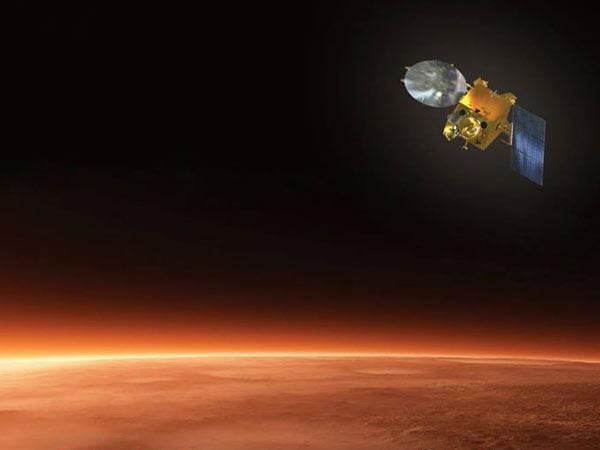
After achieving this milestone, India has placed itself in elite club of Martian explorers with United States, European Space Agency and former Soviet Union. Even big Asian giants China and Japan has not been lucky till now.
This success has surely given a boost to India's global standing in space research.
Mars Orbiter Programme (MOM) programme and it's genesis
- MOM is India's first interplanetary mission to planet Mars with an orbiter craft designed to orbit Mars in an elliptical orbit.
- Aim of the mission is largely to develop technology required for design, planning, management, and operations of an interplanetary mission
- Before reaching to Martian orbit on Wednesday, it remained dormant for 10 months.
- It was launched into Earth orbit last year on November 5.
- Remaining nearly one month into Earth Orbit, it left for this historic voyage on December 1, 2013.
- Various other countries except India have recently launched this mission but those proved futile only.
- Out of the 51 attempts, only 21 were termed successful till date.
- Brief chronology of Indian space programme
- This whole mission of space programme was started in sixties
- The Department of Atomic Energy in 1962 first set up Indian National Committee for Space Research for the big mission
- On the auspicious day of Independence day in 1969, the ISRO was started by Dr Vikram A Sarabhai, known as father of Indian space programme.
- Then subsequently Space Science and Technology Centres were established in Thumba and Sriharikota in 1963 and 1971 respectively.
- After modest start, Indian space programme took giant leap in 1975 when first satellite Aryabhatta satellite was launched.
- Buoyed by success, Bhaskara-1, an earth observation experimental satellite, Insat-1A communication satellite were launched in 1979 and 1982 respectively.
- Then in nineties various PSLVs and year 2000 onwards GSLVs were launched.
- Four of GSAT-14s predecessors were launched successfully by GSLV in 2001, 2003, 2004 and 2007.
- Showing its might, India In 2008 had launched Tecsar-an Israeli spy satellite, aimed to monitor the movements of the Iranian military.
- In June this year, ISRO PSLV C23 had put five foreign satellites in a single launch including SPOT-7.
- According to ISRO, till date India overall has launched more than 50 satellites.
India's failed space mission
- Apart from successful sojourns, India have so many failed mission to its credit.
- This heart-burning exercise started in 1979 when first experimental launch of SLV-3 remained unsuccessful.
- Then in 1987, first developmental launch of ASLV with SROSS-1 satellite onboard couldn't be sent into orbit.
- Similarly in 1993, first developmental launch of PSLV with IRS-1E onboard mission failed
- Next failure was in 2006 when second operational flight of GSLV (GSLV-F02) with INSAT-4C onboard couldn't be launched.
- 2010 is the one of the worst year on this programme. On April 15, 2010 GSLV-D3 developmental flight which was carrying GSAT4 onboard failed
- Then subsequently on December 25, 2010 GSLV-F06 launch remained unsuccessful.
Why today's feat is extraordinary?
- This is an extraordinary thing because of its low budget and moreover only handful of other countries have achieved this.
- India has spent only about $74 million, a fraction of what US ( $671 million) has spent recently.
- Recently, Prime Minister Narendra Modi had boasted and swiped at US saying , India spends less what US splurged on movie Gravity which was of 100 cr .
- Even Russia, the European Space Agency and Japan spend more than $100 million on this front
- According to WSJ reports, India spends $1.2 billion a year on its space program against NASA's $17.5 billion.
- According to HT report, Isro overall spends 0.34% of India's budget on space programme which includes 7% only to planetary exploration
- Japan's mars mission called Nozomi was launched in 1998 but couldn't reach Mars because of engine failure.
- Similarly, USA which is known as big giant on this front have so many failures and it's success rate is even less than 40 per cent.
- Russia has worst record with more than 50 per cent failures. According to HT report, the biggest disappointment being the ambitious Phobos-Grunt sample return probe in 2011.



 Click it and Unblock the Notifications
 Sign in with Google