


Technology: Reason behind less casualties in Asiana crash


San Francisco, July 10: Only two casualties were reported out of the total 307 passengers who travelled on the Asiana's flight 214(Boeing 777) on that fateful day of the crash.
"Not many casualties were reported in the accident increased because of passengers belted in before landing, new seats able to withstand greater impact and the braking effect from hitting the ground short of the San Francisco airport runway," Richard Healing, a former National Transportation Safety Board member told Bloomberg.
"The airplane only went hundreds of feet after the tail hit, which tells you that a lot of the energy was absorbed," said Healing. "It was at the end of the flight so the fuel tanks weren't heavy. It was slowing. People had on their seatbelts. Everyone evacuated within minutes. This was a phenomenally survivable accident," he added.
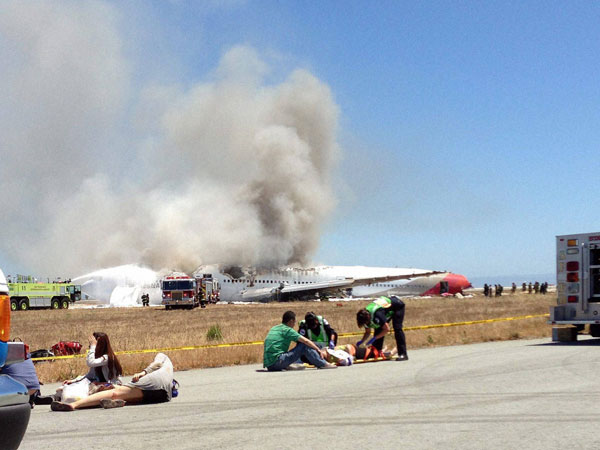
As the plane came to a halt on the airport grass after the crash, the flight attendants hustled the travelers down through emergency slides before a blaze that gutted the hull. Officials kept marveling on the fact that the death toll just reached two.
Technology played the role
"Split-second" reactions in evacuating the plane were critical, said Robert Mann, a former airline executive.
"Thirty years ago there were survivable accidents but people died in the post-crash fire," said Steve Wallace, former head of the Federal Aviation Administration's accident investigation office. "The cabin interior materials are vastly improved now, and rules were rewritten around getting precious more seconds to get everybody out of that airplane."
Boeing 777 was the plane-maker's biggest twin-engine model. It was among the newest and was also technologically most advanced commercial aircraft in the global airline fleet.
The jet feature seats can withstand 16 times the force of gravity, compared with the previous standard of 9 times, according to Boeing. The Chicago-based planemaker claims that all new aircraft designed and built after 1998 have the 16G seats.
The modern aircrafts are also required to have non-flammable material for seat cushions, carpet, walls and other interior parts. According to documents on Boeing's website, insulation blankets in aircraft walls are designed to slow the spread of flames, and along with the jet's skin can provide at least four minutes for evacuation before a fuel-fed post-crash fire can burn through.
Flight 214 was arriving from Seoul after a flight of more than 10 hours across the Northern Pacific for what should have been a routine touchdown on Runway 28 Left. While some on board said afterward that a steep descent stirred fear of a crash, there were no warnings to prepare for an accident.
OneIndia News



 Click it and Unblock the Notifications
 Sign in with Google