


Air Force version of 'Akash' missiles successfully test fired


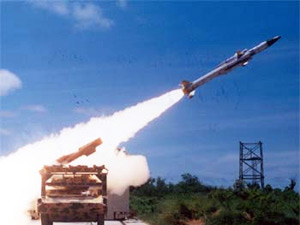
"Two Air Force version Akash missiles were test fired from the ITR in quick succession. Both the trials were successful and met all the mission objectives," ITR Director MVKV Prasad said.
The anti-aircraft missiles, with a strike range of 25 km and capable of carrying warhead of 60 kg, were test fired from a mobile launcher at launch complex-III of the ITR.
The trial, which formed part of the country's routine air defence exercises, was conducted at around noon, said an official of Defence Research Development Organisation (DRDO) associated with the Akash missile project.
To re-validate the technology and operational efficacy of the missile, defence forces conducted the trial with logistic support provided by the ITR, the official said.
The Akash weapon system, which has its Army version too, was inducted into the armed forces in 2008. Today's test-fire came after similar trials conducted from the same test range on May 24, 26 and 28.
"During the trial, the sophisticated missiles were aimed at intercepting floating object supported by a pilotless target aircraft at a definite altitude over the sea," sources said.
Akash, an anti-aircraft defence system, can simultaneously engage several targets with 'Rajendra' radar developed by the Electronics and Radar Development Establishment (LRDE), a DRDO laboratory in Bangalore. 'Rajendra' does the surveillance, tracks the target, acquires it and guides the missile towards it.
The development of Akash missile took place during 1990s under the country's Integrated Guided Missile Development Programme (IGMDP) and after many trials, it was inducted into the armed forces. The DRDO has developed both the Air Force and Army versions of the Akash missile.
Rajendra is a 'passive phased array radar'. It is a multifunction radar, capable of tracking as many as 64 targets and controlling up to 12 missiles simultaneously.
Defence experts have often compared Akash missile system with the American MIM-104 Patriot surface-to-air missile system. They claim that similar to the MIM-104, the Akash is capable of neutralising aerial targets such as unmanned aerial vehicles (UAVs), fighter jets, cruise missiles and air-to-surface missiles.
PTI



 Click it and Unblock the Notifications
 Sign in with Google