


Japan announces USD 50 bn disaster relief budget


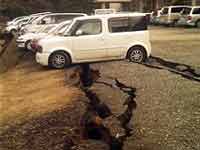
The Japanese Cabinet approved 4.02 trillion yen (some USD 50 billion) for the current fiscal year for the early phase of reconstruction work following the March 11 magnitude-9 quake and tsunami that left nearly 30,000 people dead or unaccounted for in the northeast and damaged the Fukushima atomic plant.
To deal with the worst post-war crisis in the country, the first supplementary budget for the year, which was approved earlier this month, was already bigger than the three special budgets drawn up after the 1995 Kobe earthquake, totalling 3.23 trillion yen.
But the government is not planning to issue any debt to create the budget, instead it is diverting funds from the initial fiscal 2011 budget, Kyodo news agency reported.
"We would like to tackle restoration work while the Cabinet is well united under the belief that this is a new start," Premier Naoto Kan was quoted by unnamed officials as telling his Cabinet colleagues, referring to the budget adopted today, which the government aims to have enacted on May 2 following approval by Parliament.
According to Kan, this could be the first of several extra budgets needed to fund reconstruction.
The emergency budget is aimed at disaster relief, including providing temporary housing, restoration of infrastructure and disaster-related loans.
The government yesterday declared a no-go zone near the Fukushima nuclear plant, making it illegal to enter the 20-km area around the facility, from where the residents had already been evacuated weeks back.
The no-entry zone is aimed at protecting the health and safety of local residents as some of them had been returning home without sufficient radiation safety measures.
People entering the restricted zone would face fines up to 100,000 yen (USD 1,200) or possible detention of up to 30 days. Till midnight last night, defiance of the evacuation order was not punishable by law.
Authorities today added some towns outside the 20-km radius of the crisis-hit Fukushima nuclear plant to the list of areas covered by its evacuation directive due to concerns over high cumulative levels of radiation exposure.
All residents in Iitate, Katsurao, Namie and some in Kawamata and Minamisoma in Fukushima prefecture must leave by around late May, Chief Cabinet Secretary Yukio Edano said.
The total number of such residents is 10,500, according to the government.
The stricken nuclear plant's operator Tokyo Electric Power Company (TEPCO) struggled to meet its self-imposed goal of bringing the atomic crisis under control within the six to nine months.
Fukushima Governor Yuhei Sato said he would never allow TEPCO to resume operations at the radiation-leaking plant.
"A resumption of plant operations must be impossible," Sato was quoted by Kyodo as telling TEPCO President Masataka Shimizu, who apologised for the nuclear emergency during their meeting at the prefectural government office.
After the 15-minute meeting, Shimizu suggested he would step down at an appropriate time to take responsibility for the disaster.
His comments came as TEPCO workers battled hard to remove highly radioactive debris scattered around the reactors of the troubled Fukushima plant.
The plant's operator also continued the critical work of pumping highly radioactive water out of a tunnel linked to the No.2 reactor. The toxic water is being transferred to a waste-processing facility.
TEPCO said the level of liquid in the tunnel had dropped by 5 centimetres this morning and no more leaks had been detected so far, national broadcaster NHK reported.
It was also preparing to remove the wreckage near the No.3 reactor building and hoped to start the clean-up using remote-controlled machines as early as tomorrow.
TEPCO said it had detected higher levels of radioactive material in sea water samples near the water intake of one of the reactors.
However, the Nuclear Safety and Industry Agency said there were no traces of highly toxic water leaking into the sea from the plant.
TEPCO detected 160 becquerels of radioactive iodine-131 per cubic cm in samples of sea water collected near the water intake for the No. 2 reactor on Wednesday morning. The figure is 4,000 times the national limit and higher than the level detected on Tuesday.
It was the same site where water contaminated with highly radioactive material was found to have been leaking into the sea on April 2. The leakage was fixed four days later.
TEPCO said it also detected radioactive cesium-134 at 2,300 times the limit and cesium-137 at 1,600 times the limit on Wednesday morning. These levels are also higher than those detected on Tuesday, NHK reported.
Meanwhile, visiting Australian Prime Minister Julia Gillard offered her sympathies to Emperor Akihito and Empress Michiko over last month's disaster during a meeting at the Imperial Palace in Tokyo yesterday.
According to the Imperial Household Agency, the monarch thanked Australia for supporting disaster-hit Japan.
PTI



 Click it and Unblock the Notifications
 Sign in with Google