


Why Lalu & Modi tales tell a positive story about India


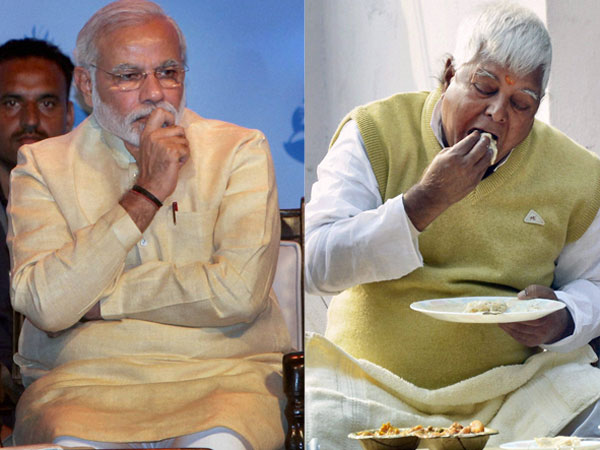
The two incidents have apparently nothing in common but they have a story to tell about India and its contemporary socio-political thinking.
The generation of ‘secular' leaders
Take the case of Lalu Prasad first. He was once one of India's most recognized faces of the post-Congress era. He rose on the ashes of the grand-old party in Bihar, particularly after the Bhagalpur riots of 1989, which had diminished the status of the Congress in the eyes of the minorities.
Politicians like Prasad made a perfect blending of religious and social divisions to devise their own social engineering formula and capitalize on the decline of the Congress system. The arrest of Lal Krishna Advani in 1990 made Prasad a messiah and his ‘secular' project based on communal undertones was a big hit in the then Indian politics.
Other politicians of his generation like Mulayam Singh Yadav, Nitish Kumar and Mayawati also applied similar formula to consolidate their respective political bases and found a convenient common enemy in the BJP's cultural nationalism.
They had a two-pronged political approach. One, to implement a social empowerment by mobilizing marginal social sections and two, to maintain a secular façade to get blessings of the minorities to deal with both the Congress and the BJP. But they never cared for overall development and ethical practices for these never mattered while managing a largely underprivileged electorate.
BJP was a common enemy
The geographical limitation of the BJP also ensured that a calculated proximity with a weakened Congress would serve the ultimate goal of this generation of politicians, i.e., to engage in a politics of compromise and concession to remain near the power centre.
Change in BJP reduced the secularists' status
The situation gradually changed as India continued with its story of economic liberalization and the coming of the NDA government in power under a moderate leader like Atal Bihari Vajpayee.
It marked a transition in BJP's political character as it began to project itself more a development-oriented party and not an entity only running after making a Hindu state. This was a blow of sort for the old ‘secular' guards of Indian politics.
With the focus of the resurgent Indian middle-class also shifting more on economic well-being and ethics, the scripts of the Prasads and Yadavs also began to run out of words.
End of Lalu, Are the others far behind?
In 2013, we have seen the end of Lalu Prasad because he never succeeded in transforming himself. The likes of Mulayam Singhs are still relevant because they lead formidable political forces in terms of vote shares. But that doesn't guarantee them a certain future.
The Samajwadi Party was seen desperately trying to revive the old secular wave in Ayodhya a few days ago but failed to curb riots in Muzaffarnagar.
An upset Mulayam was seen cautioning his chief minister son, which hints at the ‘secular' leader's apprehension about the future. Sans development, secularism is a hollow slogan, a seasoned politician like Mulayam isn't averse of that.
Nitish Kumar is also under the scanner for the fodder scam.
When we compare the secularists with that of a Modi who prioritises development over Hindutva, the question arises: is India finally getting over the age-old secular versus communal debate?
Most likely, it is. The arrest of a ‘secular' leader like Lalu Prasad and the ‘surprising' transformation of Modi from a Hindutva leader convey that neither the secular nor the communal can flourish in today's India if there is no prime emphasis on development. Lalu Prasad perished because he did not convince himself about the changing nature of Indian politics while Modi responded to the changing times.



 Click it and Unblock the Notifications
 Sign in with Google