


It was an election which BJP could not lose


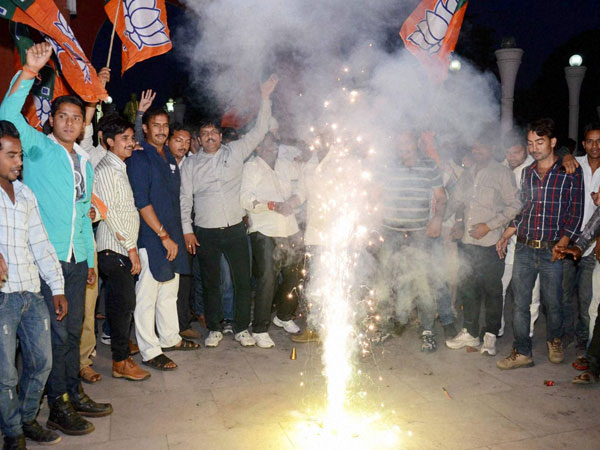
The reason is that the Congress made all the mistakes which a political party could make - banked on a dynasty whose arrogant feudalism alienated large sections of the population, pursued a flawed economic policy which turned the focus away from the economic reforms, and sank into corruption because the hands of a personally honest prime minister were tied by a party president intent on keeping the organization in power by any means, fair or foul.
Arguably, if Sonia Gandhi had allowed Manmohan Singh to follow market-oriented policies instead of making him take the foot off the accelerator of reforms, as P. Chidambaram acknowledged, then a buoyant economy would have made Modi's task of selling his development agenda much harder, not least because the Manmohan Singh government has been able to bring about a substantial reduction in poverty.
But Sonia's pursuit of the programme of the so-called rights-based entitlements for the poor not only violated the norms of fiscal prudence, but fostered the belief that the only hope for the underprivileged lay in the presence at the helm of a munificent dynasty. It is possible, however, that this attitude increasingly began to rile the ordinary people, especially when the economic reforms had fostered entrepreneurship and a sense of self-belief.
Modi appealed to this outlook of confidence. His own rise from being a tea-vendor to the prime minister's post exemplifies the "can do" spirit which is the essence of the process of liberalization and globalization which the reforms encapsulated. Just as Rajiv Gandhi's promise to take India into the 21st century gave the Congress an overwhelming victory in 1984, sweeping aside all considerations of caste and religious affiliation, Modi's articulation of leading a purposeful administration has evidently persuaded the voters to put their faith in him.
It is not impossible in this context that he has largely been able to overcome the fear which he is supposed to generate among the Muslims. Considering that growth helps all irrespective of caste or creed, the Muslims, who are mostly at the bottom of the economic ladder, must have come to believe that their condition will improve if Modi comes to power. They may have also factored in the possibility that he will not allow the hotheads in the saffron brotherhood to run amok. The decade-long communal peace in Gujarat and the marginalization of the Vishwa Hindu Parishad there probably helped to convince them.
Aware that his image as a minority-baiter is a disadvantage, Modi refrained from laying any stress on the Hindutva agenda even if he did pander to some of the longstanding fetishes of the saffron camp, such as the incursions of illegal immigrants from Bangladesh and the export of beef. But, these references did not detract in any substantial manner from his basic approach with its emphasis on development. Like the apprehension of the minorities, Modi also appears to have dispelled the notion of the 'bania' or the trader as dishonest, which has long dominated the discourse of the socialists in India, which projected the poor as honest and the rich as deceitful.
Instead, Modi's business-friendly attitude is a unique posture in Indian politics, suggesting that capitalism, reflected in Deng Xiaoping's maxim, "to get rich is glorious", will finally bury Jawaharlal Nehru's Fabian socialism, which has been the Congress's guiding feature. Interestingly, the charge that he encourages crony capitalism hasn't swayed public opinion against him. There is a lesson in this popular approval given to Modi for the dogma-bound communist parties and the left-leaning elements in the Congress.
If the stalling of the reforms helped Modi to gain electorally, so did the abysmal ineptness of the Manmohan Singh government, which made Modi's decisiveness stand out in marked contrast. Similarly, the self-assurance which he exuded was also in striking contrast to Manmohan Singh's mealy-mouthed attitude which made him appear unsure of himself, whether it was the initial rolling back of the move to introduce foreign investment in the retail sector under pressure from the Trinamool Congress, or the virtual admission that the inclusion of a reference to Balochistan in joint communiqué with Pakistan was a mistake.
Since there is generally a preference for a "strong" leader in a country where the political scene still shows signs of instability in the absence of a durable two-party system, and which has two devious and inimical neighbours in China and Pakistan, Modi's assertive, even abrasive, personality was an advantage. It is not surprising that Indira Gandhi is one of his heroines considering that she is still widely admired because of the perception she gave of being strong.
Indira, however, became a victim of her own image when she imposed the authoritarian emergency. Modi's biggest test of leadership will be whether he is able to curb his customary combative nature which is compounded by his insular tendencies. He cannot be unaware that he has been able to turn the BJP into a genuinely national party and is the repository of the high hopes of millions of Indians. He also has a dubious past. Now, he has to focus on ushering in a bright future.
(Amulya Ganguli is a political analyst. The views expressed are personal. He can be reached at [email protected])
PTI



 Click it and Unblock the Notifications
 Sign in with Google