


ISRO’s complex, historic launch: From students’ to weather satellites


Indian space scientists on Monday scripted history by placing eight satellites in two different orbits on the same flight of the workhorse PSLV rocket.
[ISRO successfully puts into orbit 7 more satellites, following SCATSAT-1]
It was a new technological feat for the Indian Space Research Organisation, which demonstrated for the first time what's known as multiple burn -- turning off and on rocket engines in mid-flight in order to be able to launch spacecraft into orbits at different heights.
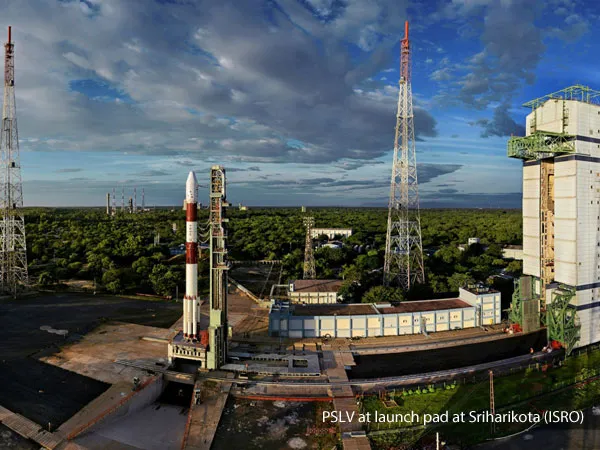
A typical flight of the PSLV to launch satellites into polar orbit takes about 17 minutes. Monday's PSLV C-35 flight lasted more than two hours.
The rocket first put the ScatSat-1 weather satellite into polar sun synchronous orbit at 730 km 17 minutes after launch at 9.12 am. The rocket's engines then turned off and then fired almost two hours later to reach a 689-km orbit where it deployed the other seven spacecraft.
[India's satellite launch order book stands at Rs 280 crore]
This kind of a twin-orbit manoeuvre was only achieved by European Space Agency's Vega rocket recently.

"This is a challenging two-in-one mission that puts India in a unique league of nations having the capability to achieve two different orbits in a single mission," said ISRO Chairman AS Kiran Kumar.
Prime Minister Narendra Modi patted on the back of the scientists with this encouraging tweet, "Our space scientists keep scripting history."

The PSLV C-35 carried three satellites from India, three from Algeria, and one each from Canada and the US.
Apart from Isro's ScatSat-1, the two other Indian satellites were built by students of IIT-Bombay and those of PESIT University in Bengaluru.

ScatSat-1
The 371 kg ScatSat-1 is meant for ocean and weather-related studies. Its main objective is to achieve data quality for Climate Data Records, apart from facilitating routine meteorological applications, the Isro said.

Pratham
An initiative of the students of IIT-Bombay, with help from Isro. The satellite took nine years to build, with some 250 students of successive batches involved in the project. The microsatellite weights over 10 kg. Pratham will be useful for scientific studies, help in tsunami warnings and correcting errors in GPS communication.

PiSat
PiSat is the second student satellite that flew on the PSLV C-35. The satellite was built by students of PESIT University, Bengaluru. The 5-kg PiSat is a remote sensing nanosatellite, built with the help of Isro scientists. It is a three-axis stabilised imaging nanosatellite and generates 13 watts power with S-band RF (radio frequency) communication, said the ISRO.
The PiSat's imaging camera puts out pictures with 80-metre resolution. Interestingly, PESIT students have even established a mini-control centre on its campus to track and maintain the satellite post-launch and have built telemetry and telecommand systems into the satellite.

AlSat-1N
The Algerian nanosatellite weighs seven kg. It is the smallest of the three Algerian satellites on board. AlSat-1N is a joint venture of Algerian Space Agency, the UK Space Agency and Surrey Space Center. AlSat-1N is also hosting three UK payloads from various institutions and aims to take images of the Earth and send back data from the UK payloads.

AlSat-1B
The second Algerian satellite is a technological collaboration between the Algerian Space Agency and Surrey Satellite Technology Ltd (SSTL). It weighs 103 kg. The earth observation satellite will monitor agricultural activities, the state of the environment and natural disasters.

AlSat-2B
The third Algerian satellite has been developed with help from Airbus Defense and Space. The AlSat-2B weighs 117 kg. The images taken by the satellite will be used for multiple purposes including cartography, agriculture, forestry, water management, land planning and management of natural disasters, said the ISRO.

BlackSky Pathfinder-1
The 44-kg microsatellite from the United States is meant for commercial purposes. BlackSky provides 1-meter resolution satellite imagery on-demand to companies, organisations and nations, for various kinds of use.

Can X-7
It has been developed by the University of Toronto Institute for Aerospace Studies (UTIAS), Canada. Can X-7 is an experimental technology demonstration satellite. Its main feature is a drag sail, which will allow the satellite to de-orbit.
OneIndia News



 Click it and Unblock the Notifications
 Sign in with Google