


How to spot the difference between a Cheetah, Leopard and Jaguar?


New Delhi, Sep 20: Cheetahs are back in India. They aren't just back in the country, they are back in news and everyone's mind too. Ever since Prime Minister Narendra Modi released eight of these big cats from Namibia in Madhya Pradesh's Kuno National Park, there is a palpable curiosity around this magnificent cat and so are the confusions.
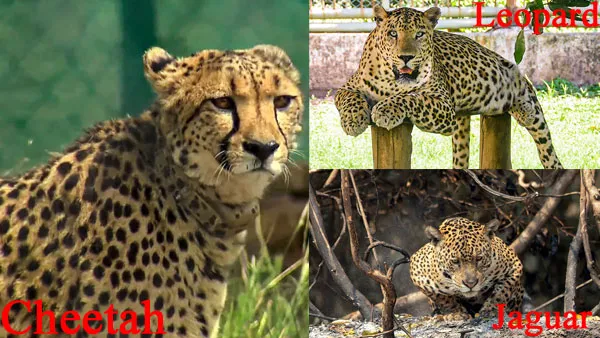
There have been lot of questions and confusions about the difference between cheetahs, leopards and jaguars, who are all big cats with spots but that is where most of the similarities end. In reality, there are loads of distinctive features of each of these animals, which once known will save you from any confusion.
Let us take a closer look at what sets cheetahs apart from leopard and jaguar
Cheetahs:
The amazing cheetahs, the fastest land animal, have the ability to go from zero to over 96 km (60 miles) an hour in only three seconds.
Cheetahs are the ones that stand out compared to jaguars and leopards. These animals are distinctly different, as they are not part of the Panthera family, and do not have retractable claws. While resting, these claws remain hidden under the body but can be retracted when necessary. Claws are sharp and useful for holding down prey and they make great speedy hunters.
When chasing down prey at top speed, cheetahs make use of their long tails to counterbalance themselves; in doing so have the ability to change direction very quickly while on the hunt.
The adult cheetah can weigh between 34 kg to 56 kg, and the males are on the heavier side. According to Cheetah.org, Cheetahs have clear black spots all over its body. Also, a very distinctive feature in cheetahs is a black 'tear' line that runs from the inside of their eyes to the big cat's mouth.
Unlike its other spotted cat cousins, cheetahs only hunt early in the morning or late afternoon. Their preys include gazelles, impalas and antelopes.
Leopard
Scientific name - Panthera Pardus
Lifespan - 12-17 years in the wild / 19-23 years in captivity
As their scientific name suggests, leopards are in the same family as jaguars. According to National Geographic, Leopards are powerful big cats closely related to lions, tigers, and jaguars. They live in sub-Saharan Africa, northeast Africa, Central Asia, India, and China. However, many of their populations are endangered, especially outside of Africa.
One of the most visible difference between a leopard and a cheetah is in the pattern of markings on their coats. While it does look similar, a closer look will tell you that while cheetahs have round or oval shaped marks, leopards have rosettes, which means rose like markings.
These incredibly agile animals can climb and jump to trees without a problem. Their strength means that they can also haul their prey up trees so that it cannot be eaten by other predators.
Although running isn't what they are known for, leopards are fast runners, and are successful hunters, though they primarily rely on stalking.
They mostly hunt at night, and are capable enough to go for anything from animals such as warthogs, baboons, impala and sometimes even kudu. Buffalo and eland are less likely to be targeted because of their immense size and strength.
Leopards have a large number of light-sensitive cells in their eyes that detect less colour but allow them to detect movement and shape easily in the dark, giving them an advantage over others.
Jaguar
Scientific name - Panthera Onca
Lifespan - 12-15 years in the wild / 18-20 years in captivity
Jaguars are stunning animals found in the Americas. They are large spotted carnivores and are famous for their abilities to swim and hunt in water. Jaguars look very similar to leopards, but there are some distinct differences too.
Jaguars also have a light brown, orange base coat and black rosettes, which are black circles with a black spot in the centre. Solid black jaguars also exist.
Jaguars are known for hunting caiman in the rivers of the Americas, but also tapir and deer. Animals such as capybaras, birds, iguanas, fish and monkeys are also on the menu for these amazing cats. Since they aren't afraid to get their toes wet, there is very little that a jaguar won't try to have for its next meal.
Their immense strength and bite force of over 2,000 lbs makes things like turtle shells easy to get through. For reference - a 2,000 lbs bite force is twice that of a lion's.
This immense force also means that they have no issues biting through the skulls of their prey to kill them quickly.



 Click it and Unblock the Notifications
 Sign in with Google