


If India could ask for an Indira Sarkar, then why not a Modi Sarkar?


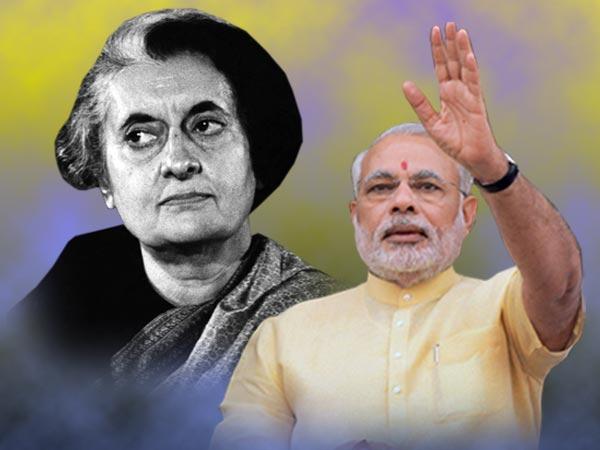
Critics of the BJP and its prime ministerial candidate, Narendra Modi, feel it's an effort to undermine the democracy in India for the slogan projects an individual's importance over his party. The criticism plays a perfect supplement to the prevailing criticism that Modi is an authoritarian ruler and will be dangerous for the nation if he becomes the prime minister.
The left-liberal (a unique combination indeed) minds of India use these fitting criticisms to distance themselves with the Gujarat chief minister, the man demonised to the furthest possible extreme over the Gujarat riots of 2002.
India not seeing personality cult for the first time
But India's political history isn't witnessing such a pattern for the first time in 2014. If "Abki Bar Modi Sarkar" is the flavor of this season, in 1970 the popular slogan was "Desh Ki Janta Kare Pukaar, Humey Chahiye Indira Sarkar" (The people of the country say they want a government of Indira Gandhi). If Narendra Modi has emerged a leader who has allegedly eclipsed his own party, the same precedent was set by late prime minister Indira Gandhi four decades ago.
Indira Gandhi had 3 advantages to cement her personality
For many, the rise of an individual is quite unthinkable in today's era of fragmented politics. Indira Gandhi had three big advantages which had helped her emerge as a leader of a gigantic stature. First, she was the daughter of Jawaharlal Nehru, a man who had given the necessary leadership to shape the fate of independent India in a way which was appreciable. His legacy had indirectly given Indira's rise to power a touch of moral legitimacy though she ultimately turned out to be an exact opposite of what her father had preached and practiced.
Secondly, Indira Gandhi belonged to the Congress, a party which was not only the dominating force in those days, but also the only viable alternative before the nation's politics.
A third advantage was her surname which always commanded a respect in every Indians' mind, even at the subconscious level. As Shashi Tharoor, a Congress MP now had said in one of his books that had Indira not been a Gandhi, the political history of India could have been a different story.
Indira's son Rajiv saw the end of the personality cult in 1989
In 1989, the fall of Rajiv Gandhi after the Bofors scam virtually marked the end of the culture of personality cult in Indian politics and the beginning of the coalition era. The slogan "Gali Gali Mein Shor Hain, Rajiv Gandhi Chor Hain" (It is being said in every nook, Rajiv Gandhi is a crook) was a decisive blow to the culture of individual leadership in Indian politics. It was the era of the fronts and alliances thereafter.
During Vajpayee, BJP used 'Bhajpa Sarkar' to connect to his appeal
Even when the BJP-led National Democratic Alliance was in power, the then prime minister Atal Bihari Vajpayee was never projected as a leader bigger than the party or the alliance. However, the word Bhajpa (short form of Bharatiya Janata Party) Sarkaar almost sounded like Vajpayee Sarkar and helped the party to reduce the gap between itself and its popular leader.
Modi's personality cult is hard-earned
Narendra Modi hasn't had any of Indira Gandhi's advantages or the backing that Vajpayee had enjoyed across the political spectrum. He rose to prominence from a province of the Indian Union and via the longer route, something Indira Gandhi never had to. He, however, had the advantage of a huge campaigning machinery and of course, the massive anti-incumbency mood working in his favour.
Modi has seen the return of personality factor in Indian polls after a long gap
Why Modi Sarkar is a positive for Indian democracy
The projection of the next BJP government as Modi's government is a welcome development in the Indian democracy. It means after 67 years of independence, the entire country for the first time is feeling enthusiastic about a leader who doesn't belong to the Gandhi family or the Congress party and has been a regional face during his formative years.
It is often claimed that personality doesn't matter in a parliamentary democracy and the PM is chosen by the MPs. Even the Gandhis today propagate such a theory, conveniently forgetting that their predecessors had never practised this. The successors might feel embarrassed today that India is not celebrating any of them as its future leader and instead backing a person who was Mr Nobody even one election back.
The concern of the Gandhis and their party and loyal friends in Indian politics is actually a story of optimism for the world's largest democracy.



 Click it and Unblock the Notifications
 Sign in with Google