


Iron ore polluting Goa's rivers


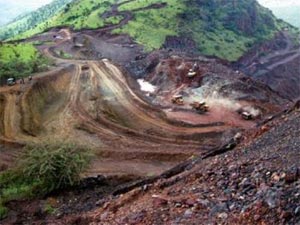
A research report released recently by the Goa-based National Institute of Oceanography (NIO) reveals iron content in the Mandovi (north Goa) and Zuari (south Goa) and blames it on mining operations in the drainage basins of the water bodies as well as spillage from the transportation.
"Since ore handling, or loading in barges, transporting and reloading at the port or mid-stream in giant ships, is done in an open system and one would expect abundant spilled-over ore material into the estuaries (of the two rivers)," the paper jointly authored by Indian and Chinese researchers said.
While the paper was released in 2013, at a time when mining has been banned in Goa by the Supreme Court, the study relied on data compiled during a time-period when mining was rampant.
"Mandovi has 37 loading points with 1,500 trips of barges per year while Zuari has 20 loading points with 1,800 trips per year. Ore transport through rivers increases annually from 14 million tonnes," the report says while establishing the quantum of ore transported using the river ways.
The report, which aims to investigate the geochemistry of the suspended particle matter in the two river estuaries, also says that industries such as iron-pellet making factory and shipbuilding were located on the shores of the Zuari estuary.
"Shipbuilding industries on the shores of both rivers may have contributed to the trace metals," it states, adding that in some areas in the two rivers pollution had reached "significant" levels.
The report, Geochemistry of the suspended sediment in the estuaries of the Mandovi and Zuari Rivers, Central west coast of India, is authored by Pratima M. Kessarkar, R. Shynu, V. Purnachandra Rao, Tanuja Narvekar of NIO and Feng Chong and Jing Zhang of Shanghai's State Key Laboratory of Estuarine and Coastal Research.
Pollution of Goa rivers due to iron ore deposition on their beds and along its course and plastic and other affluent has already been a cause for concern for Goa.
Excessive pollution has already sparked off fears of a fish famine, an NIO scientist has earlier cautioned.
Baban Ingole has said that over-fishing as well as pollution and an increase in the number of jelly fish along Goa's rivers and coastline could lead to a fish famine in the future.
Goa, known for its beach tourism, has also come under pressure after a recent report by the oceanography institute established that swimming in the state's water's was unsafe, especially in summer.
"This is primarily due to excessive land run-off containing raw sewage and fecal debris that supports the proliferation of coliform bacteria There were hardly any samples that had counts of bacteria that would be considered safe," said a report released by NIO scientist N Ramiah along with his co-scientists.
IANS



 Click it and Unblock the Notifications
 Sign in with Google