


Economy to soon revert to 8-9% growth trajectory: President


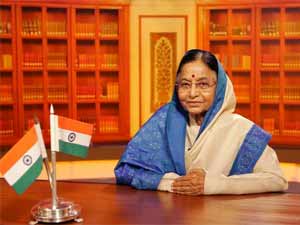
"My government is confident that it will soon steer the country back to the high growth trajectory of 8-9 per cent," Patil said while addressing the joint sitting of Parliament that heralds the beginning of the Budget Session.
As regards the current fiscal (2011-12), she said the growth will slow down to 7 per cent from 8.4 per cent last fiscal but "this remains a healthy growth given current global trends".
The long term fundamentals of the Indian economy remain robust, she said, adding, "India's growth prospects arise from factors such as high domestic savings and investment rates, favourable demographics, and a stable democratic polity."
Referring to inflation which has remained a major challenge for the government, Patil said the actions taken by the Reserve Bank and the government have yielded results and "general inflation inflation has ... eased."
Recounting the steps taken to contain price rise, she said, "The Government has taken several measures to ease the supply constraints, like reduction in import duties and a calibrated ban on exports. In order to ease the pressure of high international prices on fuels, custom duty on crude oil and import duty on petrol and diesel has been reduced."
The economy grew at an average rate of more than 9 per cent between 2005-06 and 2007-08. The growth rate fell to 6.7 per cent in 2008-09 on account of global financial crisis, but recovered the momentum to 8.4 per cent in 2009-10 and 2010-11.
Patil said government would work to achieve economic security through rapid and broad-based development and creation of productive jobs and ensure energy security for our rapid growth.
She said the government will also strive to realise developmental goals without jeopardising ecological and environmental security.
Touching on economy, she said the current year has been a difficult one for world economy and uncertainties have had an adverse impact across the globe.
"There is increased political uncertainty and turbulence in the international system and the environment in which we operate has become more challenging over the last one year.
"Our economy grew at a handsome rate of 8.4 per cent in 2010-11, but it has slowed down to about 7 per cent this year. This remains a healthy growth given current global trends," Patil said.
Asserting that the long-term fundamentals of the Indian economy remained robust, she said India's growth prospects arise from factors such as high domestic savings and investment rates, favourable demographics, and a stable democratic polity.
"My Government is confident that it will soon steer the country back to the high growth trajectory of 8 to 9 per cent," she said.
Maintaining that the government has remained committed to providing an honest and more efficient government, she said the government has taken several further important steps towards that end.
Patil said a formidable and unprecedented array of Bills has been introduced in Parliament.
These include Public Interest Disclosure and Protection of Persons Making the Disclosure Bill, Prevention of Bribery of Foreign Public Officials and Officials of Public International Organisations Bill, Citizens' Right to Grievance Redress Bill, Judicial Standards and Accountability Bill and Lokpal and Lokayuktas Bill, she said.
India, she said, has also ratified UN Convention against Corruption.
"Together these have the potential of bringing about a transformational change in curbing corruption and enhancing transparency and accountability in governance.
A comprehensive public procurement law is being formulated. The National Mission for Delivery of Justice and Legal Reforms has already been set up," she said.
On blackmoney, Patil said, the government has initiated action on various fronts to tackle the menace.
These include enactment of the Benami Transactions (Prohibition) Act, amendment of the Prevention of Money Laundering Act, setting up of a special committee to examine measures to strengthen laws to curb black money generation in the country, and commissioning of studies by independent agencies to assess the quantum of black money both inside and outside the country.
"The framing of the General Anti-Avoidance Rules and Controlled Foreign Company Rules has been taken up under the proposed Direct Taxes Code. Efforts are underway to build political consensus on the Goods and Services Tax, which will give a major boost to the economy by rationalising indirect taxes and giving full input credit," she said.
The President said the government was taking many steps to contain the generation and outflow of illicit funds from the country and for opening channels for getting wider information on black money from other countries.
These include the operationalisation of new Income Tax Overseas Units, signing of new Double Taxation Avoidance Agreements and new Tax Information Exchange Agreements and better implementation of Transfer Pricing and International Taxation provisions.
To underline inclusive growth, Patil said, government will work for the early enactment of Land Acquisition, Rehabilitation and Resettlement Bill which provides for a liberal regime of compensation along with a mandatory rehabilitation and resettlement package, not only for land owners but also for those dependent on land for livelihood.
In the area of internal security, Patil said, government has launched a number of measures towards development of areas affected by left wing extremism.
Asserting that situation in the north-east and Jammu and Kashmir has shown considerable improvement during the last year, she said the government has shown that acts of violence can be contained with a firm but humane approach.
"My Government has always been willing to enter into dialogue with any group willing to abjure the path of violence. It is encouraging that a number of organisations have come forward seeking resolution of their grievances in a peaceful manner," she said.
Patil said the government has signed a tripartite agreement for setting up of the Gorkhaland Territorial Administration.
"Another tripartite Memorandum of Settlement has been signed with United People's Democratic Solidarity in Assam. A non-lapsable central pool of resources has been created to cover the gaps in funding requirements of central Government projects in the north-east," she said.
She also mentioned the Protocol on the Land Boundary Agreement between India and Bangladesh which paves the way for settlement of long standing issues and a mutually beneficial bilateral cooperation.
"My Government also initiated steps for resettlement and rehabilitation of the internally displaced persons in Sri Lanka," she said.
Noting that India has a vital stake in peace, stability and progress of the countries of West Asia and North Africa, she said, "we would like the people of the region to chart their own pathways to nation building and development at this historic time of transition and change. We are unwavering in our support to the Palestinian cause."
PTI



 Click it and Unblock the Notifications
 Sign in with Google