


After US Names India, MEA Says No Bilateral Talks Yet On Joining Coalition To Reopen Strait Of Hormuz


India on Monday clarified that it is not currently engaged in any bilateral discussions about joining a coalition to help reopen the Strait of Hormuz, after a senior US official named India while speaking about efforts to restore movement through the crucial waterway amid the ongoing Iran crisis.

AI-generated summary, reviewed by editors
The clarification came from the Ministry of External Affairs after speculation grew over whether Indian naval assets could be part of any multinational operation in the Gulf, where tensions have sharply escalated following US and Israeli strikes on Tehran.
MEA rules out any bilateral discussion for now
Responding to a direct question during a media briefing in New Delhi on March 16, MEA spokesperson Randhir Jaiswal said India has not yet held any bilateral talks on the matter.
"We are aware this matter is being discussed bilaterally by several countries. We have had no such bilateral discussion yet," Randhir Jaiswal, spokesperson of the Ministry of External Affairs, said at a press briefing in New Delhi on Monday, March 16.
He was responding to a pointed question on whether Indian Navy ships could be committed to any mission aimed at reopening the Strait of Hormuz, which remains one of the world's most critical oil transit routes.
The strait, through which around 20% of global oil supplies pass, has been under intense scrutiny and disruption since the US and Israel launched strikes on Tehran more than two weeks ago, triggering heightened regional conflict and fears over energy security.
Jaishankar says Indian ships crossing individually, no blanket arrangement
While India has denied any formal talks on joining a coalition, External Affairs Minister S Jaishankar indicated that diplomatic engagement with Iran has helped some Indian-flagged ships transit the strait.
Speaking to the Financial Times, Jaishankar said his communication with Iranian officials had produced results, while adding that such contact remains ongoing. He stressed, however, that there is no broad agreement covering all Indian vessels.
Noting that "many more" Indian-flagged ships are yet to cross the strait, he clarified that every vessel moved through the key waterway individually and there was no "blanket arrangement" with Iran on the matter. "India and Iran have a relationship. And this is a conflict that we regard as something very unfortunate," he added.
His remarks suggest India is relying on diplomatic channels and case-by-case coordination rather than any military commitment at this stage.
US mentions India while seeking support from allies and Asian economies
The Indian clarification followed comments by US Energy Secretary Chris Wright, who said President Donald Trump was reaching out to several countries for support in ensuring passage through the Strait of Hormuz.
At a Sunday press conference, Wright said Trump had already named countries including China, Japan, the UK, France and South Korea while discussing international support.
"He named some of the countries - China, Japan, the UK, France and South Korea. He told me some countries have committed to aiding the United States," Wright told reporters.
When asked for more names, Wright explicitly mentioned India among Asian nations heavily dependent on energy flows through the strait.
"The world depends on the flows through Hormuz, and most importantly, (for) the Asian nations - Japan, Korea, China, Thailand, India - a meaningful part of their total energy supply comes from the Strait of Hormuz. So the whole world would be united in opening the Strait of Hormuz, and we will have the support of other nations to achieve that objective."
However, India has now made it clear that no bilateral engagement has taken place so far on any such participation.
Global oil route under pressure as Iran, US and allies trade signals
The Strait of Hormuz remains central to global trade and energy flows, with experts warning that any prolonged disruption could further tighten supplies and push oil prices higher worldwide.
Data from Vortexa showed that between the start and end of 2022, roughly 17.8 million to 20.8 million barrels per day of crude, condensate and fuels passed through the strait. Major OPEC producers including Saudi Arabia, Iran, the United Arab Emirates, Kuwait and Iraq send most of their crude exports through this route, especially toward Asian markets.
Since the latest conflict began, oil prices have surged to above $100 per barrel, reflecting fears of supply shocks.
Meanwhile, US President Donald Trump appeared to send mixed signals. After days of asserting that the United States could secure the strait on its own, he later suggested Washington may not need to remain involved without support from other nations.
"I am demanding that these countries come in and protect their own territory, because it is their territory... they should help us," he told reporters aboard Air Force One on Sunday night (US time), apparently using 'territory' to mean area of interest. "You could make the case that maybe we shouldn't be there at all, because we don't need it. We have a lot of oil," he argued.
Japan, however, has already signalled caution. Prime Minister Sanae Takaichi told parliament that Tokyo has no plans to dispatch naval vessels to escort oil tankers through the strait.
On the Iranian side, Foreign Minister Abbas Araghchi maintained that the waterway is not universally shut and claimed restrictions apply only to US and Israeli-linked shipping.
"As a matter of fact, the Strait of Hormuz is open. It is only closed to the tankers and ships belonging to our enemies, to those who are attacking us and our allies. Others are free to pass," Araghchi told MS Now in an interview over the weekend.
"Of course, many of them prefer not to because of their security concerns. This has nothing to do with us. And at the same time, there are many tankers and ships that are passing through the Strait of Hormuz," he said.
-
 Gold Silver Rate Today, 25 March 2026: City-Wise Prices As MCX Trends Mixed, Gold Falls And Silver Rises
 -
 Hyderabad Gold Silver Rate Today, 25 March 2026: Gold Slips From Highs, Silver Remains Volatile In City
 -
 Dhurandhar 2 Box Office Collection Day 7: Ranveer Singh's Film Dominates, Inches Closer to ₹1000 Crore Club
 -
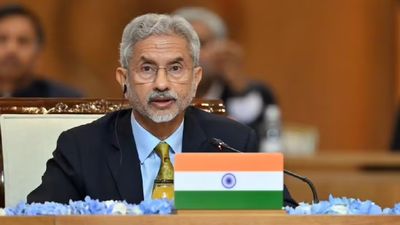 ‘Not a Dalal Nation’: S Jaishankar Hits Back at Pak Mediation Narrative on US-Iran Crisis
 -
 Bangalore Gold Silver Rate Today, 25 March 2026: Gold, Silver Prices Rise After Extended Losses
 -
 Ananya Birla in Spotlight After RCB Owner Deal; Fans Draw Parallels with Kavya Maran
 -
 Gas Cylinder Booking Rules Changed to 35 Days? Truth Behind Viral Claims
 -
 Platinum Rate Today, 25 March 2026: Rising Platinum Prices Strengthen Its Position Against Gold
 -
 Mamata Banerjee Resigns from 23 Posts Ahead Of Bengal Elections, Bhawanipur Battle Takes Centre Stage
 -
 Ram Navami 2026 On March 26 Or 27? Know Exact Date, Madhyahna Muhurat, Tithi Timings And Puja Rituals
 -
 Majority in US Call Iran Military Moves ‘Excessive’ Amid Fuel Price Fears
 -
 ‘Iran Has Agreed To Never Pursue Nuclear Weapons’: Donald Trump Declares Victory After Three-Week War



 Click it and Unblock the Notifications
 Sign in with Google