


Sreevallabha Temple, Thiruvalla
Thiruvalla, Kerala

Sreevallabha Temple History and Significance
Present Thiruvalla was once a village among 64 Namboothiri villages in Kerala. It is one of the oldest human settlements in India. The place was named after Sreevallabha temple as Sreevallabhapuram and Thiruvalla in colloquial Malayalam.
The temple for Sudarshana Chakra was built by Sreedevi Antherjanam of Sankramangalathu Illam. It was elaborately rebuilt by Queen Cherumthevi in 59 BC. Sreevallabha temple flourished to a major spiritual and educational centre by CE 1100.
The temple governed a Vedic school with around 1500 students and 150 teachers. The temple also owned an ayurvedic hospital with facilities to admit and treat 100 patients at a time. Famous Sanskrit poet Daṇḍin mentioned the temple in his works.
The first ever prose work in Malayalam is the Thiruvalla inscriptions dated to the first half of the 12th century CE. The Unnuneeli Sandesam of the 13th century CE highlighted the grandeur, beauty, serenity, fame and status of the temple during its time.
From the date built, the temple was under control of thiruvalla pattillathil pottimar till 1752-1753. Sreevallabha Temple emerged as a major spiritual destination for devotees all over India centuries before. It had 15 major priests and 180 sub-ordinate priests all the time and another 108 for only daily noon puja.
During 1752-1753 Marthanda Varma of Travancore captured the temple from Pathillathil Pottimar. Up to 1968, ladies and elephants were not allowed in the temple. The temple used to be opened for ladies only during Thiruvathira of Dhanu month and Vishu of medam till then. This custom is no longer in practice.
Sreevallabha Temple Pooja Timing
| Pooja Name | Timings |
|---|---|
| Nirmalya Darshanam | 4:00 AM |
| Usha Pooja | 6:30 AM |
| Ucha Pooja | 12:00 PM |
| Athazha Pooja | 8:00 PM |
Sreevallabha Temple Location Details
How to Reach Sreevallabha Temple
By Road:
By Train:
By Air:
Thiruvalla is well-connected by road to major towns in Kerala. State Transport Buses and private taxis operate regularly.
Nearest railway stations: Thiruvalla Railway Station (around 2 km away) and Chengannur Railway Station (approximately 10 km away). From these stations, buses or taxis are available to Thiruvalla.
Nearest airport: Cochin International Airport (approximately 117 km away). From the airport, you can take a taxi or bus to Thiruvalla via connecting cities.
Sreevallabha Temple Nearby Temples
Sreevallabha Temple Visitor Information & Tips
Best time to visit (season/months):
November to February is the best time to visit due to pleasant weather. Avoid the monsoon season (June to September) due to heavy rainfall.
Sreevallabha Temple Interesting Facts
-
Legends BeliefsLegends and BeliefsLegends have their own space with the history of a temple, but they should never be mixed up. While going through the legends related to Sreevallabha temple it is clear that even though Sreevallabhan’s idol is older, it was the temple for sudarshana built first.Before creation, while being in deep meditation at the origin of the universe, Vishnu appeared to Brahma. Brahma understood the deity as he could and later on continued worshipping Vishnu in an idol created by Vishvakarma from energy concentrated out of the extreme power and vehemence of Vishnu.After the churning of the milky ocean, sage Durvasa was upset due to his wrathful nature which led to many unfortunate incidents. He sought the advice of his father, Shiva who directed Durvasa to go to Brahma to get the knowledge of Parabrahma. Brahma advised the same as he did to Sagara and asked him to worship Vishnu.Despite being the son of Shiva, Khandakarnan was a horrible demon who used to sacrifice animals to please his father Shiva and never missed any chance to humiliate Vishnu. He had a pair of bells as earrings so that he can hear only the name of Shiva what he used to chant always.Soon after the construction of Dvaraka, Sagara gifted many precious things including the Sreevallabhan idol to Krishna. Krishna handed it over to his friend Satyaki saying "There is nothing better in the world for the worship of Vishnu than Sreevallabhan’s idol. Worshipping Vishnu directly and worshipping this idol is considered the same. It has the power to wash away the sins of all the lifetimes."The area around the jasmine forest became a human settlement thousands of years ago and emerged as a high-profile spiritual and educational center with enormous wealth and human power. At that time only Brahmin families were not less than 3000 and the Brahmins of the Sankaramangalath House enjoyed top status among them.After many years Mallikavanam was attacked by a dreadful demon called Thukalasuran who looted everyone and was fond of eating young human flesh. At the same time a yakshini also reached the western road to the village, attacking everyone who came in her way.Later the boy with five other boys reached the Sankaramangalath House. Antharjanam completed all the rituals and served food to them in areca nut leaves as the rakshasa had destroyed all the banana plantations. Since Antharjanam didn't have pickles at home and pickles were a customary food for Brahmins, Goddess Lakshmi, disguised as a housewife entered the scene and served 'thrippuli' (a kind of pickle) to the boy.Around 3000 years after this incident, King Cheraman Perumal visited the temple and his wife Queen Cherumdevi expressed her wish to build a shrine for Vishnu attached to the Sudarshana shrine, having to rebuild the whole structure. They ordered a Vishnu idol from Tamil Nadu after the temple construction.After an incident of a woman getting salvation inside the shrine, women were more attracted to the temple. A series of inauspicious events happened after a lady who had been enchanted by the beauty of the handsome idol entered the sanctum-sanctorum to marry the Lord and the administrators decided to ban women from entering the temple after astrological counseling.One early morning, Vilwamangalam Swamiyar visited the temple while a dance troupe was performing Kathakali dance. Swamiyar was astonished for not feeling the presence of the deity inside. As he reached the outer enclosure, he saw a young Brahmin man watching the dance and recognised him as none other than the Lord.
-
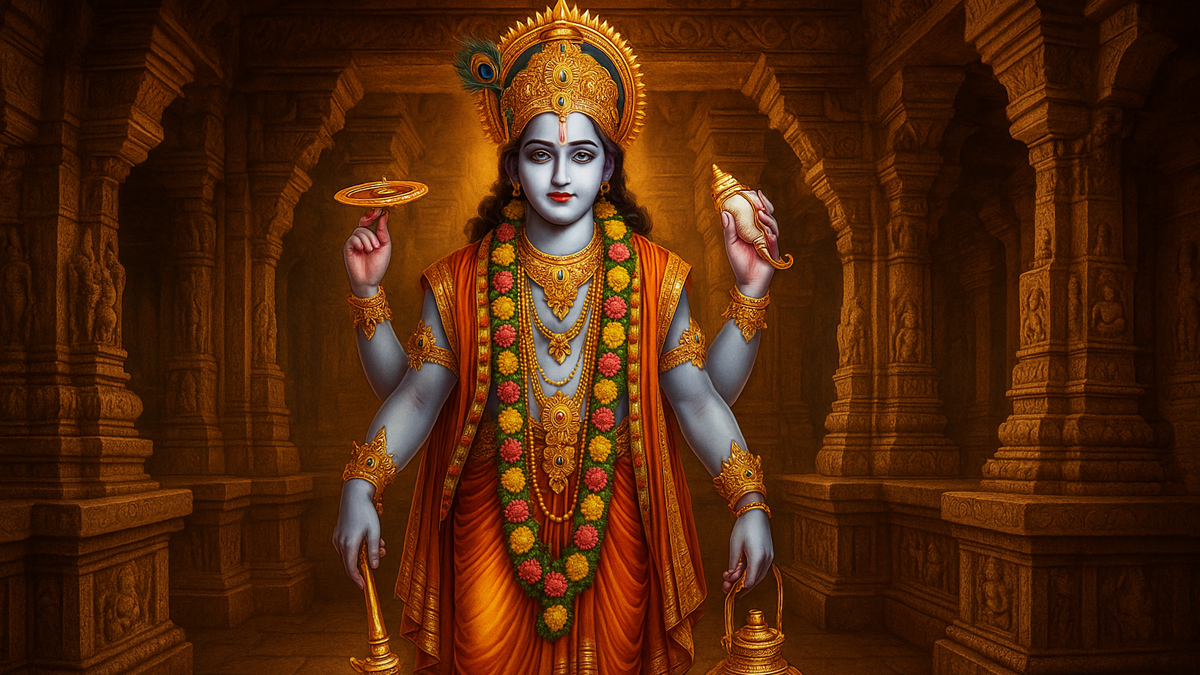
Deities and Sub DeitiesDeities and Sub-DeitiesThe main deity of the temple is Sreevallabhan, a form of Vishnu. The temple also houses other deities such as Sudarshanamoorthy, Kolapiran, ThiruVaazhmarban, Selvathirukozhunthu Nachiyar, Vaatsalya Devi, and Khandakarnan.The temple is also associated with several other deities and sub-deities. These include Thayar:Selvathirukozhunthu Nachiyar, Vaatsalya Devi, Prathyaksham:Khandakarnan, and Mangalasaashanam: Thirumangai Azhwar and NammAzhwar.
-
OfferingsOfferingsThe main four offerings are Paala Namaskaaram, Kathakali, Pantheerayiram and Kesadipaadam Garland. Paala Namaskaaram is actually a part of the third pooja around 10:45 am and is serving food with specific dishes to the deity and Brahmins in areca nut palm leaves as Sreedevi Antharjanam served the same to the Lord.Kathakali is daily played in the night as an offering and main stories played are Duryodhana Vadham, Santhana Gopalam, Kuchela Vrutham, Sreevallabha Vijayam and Thokalaasura Vadham. Santhana Gopalam is famous for getting children for those who don't have children, DuryodhanaVadham against enemies, Kuchela Vrutham to remove poverty and the two others to fulfil all wishes.Pantheerayiram is offering 12,001 bananas through a special ritual to the deity as banana was the first offering to the deity soon after installation. It is a heavily expensive one and usually done at Pantheeradi Pooja. Kesaadipaadam garland is a flower garland measuring approximately 15 feet and the deity will be adorned with it during third and fourth pooja.
-
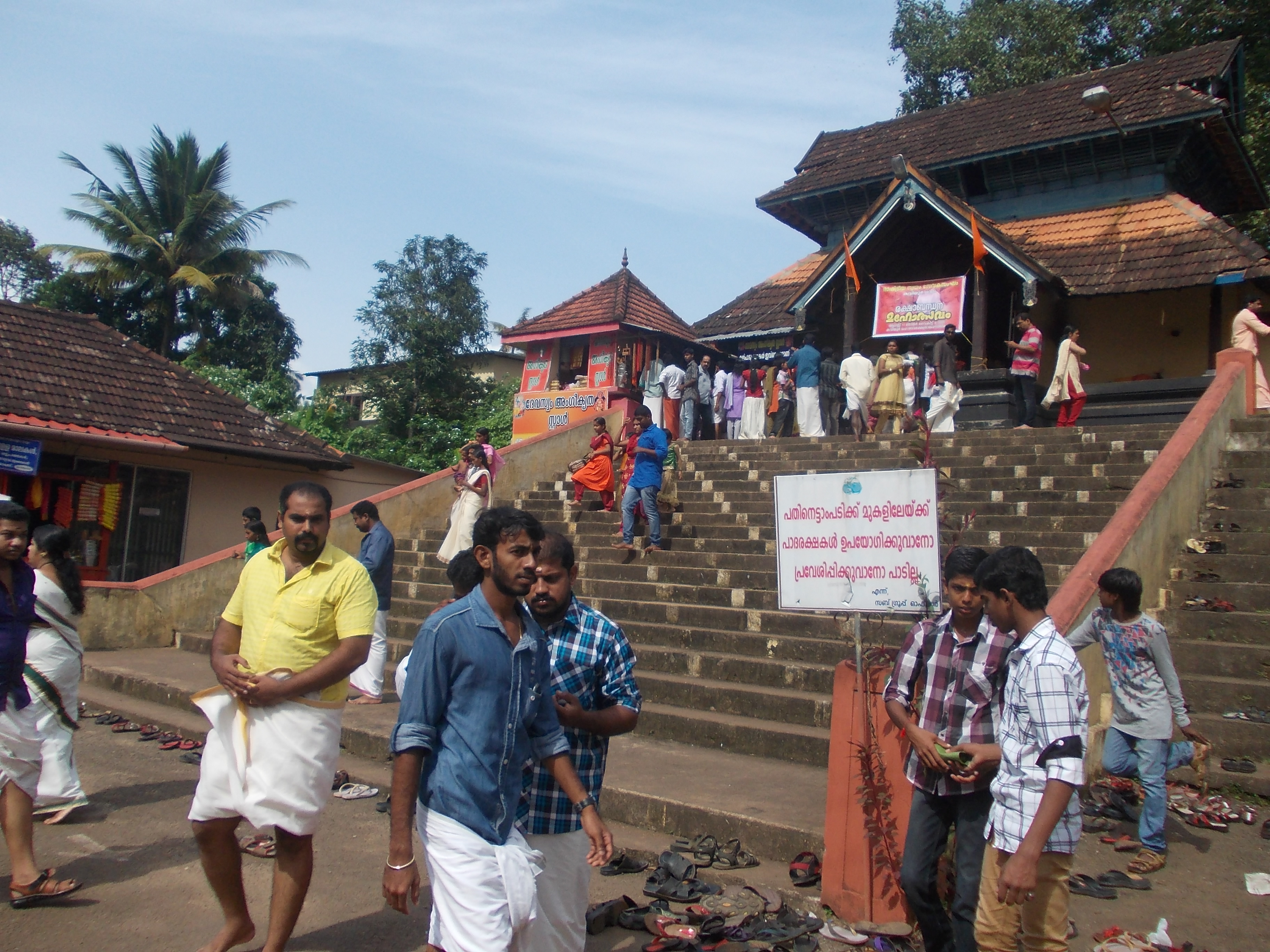
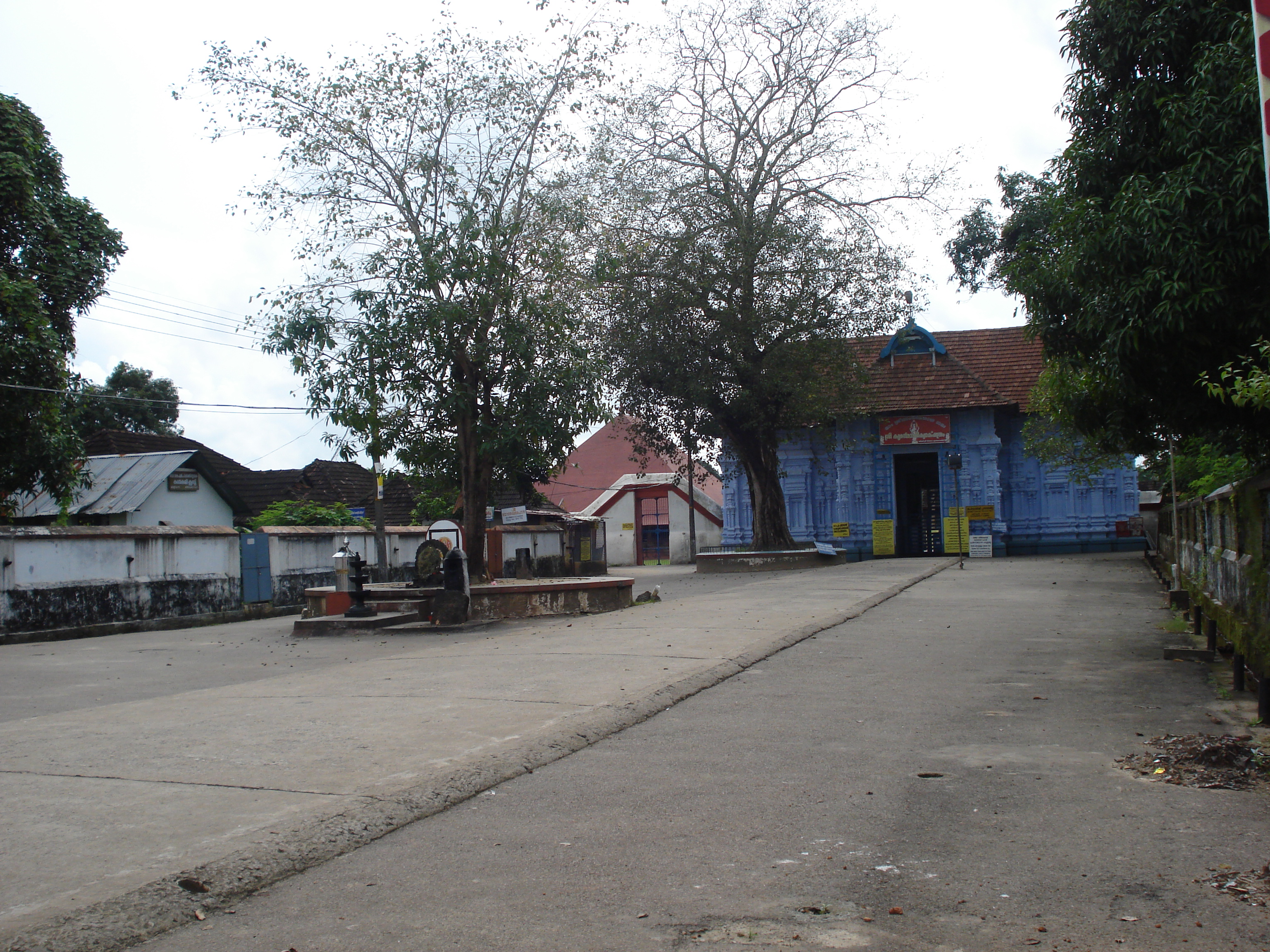
ArchitectureArchitectureBuilt in the silent and picturesque land on the banks of Manimala river, this icon of Kerala temple architecture, covers an area of 8.5 acres and ranks first among the temples of old Travancore state in terms of area inside the compound wall. The temple is surrounded on all sides by 12 feet, tall 566 feet long, 4.5 feet thick red granite compound walls with a two-storied gopuram (gate tower) on each side.This huge wall was built in 57 BC and is believed that it was completed in a single night by bhoothagana (servants) of The Lord. Outside eastern wall a big pond covering 1.5 acres is seen in north-eastern direction with a copper flagstaff on its southern bank. A platform for performing kathakali is seen just in front of the eastern entrance.Inside the wall pradakshina veethi or outer circumambulation path is seen with four small aankottils (places where the deity is taken out and kept for worship inside temple wall) and a big one on south-eastern corner. South-east to this an oottupura or dining hall is seen which is built in all other temples only on northern side and this is unique to Sreevallabha temple only.Temple auditorium and administrative offices can be seen next to this. Smaller shrines for lord Ganapathy and Ayyappan and another auditorium are seen in south-western side. The position of kshethra palan or temple guard which is strictly built in all temples on northern side is found here just in front of Ganapathy's shrine i.e. on southern side which also is another peculiarity found nowhere else.The sacred fig and mango trees beneath which sage Durvasa meditated is found near Ayyappan shrine. Just outside the western gopuram, Sankaramangalth Illam where Sreedevi Antharjanam lived is seen well preserved for the initiation of any puja in the temple. Northern gopuram is always closed and is opened only for Uthra Sreebali festival.Northeast to pradakshina veethi, a self originated pond called Jalavanthi or Khandakarna theerthem, which is believed to contain 64 hidden idols of the deity, is seen. It is for only the use of priests. Spot where sage Vedavyasa and sage Durvasa disappeared is found on its eastern bank and resting building for the priests on southern side.North to the temple a roofless shrine dedicated to kurayappa swamy is seen. There is no pooja here, but only banana as naivedyam. The bahir bali vrutham or outer circle of sacrificial stones is built inner to bahir pradakshina veethi. The temple koothambalam (stage) was destroyed by fire in 1915.The most highlighted construction of the temple is the Garuda dhvaja sthambam or flagstaff of Garuda, the majestic eagle mount of lord Vishnu. This monolithic structure is completely built from black granite and elevated 53.5 feet above the ground with its lower end touching water table.Constructed in 57 BC, this structure was also built in a single night along with the outer wall. And an amazing fact is that no black granites can be found in an area ten miles around the temple. A 3 feet massive idol of Garuda is placed on top of it, facing the main sanctum. Since this flagstaff started slanting and reached its current position, a three tiered copper roofed construction has been made all around it to prevent further slanting. West to this, the currently used golden flagstaff can be seen.West to the third flagstaff, balikkalpura (room of the major sacrificial stone) is built around a ten feet tall bali pitha (main sacrificial stone). Vallyambalam (building attached to naalambalam at its main entrance and between naalambalam and balikkalpura) is a double storied copper sheet roofed building standing on 16 stone pillars. These pillars and the roof are noted for their exquisite and minute carvings demonstrating the excellence of those who built it.The central corridor of vallyambalam leads to naalambalam (double walled building constructed around sanctum-sanctorum at a distance) with thidappalli or holy kitchen, navakappura or room for navaka pooja etc. The 150 feet long, 11 feet Broad square naalambalam is completely made out of black stones and supported by 54 stone pillars beautifully carved with the image of a Salabhanjika on each.Outside naalambalam, a deepasala (galaxy of bronze lamps) is built on teak wood. The western part of naalambalam is adorned with some murals and a small shrine for vadakkum thevar i.e., the idols of Vishnu, Shiva, Parvati, Murugan and Nritha ganapathy worshipped by Sreedevi Antherjanam. Two namaskara mandapam (prostration building) are built against both doors of Sreekovil (sanctum-sanctorum) and only Brahmins are allowed there.The eastern mandapam is 24 feet long square building with copper sheeted roof and stand on 12 wooden and 4 stone pillars. All these are well known for their fine carvings. The western mandapam is small and also square shaped. The circular, copper roofed, golden domed sreekovil is adorned with finely etched murals of Matsya, kaaliyamardana, Kurma, Dakshinamurthy, Varaha, venu gopala, maha ganapathy, Narasimha, Vamana, sudarshana, Parashurama, sree Rama, Purusha sukta, Balarama, sree Krishna, Lakshmi, Kalki and Garuda in clockwise manner.Sreekovil has an outer perimeter of 160 feet and has three concentric walls. It enshrines Sreevallabha facing east and Sudarshana chakra(sathrusamhaaramoorthy) facing west under the same roof. Sreevallabha is portrayed as bearing a lotus in right hand, chakra in right upper hand, sankha in left upper hand and his left hand kept on his waist (kati hastham).This 7 feet tall massive idol is situated at a height of 10 feet so that one has to bend his body to see it and its top and bottom cannot be seen. Along with this idol other idols of Vishnu, Lakshmi, Dakshinamurthy, Varaha and Sreebali bimbam or procession idol of Sreevallabha are also there. Unlike usual yantra form, here Sudarsana is installed in eight handed human form bearing sankha (conch), chakra(disc), gada, padma(lotus), pasha(rope), ankusa (hook), musala(pole), and dhanu(bow). No other temples are known to enshrine lord Vishnu and lord Sudarsana under same roof.
-
FestivalsFestivalsThere are two main festivals – thiru uthsavam and Uthra Sreebali. In Sreevallabha Temple Uthsavam is conducted giving importance to aaraattu(holy bath)and is for ten days ending with Pushya nakshatra of kumbham (February-march) of Malayalam calendar. Its customs and procedures are much complicated and start with kodiyett or raising the festival flag on the flagstaff.Two days before kodiyett, temple sanctifying procedures are performed. Then on the kodiyettu day, the holy flag is raised. Special poojas are done every day along with sreebhoothabali (sacrificing food to all crew of the deity) in the noon. On the seventh day night, pallivetta(custom done on the belief that the deity hunts away all evil spirits) and tenth day the holy bath or aarattu.It is done at the river near Thukalassery and the deities of Sreevallabha and Sudarshana moorthy are taken back to the temple after deepa aaradhana at Thukalassery Mahadeva Temple, accompanied by large and colourful procession and the temple is closed. Uthra Sreebali, the biggest festival of the temple, is conducted in the Malayalam month of Meenam(March–April).This is the festival of three Goddesses who had been asked by Sreevallabha to protect Thiruvalla and it is conducted when they come to the Sreevallabha Temple to meet both the Lords. These goddesses are from the temples Aalumthuruthy, Padappattu and Karunaattu kaavu where temple festival starts on the same day in the month of Meenam.Before their holy bath on the eighth day the three goddesses proceed to Sreevallabha Temple where its northern gate is opened only at that time for them. The goddesses enter the temple through the northern gate and are welcomed by playing 18 groups of instruments and are directed towards the balikkalpura where the two Lords will be waiting to receive them.Then Ashtapadi is played and sreebali is done. This is followed by jeevatha dancing of the Goddesses in the middle of many lamps. Then the Goddesses proceed for their holy bath and the Goddess of Aalumthuruthy temple returns Sreevallabha Temple by next day noon Sreebali when Vishnu gives her vishu kaineettam.As the sreebali ends, the programme gets over and the deities are taken back to respective temples. Taking part in the whole Uthra Sreebali is said to wash away sins of all births as all vedic and puranic deities are taking part in it. Other major fastivals as per Malayalam Calendar are on Thiruvonam of Chingam month, Thirunaal (chitra nakshatra) in Thulam month, Thirunaal chirappu (chitra nakshatra) in Vrischika month, Ardra of
FAQ's
Where is the Sreevallabha Temple located?
Which God is Sreevallabhan?
What is the best time to visit Sreevallabha Temple?
How to reach Sreevallabha Temple from near City or Town?
In Kerala

Near By Temples
-
 Sign in with Google
-
Block for 8 hours
-
Block for 12 hours
-
Block for 24 hours
-
Don't block


 Click it and Unblock the Notifications
Informed.
- Male
- Female
- Others
- Under 18
- 18 to 25
- 26 to 35
- 36 to 45
- 45 to 55
- 55+