Iruttu Mandapam (Pitchatanar):
Entering
through the Chitra Gopuram is the Dark Hall. It was built in AD
1613 by the kadanthai Mudaliyar. Hence it is also called
Mudalipillai Mandapam after him. During the restoration work in AD
1960-63, its northern wall was demolished and windows were
constructed. Till then this mandapam was dark so it was known as
dark hall. Sculptures depicting the story of Pitchadan are housed
here. Also four yalis and two rishis are placed on one pillar with
a spoon of Rishipathini begging Lord Shiva and on the opposite
pillar the sculpture of Mohini and next to it the image of
Pitchadanar. The rishis are shown nearby mesmerized by Mohinis
beauty. Apart from these, Nardhana Ganapati, Subramanyar sculptures
and the sculpture of kadanthai Mudaliar who built the mandapam are
placed in this mandapam.
PUDHUMANDAPAM (THADATHAGAI
PRATIYAR):
One of the
most publicized edifices in the Madurai. Temple is the pudu mandapm
built by Thirumalai Nayakar between 1626 and 1633 AD. This is a
large corridor measuring 34,650 square feet and is axially in front
of the cost gopuram. Along length of it is a central nave with an
aisle on either side of it provided by four rows of pillars. The
Mandapam belongs to the Madurai period of architecture and has all
the four styles of pillars, the decorative compound type, the yali
type, the iconographic type and the portrait type pillars. The
whole mandapam is the high watermark of medieval building craft. At
the western end, that is at the end next to the east gopuram there
is a platform with a canopy supported by a number of polished black
stone pillars. This canopied mandapam is known as the Vasantha
Mandapam to which the images of meenakshi and Sundareswarar are
brought on certain festival occasions. Ten statues of nayaka rulers
of Madurai from Viswanathar to Thirumalai Nayakar are on five
pillars on either side in the centre of the nave. Equestrian and
yali pillars are on the outer pillars at the entrance on the east
and west side. These areas also have many pillars with iconographic
figures. The whole corridor is an imposing structure revealing very
good planning and excellent execution.
Kambathadi Mandabam sculpture-
Jalandhara Vadha Murthi:
Kambathadi
Mandabam sculpture Indra, the king of Devas, also known as
Devendra, once went to Mount Kailash to worship Shiva. But Shiva
stood in a different form. Devendra asked him who he was, but there
was no reply. Devendra angrily threw his vajraayutha on Him, but it
was broken to pieces. Shiva became a Rudra and from his sweat came
out a child.
KILIKOONDU MANDAPAM:
Adjoining
the Unjal Mandapam is the largest Kilikootu Mandapam which derives
its name from the fact that Parrots are reared here in a cage. The
shriners of Siddhi Vinayagar (Sthala Vinayagar) and Kumarar are to
be found in this Mandapam. On the 28 pillars of this Hall are to be
seen carved figures including those of the Pandavas their wife
Draupadi, Vali and Sugrivan. Above the pillars on the walls are
carvings depicting the 64 Thiruvilayadals. Though these carvings
are small they have been delicatedly and exquisitely finished. On
the ceiling are paintings of various deities. Facing the Amman
Sannidhi is the beautiful painted scene of Meenakshirsquos Wedding.
During (1960 ndash 63) renovation all these Paintings have been
redone in oil colours. This Mandapam was built by Abishekha
Pandaram in 1623. Some of the pillars are said to have been brought
from the Kariamanikka Perumal Temple when the latter was
destroyed.
Kambathadi Mandabam sculpture -
Kaalasamhaara Murthi:
Kambathadi
Mandabam sculpture Kaalari is the vanquisher of Death - Kaala
samhaaramurthi. The defeat of Death by Lord Shiva is celebrated in
a touching legend and given powerful form in this aspect of Shiva.
The legend tells us about a sonless sage Mrikandu, to whom Shiva in
answer to his prayer. offered the choice of a large number of
useless sons or only one son, a singularly gifted child, who would
be doomed to die at the age of sixteen. The sage asked for one
remarkable son and Maarkandeya was born and fulfilled every
expectation. When the boy learnt of his fate, he went on a
pilgrimage as he worshipped the Linga at Thirukkadayur temple
Kaala-Yama (God of Death) appeared and was about to bind him with
his noose when shiva in anger, burst out of the Linga and punished
Yama almost destroying him. Yama was chastened and hence went away
leaving Maarkandaya without taking his life. Shiva blessed
Maarkandaya to remain forever a youth of sixteen years. In this
pillar Shiva in his back right hand holds the axe. Right leg of
Shiva is placed on the neck of Yama. Maarkandaya clinging to the
Lingam is sculptured on the adjoining face.
Kambathadi Mandapam:
The
Kambatthadi mandapam is famous for depicting all the 25 forms of
lord shiva. Being situated just in front of the main sanctum and
containing as it does the Nandhi mandapam and the dwajasthambams,
it has all its sculptures relating only to shiva forms. Going round
the pillars one can notice the pillar on the left, the well known
Meenakshi Sundareswarar marriage group. The sculpturing, though
done as late as 1870, is a magnificent piece of hindu craftsmanship
and is in some ways better than a similar sculpture in the pudhu
mandapam which of course, must have been dong during Thirumalai
Nayakar days. This scene shows Shive standing on the right with His
right hand just holding Meenakshi right hand while Vishnu giving
away His sister, ceremoniously shown by the way of pouring water as
part of the Kanniga dhanam, out of a pot Behind the wedding group
is sculptured a beautiful decorative tree. This is perhaps the
karpaga Vriksham presented to Meenakshi by Indra during Her
digvijayam. The expression on the three principal deities to the
happy is most beautifully rendered and one must note especially the
shy face of Meenakshi which has yet an expressive smile. This
picture of the celestial wedding finds its place in almost all the
wedding functions of Tamil Nadu Hindu family marriages through
invitations,marriage hall decoration and etc
Kambathadi Mandabam sculpture -
Kalyana sundareswarar:
Kambathadi
Mandabam sculpture This is probably the most extravagant sculpture
of its kind that depicts the Hindu wedding ritual in a very
descriptive manner. Nowhere can such a sculpture be found that
involves the celestial ritual. Shiva is an eternal Bridegroom and
Sakthi is the eternal Bride. In every Shiva temple Shivas wedding
is celebrated annually to show that Shiva weds Uma to bless the
universe. The wedding of Shiva and uma was needed for the birth of
Kumara to destroy the demons. Shiva and Sakthi are depicted as
immortal lovers. Their wedding is the of truth (Shiva) and wisdom
(Sakthi) as a result of which Ananda (Skanda) is born. Lord Shiva
is known as Kalyana Sundara Moorthy with the wedding of Uma. This
form is the model for the human race to follow and to lead a life
of piety and bliss.
Meenakshi Nayakar Mandapam:
After the
Ashta Sakthi Mandapam comes a huge Hall 160*110 feet. There are 110
stone pillars in the Hall, each 22 feet in height, with the figure
of the yail on the capital and delicate carving below. The large
statues, including that of the builder, commonly found in the
building of the Nayakkar is absent in this Hall, known as the
Meenakshi Nayakkar Mandapam. some of the carved are unfinished.
Connecting the Ashta Sakthi Mandapam and the Meenakshi Nayakkar
Mandapam is a smaller Mandapam. On the southern side of this Hall
is the figure of Parvathi with a trident and a five headed serpant
above. Some people say that depicts a huntress. This is likely as
also a story in the Thiruvilayadal Puranam according to which Siva
and Parvathi in the guise of a hunter and huntree stationed
themselves at the entrance to the temple to give salvation to a
person who had committed many grave sins. These figured signify
that their is always salvation for those who repent for their sins
and enter the temple to worship the Lord. Formerly on either side
of the 20 feet passage, the temple elephants, camels and bulls were
tied. At present there are shops selling flowers, toys, bangles
etc., At the Western end of this 30 feet hall, is a 25 feet high
brass Thiruvatchi with 1008 lamps. The Hall was built by Sanmugam
Meenakshi Nayakkar, a minister of Vijayaranga Chokkanathar, in
1707. The brass Thiruvatchi was installed by Maruthu Pandiar, and
the lamps are maintained and lit by the Sivagangai Devasthanam.
During the (1960-63) Renovation the beauty of the Hall has been
enhanced by cleaning of the pillars and addition of kmany fine
paintings.
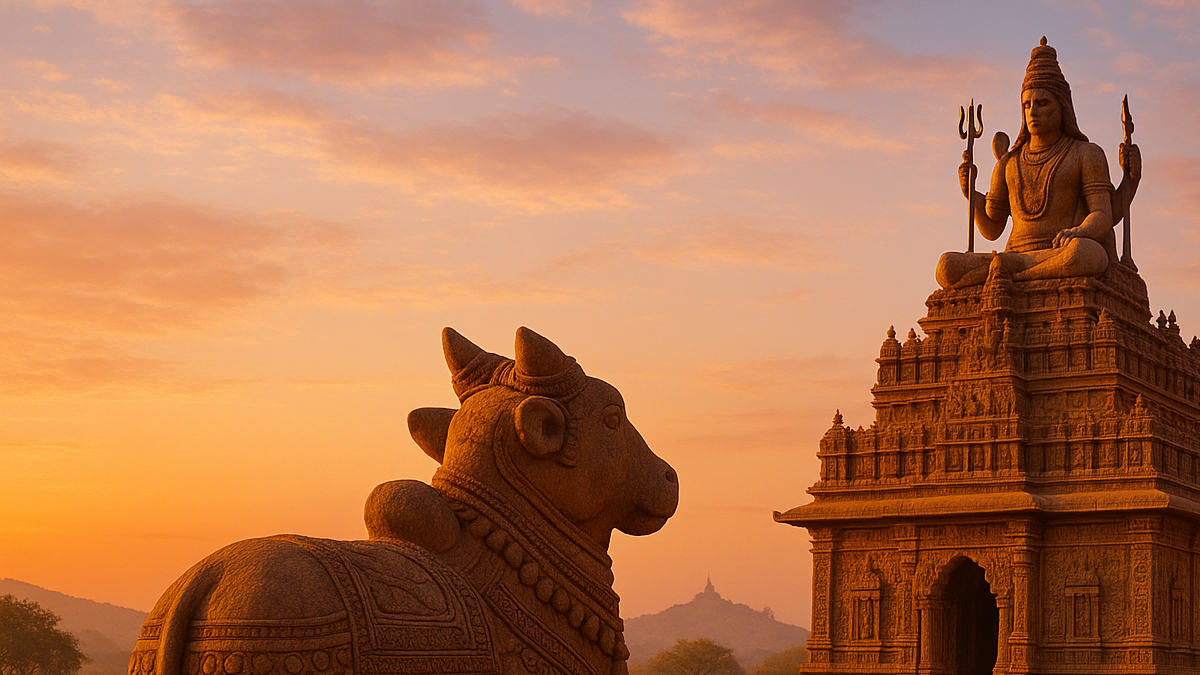
Nandhi Mandapam:
This
mandapam is located directly opposite the Swami sanctum between the
sculptures of the Mandapathoon under the pillar. This Nandi
Mandapam is carved with great artistic skill. Above its canopy
there are narrative sculptures . In AD 1564, Krishnaveerappa Nayak
built this hall. In the middle of this hall there is a flagpole and
a sacrificial pedestal. This mandapam is called the four-quarter
mandapam and Veerappa Mandapam because it was built by Krishna
Veerappa Nayak. In 1877 AD, when the class of Nagarats undertook
the temple restoration work, it is known that they renovated this
hall and erected new pillars around the Nandi hall and designed the
forms of Lord Shiva in it that attract the eye and attention. Lord
Shiva has 64 excellent forms. Among them are 25 of the best forms.
The 25 forms of Lord Shiva are explained in books like
Shivaparakramam, Shivamaagapuranam, Ilingapuranam etc.
Kambathadi Mandabam sculpture-
Kiratarjuna Paasupadamurthi:
Kambathadi
Mandabam sculpture Kiratarjunamurthi is a form of Shiva, in which
he supposed to have appeared before Arjuna, who was doing penance
to obtain a powerful weapon, pasupatastra, from Siva to destroy his
enemies, the Gowravas in the Kuruchetra War.
Kambathadi Mandabam sculpture -
Nandhi:
Kambathadi
Mandabam sculpture The splashing water poured on Nandhi by a priest
highlights the belief that it cleanses ones soul. Nandhi mandabam
surrounded by Shiva manifestations was built by Krishna Veerappa
Nayakar during 1564 A.D.
UNJAL MADAPAM:
Passing
along the eastern and southern corridors of the Potramarai Kulam,
one enters the Unjal Mandapam. On the enters western side of the
Mandapam is a platform of black Marble where gold images of
Meenakshi and Chokkanathar are placed in Unjal on Fridays. In this
hall are depicted the Six Padai Veedusrdquo of Lord Murugar. The
Paintings in this hall were completely renewed during the (1960-63)
renovation. The Eastern Portion of this Mandapam cuts across the
western corridor and projects over the steps to the Potramarai
Kulam. In this portion are to be seen paintings dating back to the
days of Queen Mangammal and also figures of the Queen, her minister
Ramappayyan and her grand-son Vijayaranga Chokkanathar. This
Mandapam was built in 1563 by Chettiappa Nayakkar.
Thousand Pillar Hall Sculpture -
Dhakshan:
Thousand
Pillar Hall Sculpture Dhakshan is holding his sword in his right
hand and the depiction shown here is the one where he is
confronting Veerabhadrar. His face is a picture of pitched anger.
His left hand has been damaged and perhaps, it had carried the
shield.
Kambathadi Mandabam sculpture -
Natarajar:
Kambathadi
Mandabam sculpture Shiva in the form of Nataraja is the Lord of
Dancers. Shivas Cosmic Dance incorporating the rhythm of the
movement of the Sun and the Moon, of the earth and the wind pulsate
in His body. Man the microcosm who shares in and is conscious of
them is also a part of Shivas body, the total creation.
Thousand Pillar Hall Sculpture-
Hunter:
Thousand
Pillar Hall Sculpture The hunter is seen here with the bow on his
shoulders
Thousand Pillar Hall Sculptures-
Bhikshaatanaar:
Thousand
Pillar Hall Sculpture In this form of Bhikshaatanaar, the hands
towards the back are sculpted to hold the cylindrical drum and the
snake together with the trident. The wives of the troubled sages
are shown nearby. On the left side, a Bhoothagana is holding the
huge metal vessel (gangaalam) on its head.
Kambathadi Mandabam sculptures -
Dakshina Murthy:
Kambathadi
Mandabam sculptures On the pillar in the north side, on the side
facing south, an important manifestation of Lord Shiva shows Him
seated under a banyan tree on the Mount Kailash engaged in yoga.
This form is known as Dakshina Murthy, the Supreme Guru, who seated
under a banyan tree at its root, teaches in silence, the oneness of
one (innermost self) with Brahman (the ultimate reality). This
knowledge is the very essence of Shiva.
Kambathadi Mandabam sculpture -
Thripurantaka Murthi:
Kambathadi
Mandabam sculpture One of the main valorous acts of Shiva is the
destruction of the three cities by burning them referred to as
Thirupura Dahanam. There are a number of sculptures relating to
Tripurantakamurthi in the temple. An identical sculpture like the
one in the Kambatthadi Mandabam just referred to is in the Pudhu
Mandabam.
Veda Mandapam (Veduvachi and
Veduvar):
Veda
Mandapam is located next to Ashtashakti Mandapam. On both sides of
this hall there are 6 feet high idols of Veduvachi and Veduvar.
Both of these are signs that Mahabhatakam has been resolved for an
Anthanan.
Kambathadi Mandabam sculpture-
Veerabadhrar Bhikshaatana:
Kambathadi
Mandabam sculpture-Pitchandavar Veerabadhrars third eye manifested
a Ugra form of Veerabhadra, who destroyed the sacrifice, punished
the gods present and also killed Daksha. Veerabadhrars third eye
manifested a Ugra form of Veerabhadra, who destroyed the sacrifice,
punished the gods present and also killed Daksha. Veerabhadras
anger caused Agni to lose hand, Indras shoulder was injured, Brahma
lost his head, Sun loas hiseye and teeth, Vishnu lost his head and
yama lost his head and so on. Here in this form the following
battle symbols are manifested in the right hands, the trident, the
axe, and an arrow on the head of Dhksha and a sword. The left hands
hold the skull, the deer, the bell and the shield. Veerabhadra
stands on a prostrate Daksha with his trident piercing Dakshas
neck. In this Bhikshaatana form, out of the four arms, the back
right arms holds the celestial drum and front right hand rests on
the antelop. The back left hand has the Kapaalam Bhikshaatana is
dressed with only a snake with only a snake coiled round him. He
has bells on his leg and stands wearing sandals.
Kambathadi Mandabam sculpture -
Kaamadahana Murthi:
Kambathadi
Mandabam sculpture Kaamaani or Kaama Dahana Murthy the aspect of
which Shiva is symbolises the victory of lust by the supreme bliss.
Shiva destroyed Cupid (Manmatha) with his third eye. According to
mythology, the gods prayed Shiva to bless them with a child
(Kumara) to destroy the troublesome demon &ldquoSura
Padma” but Shiva was sitting in yogic contemplation,
which meant he wouldn’t marry in that condition. Yet the
gods wanted Shiva to marry Uma to have a son. So they thought of a
plan and send Manmatha (God of Love) to shower his flowery arrows
on Shiva and cause Him to love Uma. When the flowery arrows of
Manmatha fell on Shiva, he opened third eye (Agni-fire) and
Manmatha was burnt to ashes. The Kaamaari Murthi resembles
Dakshinaamurthi with His third eye kept open.
Kambathadi Mandabam
sculpture-Ardhanaari:
In this
manifestation as Ardhanaarishwara, the Lord whose left half is
women, reveals Himself through the symbol of sexual unity as beyond
the duality of Shiva and Sakthi for both are within Him. The great
God Shiva is beyond even the totality of His male-female unity. The
unity of Ardhanaarishwarw in the sculpture is shown not as a form
but as a symbol of Shiva, the ultimate reality beyond the
androgynous shape of the image. It is a symbol of a higher Plane
than of Uma Maheswara.
Kambathadi Mandabam sculpture-Sri
Rishaba Hatikar:
Kambathadi
Mandabam sculpture-Sri Rishaba Hatikar Vishabha or Rishaba, the
bull is the vehicle of Shiva symbolizing the procreative power.
Three sculpture form of Shiva are associated with his vehicle bull.
When Shiva is seated, along with his consort, on the bull or
Nanthi, He is usually called Rishabaruda. If he stands in front of
the bull he is called Rishabavaahana and if he is shown as learning
on the bull he is called rishabaantika. There is a sculptured
representation of this form in the Kambatthadi Mandapa in which
both Shiva and Parvathi are seated on the bull as Rishbhaaruda.
Shiva is seated in suhaasana and holds an axe and deer in his upper
hands. His lower right hand shows abbaya hasta. Uma (Parvathi) is
seated in suhaasana to the right of Shiva. She holds a flower in
her right hand. The bull is depicted as if about to move and he
looks at the face of the lord with pleasing mood touching Shivas
right arm with his tongue. A beautifully decorated cloth is spread
over the body of the bull.
Thousand Pillar Hall
Sculpture-Arjunan:
Thousand
Pillar Hall Sculpture Arjunan is raring to go and is holding the
sword in his right hand. Regrettably, the left hand is broken and
one is not in a position to say what weapon was held by this
hand.
Thousand Pillar Hall Sculpture-
Baanan:
Thousand
Pillar Hall Sculpture A five-headed serpent assumes the position of
a unique umbrella over the head of this statue. One cannot so
easily determine whether this is the form of Baanan or someone
else. A parrot is perched on his left shoulder. Judging from the
next statue that represents Viraali, this may represent Baanan the
palace singer.
Thousand Pillar Hall Sculpture -
Bhikshaatanaar:
Thousand
Pillar Hall Sculpture Shiva takes his form to rid the sages of
Dhaaruka forest, of their pride. One can see how he is feeding
grass to a small deer, a young one, using His right hand. The left
hand holds a skull and His hands at a back are sculpted to hold the
cylindrical drum and the snake together with the trident (The
figure opposite this is that of Mohini, the seductress)
Kambathadi Mandabam
sculpture-Nandhi Mandabam:
Kambathadi
Mandabam sculpture-Nandhi Mandabam The splashing water poured on
Nandhi by a priest highlights the belief that it cleanses ones
soul. Nandhi mandabam surrounded by Shiva manifestations was built
by Krishna Veerappa Nayakar during 1564 A.D.
Thousand Pillar Hall Sculpture -
Dancing Ganapathy:
Thousand
Pillar Hall Sculpture The elephant god ganapathy, is seen sporting
a dancing pose and is presented with His 10 hands, a wonderful
sight. His right leg is firmly planted on the ground and his left
is bend in such a manner as to seat his powerful lady-love,
Vallabhai - a sight which is a feast to the eyes. The Amirtha
Kalasam is placed on Ganapathys trunk.
Kambathadi Mandabam sculpture-
Ravana Anugrahamurthi:
Kambathadi
Mandabam sculpture Two sculptures of the episode of Raavanan under
Kailaasam are in the Madurai temple. One is in the Pudhumandabam
and the other, almost a copy of it, is in the Kambatthadi Mandabam.
Of the two the Pudhu Mandabam is more finely d and is the better
known work. The legend is how the vain Raavana is humbled by Shiva,
when he tried to uproot the abode of Shiva. Shiva presses the
mountain with his toe and Raavana is crushed by the Mountain and is
trapped in that position. He fashions a musical instrument out of
one of the heads and hands and using his own veins and nerves
pleased Shiva with his music. Here, Siva is seated in suhasana
along with Parvati and garlanding his staunch devotee Visarasarmar
( Chandesa). Visarasarmar is seated under the foot of the lord and
touching his right foot with devotion.
Kambathadi Mandabam sculpture -
Somaskandar:
Kambathadi
Mandabam sculpture This important sculpture is also one of the best
in the Kambatthadi Mandabam. Shiva and Parvathi are seated in the
sukhasana pose with a dancing figure of Skandar standing between
them. Shiva holds the axe and the deer. The front rigt hand is in
the abhaya pose. The front left hand is in the simhakarna pose.
Parvathi holds a flower in her right hand and her left hand rests
on the pedestal. Skandar holds a flower in each hand. The child
wears a karandamakutam. A fine old bronze of Somaskanda could be
seen at the Thiruvaappudaiyar temple on the northern bank of the
Vaigai. The work follows classic lines and the craftsmanship shows
remarkable restraint and economy. The front left hand of Shiva is
in the same simhakarna pose as the statue in the Kambatthadi
Mandapam.
Thousand Pillar Hall Sculpture -
Gypsy Man:
Thousand
Pillar Hall Sculpture The Gypsy (man) is depicted sculpturally
here. He holds a leash in his right hand that has a monkey tied at
the other end. As he draws the monkey along, one can sense how the
monkey is holding its young one in a tight embrace. The left hand
has a spear. The rib-bones are prominently seen. He wears many
strings of pearls around his neck and his male-hair-do enthrals the
viewer.
Kambathadi Mandabam sculpture -
Sukhaasanar:
Kambathadi
Mandabam sculpture The next pillar in the Kambatthadi Mandapam has
Sukhaasanar, Maarkandeya and Kaalasamharamurthi images. The image
which is labelled Sukhaasanar shows Shiva with the Devi on his
left. His front hands are in the abhaya and varada pose, His back
right hand holds what appears to be an Aksharamaala while his left
back hand holds a Trident Sulam. Shivas right leg hangs in front of
the seat. Devi has two hands. In the right hand she holds a flower,
the left hand is placed on her thigh. Devis left leg is hanging
over the seat. Also Shivas left leg is resting on the right leg of
the Devi. Perhaps this image is a form of Uma maheswara
Murthi.
Thousand Pillar Hall
Sculpture-Gypsy Women:
Thousand
Pillar Hall Sculpture The gypsy featured in this sculpture has
three children. She is holding the head of one child as she stands.
On her shoulders is another that is consuming the food kept in the
basket. The last, the youngest, frail and delicate, and tenderest
of all, appears to be enjoying its stay in a swing formed out of a
cloth that is tied to be gypsys breast. Its feeding on the milk
from its mothers breasts. The basket in her hand has been woven
exquisitely and has been well represented in stone.
Kambathadi Mandabam sculpture -
Uma Maheshwar:
Kambathadi
Mandabam sculpture Uma Maheswara is a form of Shiva seated in
Suhaasana in the company of his consort Parvathi at his Himalayan
abode. There is a sculpture of this form in the Kambatthadi Mandapa
in which Shiva is seated in suhaasana folding one leg and dangling
down the other. He has four hands and jataamudi. The crescent moon
is seen on the right side of his head. His upper hands hold deer
and axe while the lower hands show abhaya and varada hastas. To the
left of Shiva is seated Parvathi in suhaasana. Her right hand holds
a lily flower while the left hand is placed on her left thigh. A
metal arch is found behind her head.
Thousand Pillar Hall Sculpture-
Musical Pillars:
Thousand
Pillar Hall Sculpture -Musical Pillar In the south eastern corner
of this Mandabam one can see the pillars endowed with musical
properties. Those musical pillars give the seven Swaras (notes)
that form the very basic of music- Sa Ri Ga Ma Pa Dha Ni. If
pillars of stone can produce such varied notes on tapping, it only
shows the mastery of the sculptor, his complete involvement and
skill in such a creative pursuit.
Kambathadi Mandabam
sculpture-Chakradhaara Murthy:
This aspect
of Shiva is also called Vishnu Anugrahamurthi. Once Vishnu offered
one thousand lotus flowers to Shiva. As one flower fell short, He
offered His own lotus eyes to Shiva. Pleased with His devotion,
Shiva blessed Him with a Chakra, and the Sundharsana Cakra. Thus
Vishnu got the Chakra, and the circumstances therefore are narrated
in the Shiva puraanam. In this form Shiva is portrayed as gifting
His Chakra to Vishnu, and Shiva seated on a peetam.
Thousand Pillar Hall Sculpture -
Pandya King:
Thousand
Pillar Hall Sculpture The sculpture is said to be that of a Pandya
King.The erect posture and the benevolence on the face shows hoe
great he was as a ruler.He probably ruled with a steady head,warm
heart and ruthless discipline as is depicted in this figure.
Thousand Pillar Hall Sculpture-
Rathi:
Thousand
Pillar Hall Sculpture The ineffably beautiful wife of Manmathan,
Rathi is gracefully seated on the swan and has a brisk appearance.
She holds a bouquet in her hand and lovely women around her fanning
her smilingly. Should one mention that the winsome sight of the
goddess of love, Radhi with her graceful demeanor along with
Manmadhan, would draw viewers and capture their attention.
Thousand Pillar Hall Sculpture -
Horse Attendant:
Thousand
Pillar Hall Sculpture This statue which found to the left as you
enter features a person deftly seated on the back of a horse. One
can see that the horse has raised its front legs and is about to
charge. It is held that this statue was built by Dalavai Ariyanadha
Mudaliyar who had also built this Mandabam. It is quite possible to
view this as Lord Shivas figure too. In Thiruvilayadal, the lord
had converted foxes into horses for the sake of Manikkavasagar and
one can well imagine that this was the statue of Lord Shiva as the
horse man. In the pillar situated on the lower side, one can
clearly see a stone carving of a fox. One can therefore conclude
that the person atop the horse is none other than the Lord Shiva
himself, the one who converted a whole set of foxes into a whole
set of horses.
Thousand Pillar Hall Sculpture -
Thripurantakar:
Thousand
Pillar Hall Sculpture Shivas right hand has an arrow with Lord
Vishnus face at its centre. It is shown as virtually carrying fire
at its edge. This statues position is not on the chariot but is
seen at the normal standing posture as it were. Just beneath the
pedestal on which Shiva stands, is the memorable sight of Brahma
drawing Shivas chariot. All this when seen and read together with
legends would substantiate that this is the sculpture of
Thripurantakar.
Kambathadi Mandabam sculpture -
Chandrasekhara Murthi:
Kambathadi
Mandabam sculpture The thin crescent of the moon on the right of
Shivas Crown contributes its meaning to the significance of this
form. The moon is the symbol of cyclical time and the vessel of
Soma, the drink of immortality and the water of life. There is an
anecdote in mythology to Chandra(Moon) on the crown of shiva.
Kambathadi Mandabam sculpture -
Rishabaarudar:
Kambathadi
Mandabam sculpture Vishabha or Rishaba, the bull is the vehicle of
Shiva symbolizing the procreative power. Three sculpture form of
Shiva are associated with his vehicle bull. When Shiva is seated,
along with his consort, on the bull or Nanthi, He is usually called
Rishabaruda.
Kambathadi Mandabam
sculptures-Chandesa Anugraha Murthi:
Kambathadi
Mandabam sculptures The figures of Chandesa Anugraha murthi depicts
the story of Shivas favorite devotee- Chandesanayanar. Vicharasarma
was an ardent devotee of Shiva. He started to take care of the
village cattle as the current herder was not treating them
properly. Under his loving care, the cattle produced lot more milk
that he was left with a surplus.
Kambathadi Mandabam sculpture-Sri
Rishaba Rutar:
Kambathadi
Mandabam sculpture-Sri Rishaba Rutar Next to the Ekapathamurthi is
seen Rishabaruda seated in Subasana along with his consort Parvathi
on the back of his vehicle bull. The bull (Nandhi) stands
majestically. Shiva folds his left leg in suhasana and the hands
right leg. The right and left upper hands hold axe and deer
respectively.
Kambathadi Mandabam sculpture-
Gaja Samhaara Murthi:
Kambathadi
Mandabam sculpture In the manifestation of Gaja Samhaara Murthi
also known as Gajaari, Shiva killed Gajaasura - the elephant demon
and wore the skin. In this form Shiva is shown with eight hands.
Two back hands hold the hide of the elephant. The other three right
hands hold the axe, the trident and the arrow. The three left hands
hold the deer, the skull and the bow.
Hundred Pillar Mandapam (Natarajar):
In the north
east corner of this prakaram, at a higher level than the prakaram
itself, is a Huindered Pillared Hall with exquisite sculptures,
known as the Mandapa Nayagam. This Hall contains a fine status of
Natarajar. The Mandapam was built in 1526 by Chinnappa
Nayakkar.


 Sign in with Google


 Click it and Unblock the Notifications